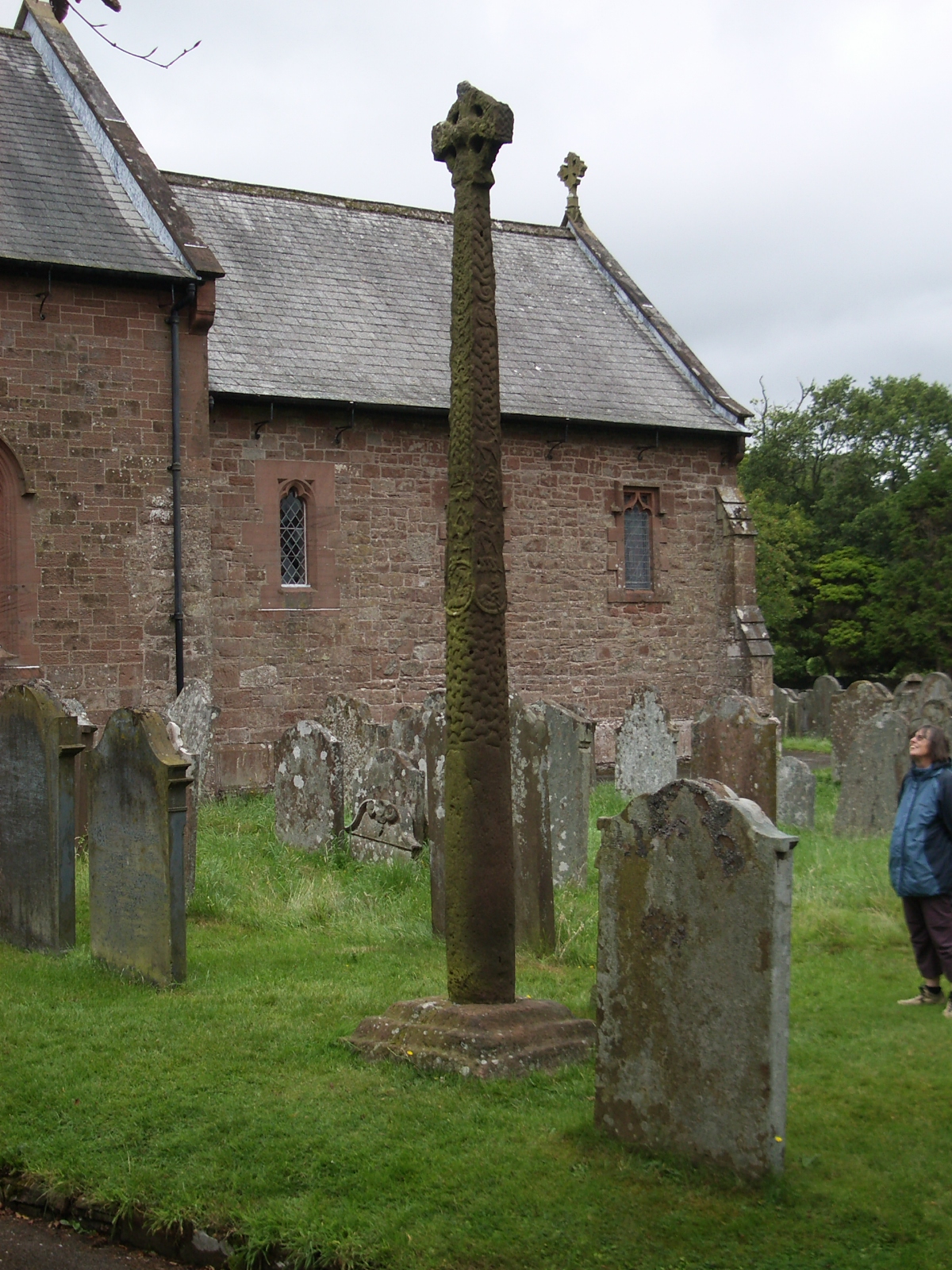
Photo: English Lakes at English Wikipedia · Public domain · Wikimedia Commons
Gosforth Cross is a cross in Gosforth, Cumbria, England, UK. Tallest Viking-age cross in England, around four and a half metres. The free Lokali audio guide runs 7 minutes.
✓ Published October 2026 · how we write these guides
Visitor facts
| Lokali audio guide | 7 min · free |
|---|---|
| Type | Monument |
| Location | Gosforth, United Kingdom |
| Coordinates | 54.4193, -3.4316 |
| Languages | 50+, in the Lokali app |
The story
Run your eyes up the shaft, slowly. The stone is a soft reddish sandstone, worn smooth in places, still sharp in others. Grass grows around its base. Rooks call from the trees around the churchyard. Rain, wind and more than a thousand winters have touched this surface. Yet the carvings are still there, coiling upward toward a small ring-headed cross at the top. You are standing in front of the tallest Viking-age cross in England.
The Gosforth Cross stands in the churchyard of Saint Mary's Church, in a quiet village on the western edge of the Lake District. It rises roughly four and a half metres from the ground. Scholars generally date it to the first half of the tenth century. That was a time when settlers of Scandinavian descent were making homes along this stretch of the Cumbrian coast. Many of them seem to have come not straight from Scandinavia, but by way of Ireland and the Isle of Man.
Look first at the shape of the shaft. The lower part is round, like a tree trunk. Higher up, it changes into a square shaft with four flat faces. This round-to-square design is found on other early crosses in northern England. Some writers link it to the image of a tree, perhaps even the great world tree of Norse belief. That is an interpretation, not a certainty. But stand close, and the column does feel almost alive.
Here is the first surprise. Most visitors expect a Christian monument to show Christian stories. This cross does — but it also shows scenes from Norse mythology. Gods, monsters and the end of the world are carved here, beside the death of Christ. The two sets of stories sit on the same stone, made by the same carvers, for the same community. It is one of the clearest pictures we have of two beliefs meeting.
On one face, near the lower part of the square shaft, look for the Crucifixion. A figure stands with arms outstretched. Below, one figure holds a spear, usually read as the Roman soldier who pierced Christ's side. Nearby is a long-haired woman, often identified as Mary Magdalene. The carving is simple. There is no gold here, no painted halo. Just a few lines of stone, telling the central story of the Christian faith.
Now look for a figure with one foot inside the open jaws of a monster. Many scholars read this as Vidar, a son of the god Odin. In Norse myth, at the end of the world, the wolf Fenrir swallows Odin. Vidar avenges his father by forcing the wolf's jaws apart. On this cross, the scene may echo the Christian idea of good defeating evil. The old story, in other words, is used to tell the new one.
Another scene is often read as Loki, the trickster god, bound as punishment. In the myth, a serpent drips venom onto his face. His wife Sigyn holds a bowl to catch the poison. When she turns to empty it, the venom falls, and Loki's struggles shake the earth. Look for a bound figure and a kneeling woman. This is the second surprise. A story many people know from modern films is carved here, by people who heard it told aloud.
Higher up, there is a figure holding a horn. He is usually identified as Heimdall, the watchman of the gods. In Norse belief, he blows his horn to warn that the final battle, called Ragnarok, has begun. Ragnarok is the end of the old world, when gods and monsters destroy each other. Around him, look for animals, serpents and tangled knotwork. The carvers filled almost every surface. Empty stone seems to have been something they avoided.
Why put these stories together? Nobody left a written explanation, so we have to be careful. One common view is that the cross helped people move from the old gods to the new faith. The end of the old world in Norse myth could be set beside the Christian promise of a new one. Another view is that both traditions simply lived side by side in the same families. Either way, the stone shows a community in conversation with itself.
Walk around the cross slowly, in a full circle. Each face is different. The light changes the carvings as you move. On a bright day, shadows make the figures jump out. On a grey day, the details flatten, and you need to come closer. Notice how the weather has worn the stone. Some faces are sharper than others, depending on how they meet the wind and rain from the coast.
If the church is open, step inside. Saint Mary's holds more stones from the same period. The most striking are two hogbacks. A hogback is a long, curved grave cover shaped like a house with a sloping roof. They are found mainly in northern England and southern Scotland, in areas of Scandinavian settlement. One of the Gosforth pair is often called the Warrior's Tomb, because of the armed figures carved on it.
Inside the church there is also a carved fragment known as the fishing stone. It is usually read as a scene of the god Thor fishing for the great serpent that lies coiled around the world. In the myth, Thor uses an ox head as bait. The stone is small, but the story is large. Together with the cross outside, it shows that these tales were well known here, in this valley, over a thousand years ago.
Before you leave, stand back from the cross for a moment. Let the whole column fill your view again — the round base, the square shaft, the small ring at the top. Behind it, the church walls. Beyond them, the fells of the Lake District rise toward the east, and the sea lies to the west. People have stood on this ground and looked at this stone for more than forty generations.
As you walk back through the churchyard, listen to the birds and the wind in the trees. Look at the newer gravestones around you, with their names and dates. They follow the same idea as the cross. People carved stone to tell others who they were and what they believed. The cross is older, and stranger. But it was made for the same reason... to be remembered.
Key facts
What to look for
Practical tips
Common questions
Is there a free audio guide to Gosforth Cross?
Yes — the Lokali app narrates Gosforth Cross free of charge in 50+ languages. The guide runs about 7 minutes, covers the history, what to look for on site and practical tips, and works offline once downloaded.
Where is Gosforth Cross?
Gosforth Cross is in Gosforth, United Kingdom, at 54.4193, -3.4316. Tap the map link on this page for directions from where you are.
What is Gosforth Cross known for?
Tallest Viking-age cross in England, around four and a half metres. Generally dated to the first half of the tenth century.
What should you look for at Gosforth Cross?
The round lower shaft turning into a square upper shaft. A figure forcing open a monster's jaws. A bound figure beside a woman holding a bowl.
What should you know before visiting Gosforth Cross?
Walk a full slow circle to see all four faces. Visit in low side-light when shadows sharpen the carvings.
On the map
Opens directions to Gosforth Cross from your location.
More to see near Gosforth Cross


Hear Gosforth Cross in your language
The full story, narrated, in 50+ languages. Download it before you go and it plays offline, at your own pace, with no ticket and no tour group.