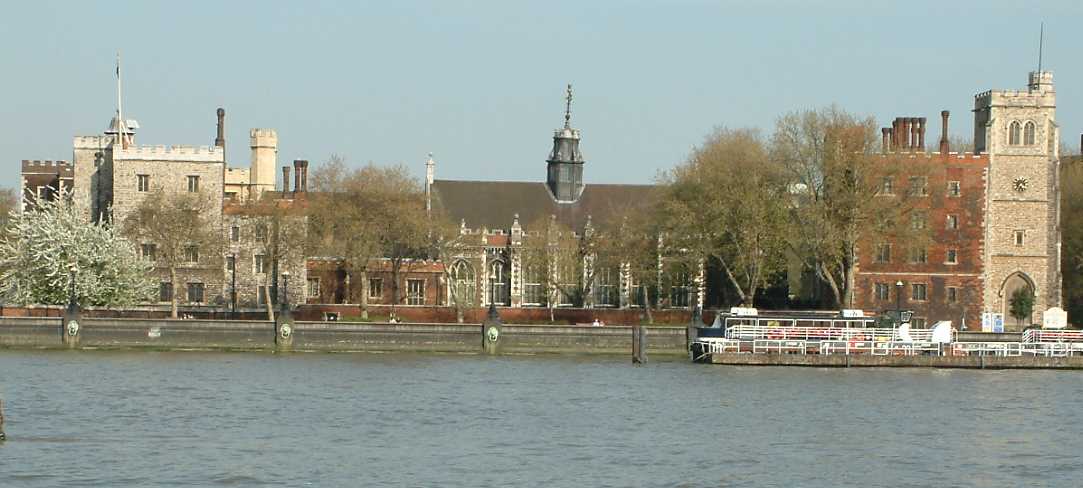
Photo: Wikimedia Commons contributor · CC BY-SA 3.0 · Wikimedia Commons
Lambeth Palace is an official London residence of the Archbishop of Canterbury. Official London home of the Archbishop of Canterbury. The free Lokali audio guide runs 7 minutes.
✓ Published October 2026 · how we write these guides
Visitor facts
| Lokali audio guide | 7 min · free |
|---|---|
| Type | Palace |
| Location | London, United Kingdom |
| Coordinates | 51.4956, -0.1197 |
| Official website | archbishopofcanterbury.org |
| Languages | 50+, in the Lokali app |
The story
Stand for a moment by the river wall and listen. The Thames slaps against the embankment below you. Buses grind across the bridge. Then your eye lands on a gatehouse of deep red brick, its two towers dark with age and city soot. It looks almost out of place beside the traffic, like a page from an older London that nobody thought to turn.
This is Lambeth Palace, the London home of the Archbishop of Canterbury, the senior bishop of the Church of England. It has served that purpose for around eight centuries. Across the water stand the Houses of Parliament and Westminster Abbey. That view matters. For most of English history, church and crown faced each other across this stretch of river, and the archbishops wanted to stay close to power.
Why London, when the archbishop's cathedral is in Canterbury, in Kent? The answer is practical. An archbishop was a political figure as much as a spiritual one. He advised kings, sat in Parliament, and crowned monarchs. Riding to Westminster from Kent took days. A house on the south bank, a short boat trip from the royal court, solved the problem. The archbishops acquired this land around the end of the twelfth century, and they never really left.
Look now at the gatehouse in front of you. It is called Morton's Tower, after Archbishop John Morton, who built it in the 1490s, in the reign of Henry the Seventh. Notice the material. This is brick, not stone. At the time, brick was a fashionable and fairly expensive choice in England. The diamond patterns you may spot in darker brick are a Tudor habit, a quiet display of skill and money.
Here is a detail most passers-by never learn. For centuries, the archbishops handed out food and money to the poor at this gate. It was a regular charity, known as the dole. Imagine the scene. Instead of tourists with phones, there were hungry Londoners waiting by these same doors. The gate was a place of welcome as well as a barrier.
The palace has not always been a peaceful place. In 1381, during the Peasants' Revolt, rebels from Kent and Essex marched on London. They broke into Lambeth Palace and burned records and goods. The archbishop of that time, Simon Sudbury, was also the king's chancellor, and the rebels blamed him for a hated tax. He was later captured at the Tower of London and killed. The palace survived, but its owner did not.
Along the river side of the palace rises another old building, the Lollards' Tower, from the fifteenth century. The Lollards were early religious reformers who followed the ideas of John Wycliffe, and the church treated them as heretics. Tradition says some were held prisoner in this tower, and the name comes from that story. Historians debate how true it is. Either way, the name carries a memory of a harsher age of religious conflict.
The sixteenth century brought new pressures. When Henry the Eighth broke with Rome, the archbishops at Lambeth found themselves at the centre of the storm. In 1534, Thomas More, the king's former chancellor, was brought here and asked to swear an oath supporting the king's new marriage and succession. He refused. That refusal led, in time, to his execution. A quiet conversation inside these walls helped to shape English history.
The next century was just as rough. During the English Civil War, Parliament's side took control of the palace. The Great Hall was badly damaged, and parts of the building became a prison. When the monarchy returned in 1660, Archbishop William Juxon rebuilt the hall. He chose an old-fashioned hammerbeam roof, a style of heavy timber beams that reach out from the walls. Even then, people saw it as a deliberate look back to the past.
Now for a surprise that book lovers enjoy. Lambeth Palace holds one of England's oldest public libraries, founded in 1610 by Archbishop Richard Bancroft. Its collections cover the history of the church, and much more besides. There are medieval manuscripts, early printed books, and papers that touch on royal history and everyday life. In recent years, the collections moved into a new purpose-built library in the palace grounds, a tall modern building in brick that echoes the old gatehouse.
Beyond the walls lies something you probably cannot see from here — a large garden, one of the oldest continuously cultivated gardens in London. On a few days each year, it opens to the public. Locals tell a pleasant story about the fig trees in the garden. They say a fig was first planted here centuries ago by an archbishop of the Tudor age. Treat that as legend, but it is a nice thought when you see green leaves above the wall.
Just beside the gatehouse stands an old church tower. This was once the parish church of Saint Mary-at-Lambeth, and today it houses the Garden Museum. In its small churchyard lie the Tradescants, a father and son who were royal gardeners and plant collectors in the seventeenth century. Captain William Bligh, of the ship Bounty, is buried there too. It is a short walk, and it adds a human layer to this corner of the river.
The palace is still a working home and office, so most of it stays closed to casual visitors. Guided tours run at certain times and need booking in advance. Even from outside, though, you can read a great deal. Follow the line of the walls. Notice where Tudor brick meets later stone and Victorian repair. Every change in colour and texture marks a different century and a different set of hands.
Before you move on, turn back toward the river. Parliament stands across the water, its golden stone catching the light. Behind you, the old red gatehouse holds its ground, as it has for more than five hundred years. Take a slow breath and listen again to the traffic and the tide. As you walk away along the embankment, glance back once more. The palace looks small against the modern city... but it has watched almost all of London's story pass by.
Key facts
What to look for
Practical tips
Common questions
Is there a free audio guide to Lambeth Palace?
Yes — the Lokali app narrates Lambeth Palace free of charge in 50+ languages. The guide runs about 7 minutes, covers the history, what to look for on site and practical tips, and works offline once downloaded.
Where is Lambeth Palace?
Lambeth Palace is in London, United Kingdom, at 51.4956, -0.1197. Tap the map link on this page for directions from where you are.
What is Lambeth Palace known for?
Official London home of the Archbishop of Canterbury. Archbishops acquired the site around the twelfth century.
What should you look for at Lambeth Palace?
Dark diamond patterns in the gatehouse brickwork. The twin towers framing the Tudor entrance arch. Lollards' Tower rising along the river side.
What should you know before visiting Lambeth Palace?
Book a guided tour in advance to see inside. Cross Lambeth Bridge for the best palace view.
On the map
Opens directions to Lambeth Palace from your location.
More to see in London


Hear Lambeth Palace in your language
The full story, narrated, in 50+ languages. Download it before you go and it plays offline, at your own pace, with no ticket and no tour group.