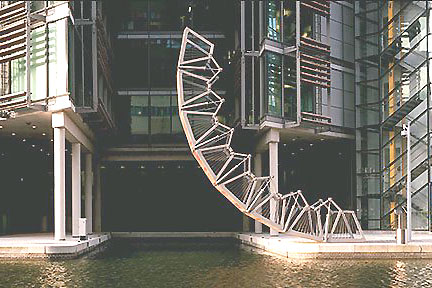
Photo: en:User:Leonard G. · CC BY-SA 3.0 · Wikimedia Commons
The Rolling Bridge is a bridge in London. Designed by Thomas Heatherwick's studio, completed in 2004. The free Lokali audio guide runs 7 minutes.
✓ Published October 2026 · how we write these guides
Visitor facts
| Lokali audio guide | 7 min · free |
|---|---|
| Type | Bridge |
| Location | London, United Kingdom |
| Coordinates | 51.5184, -0.1747 |
| Languages | 50+, in the Lokali app |
The story
Listen first. Water laps softly against stone and steel. Somewhere behind you, an office door hisses shut, and a narrowboat engine idles further along the canal. You are standing beside one of the strangest small structures in London. At first glance it looks like an ordinary footbridge, a short walkway of grey steel and timber across a narrow inlet. Nothing about it suggests movement. But this bridge does not stay still. On certain occasions, it curls up on itself.
This is the Rolling Bridge, at Paddington Basin in the City of Westminster. It was designed by Thomas Heatherwick and his studio, and it was completed in 2004. Heatherwick is a British designer known for unusual public objects and buildings. This bridge was one of the projects that made his name. It is small, only a few strides long. But people travel across the city just to watch it move.
Here is the surprise. When the bridge opens, it does not lift, swing, or slide like most moving bridges. Instead, it rolls. The walkway is made of eight triangular sections joined together. Hydraulic rams, which are pistons pushed by pressurised oil, sit inside the handrail. As they extend, the sections fold upward one by one. Slowly, the whole bridge bends into a closed shape with eight sides, an octagon, resting on one bank of the canal.
Watching it is a slightly odd experience. The motion is smooth and quiet. The bridge seems less like a machine and more like a living thing, perhaps a caterpillar or a hedgehog curling into a ball. Many visitors find themselves laughing the first time they see it. When the sequence reverses, the octagon unrolls. The sections lower back into a flat line, and the walkway reaches across the water again, as if nothing happened.
Why build a bridge like this? The inlet here gives boats access to a small mooring area. A fixed bridge would block their path. Many engineers would solve that with a simple lifting span. Heatherwick's studio wanted something different. Their idea was to make the act of opening the interesting part. Most moving bridges look their best when closed. This one is designed to look its best in the middle of its movement.
Now take a closer look at the handrail. It is not only for safety. It is the bridge's muscle. The rams that drive the folding sit inside the vertical posts of the balustrade. When the bridge is flat, they are almost invisible. You could walk across without guessing that the railing beside your hand is the engine. This is a detail most people miss, even after watching the bridge roll.
The setting around you also has a story. Paddington Basin is an old canal terminus. Around 1800, a branch of the Grand Junction Canal was cut to this spot, bringing goods into west London by boat. That waterway later became part of the Grand Union Canal. For generations, this was a working place of barges, warehouses, and freight. Coal, timber, and building materials came in here and moved out into the growing city.
In the twentieth century, canal trade declined. Railways and then roads took over the work that boats once did. The basin became quiet, and much of the area fell into disuse. Toward the end of the century, a large redevelopment began. New offices, flats, and walkways rose along the water. The Rolling Bridge was part of that effort to give people a reason to walk here, and to make the canal feel like a public space again.
Look around and you can see the contrast. Glass and steel towers stand close to the towpath. Narrowboats, long and slim, painted in deep greens, reds, and blues, still moor along the canal. Some are homes. Some are cafés or floating businesses. The old industrial waterway and the new business district sit side by side. The bridge, small as it is, connects these two worlds in a literal way.
Here is a second surprise. The Rolling Bridge is not the only moving bridge in this basin. Nearby, a few minutes' walk along the water, there is another kinetic footbridge. It opens in a completely different way, with its deck rising in separate beams like the ribs of a hand fan. If you have time, walk along the basin and look for it. Seeing the two designs close together shows how many ways engineers can solve the same simple problem.
When the Rolling Bridge is flat, it is still worth your attention. Stand at one end and look along its length. You can see the joints between the eight sections, where the deck will break and fold. The steel has a plain, industrial finish. The timber treads are worn by many footsteps. Nothing is decorated. The design depends entirely on movement and proportion, not on ornament.
A few words of practical advice. The bridge does not roll constantly. It moves only on scheduled demonstrations or special occasions, so check current information before you come if you want to see it in motion. Arrive a little early to find a good view. The banks on either side, and the walkways opposite, give you clear sightlines. Keep children close to the edge of the canal, because the water here is deep.
If you are here on a quiet day and the bridge stays flat, do not feel disappointed. Walk across it. Feel the slight spring of the deck under your feet. Run your hand along the rail, and remember that this simple railing is the mechanism that lifts the whole structure. Then step back and imagine the sections rising, folding, and locking together into that neat octagon on the bank.
Before you leave, pause for a moment at the water's edge. Notice the reflections of the towers in the canal, broken by the wake of a passing boat. Listen to the mix of footsteps, birds, and distant traffic from the city. This small bridge is a reminder that public places can still surprise us. As you walk away along the towpath, glance back once. Even standing still, it seems ready to move.
Key facts
What to look for
Practical tips
Common questions
Is there a free audio guide to The Rolling Bridge?
Yes — the Lokali app narrates The Rolling Bridge free of charge in 50+ languages. The guide runs about 7 minutes, covers the history, what to look for on site and practical tips, and works offline once downloaded.
Where is The Rolling Bridge?
The Rolling Bridge is in London, United Kingdom, at 51.5184, -0.1747. Tap the map link on this page for directions from where you are.
What is The Rolling Bridge known for?
Designed by Thomas Heatherwick's studio, completed in 2004. Made of eight triangular sections joined in a line.
What should you look for at The Rolling Bridge?
Joints in the deck where the sections fold. Vertical handrail posts that conceal the hydraulic rams. Worn timber treads across the narrow steel walkway.
What should you know before visiting The Rolling Bridge?
Check the current demonstration schedule before visiting to see it roll. Arrive early to claim a clear view from the opposite bank.
When is the best time to visit The Rolling Bridge?
Arrive early to claim a clear view from the opposite bank.
On the map
Opens directions to The Rolling Bridge from your location.
More to see in London


Hear The Rolling Bridge in your language
The full story, narrated, in 50+ languages. Download it before you go and it plays offline, at your own pace, with no ticket and no tour group.