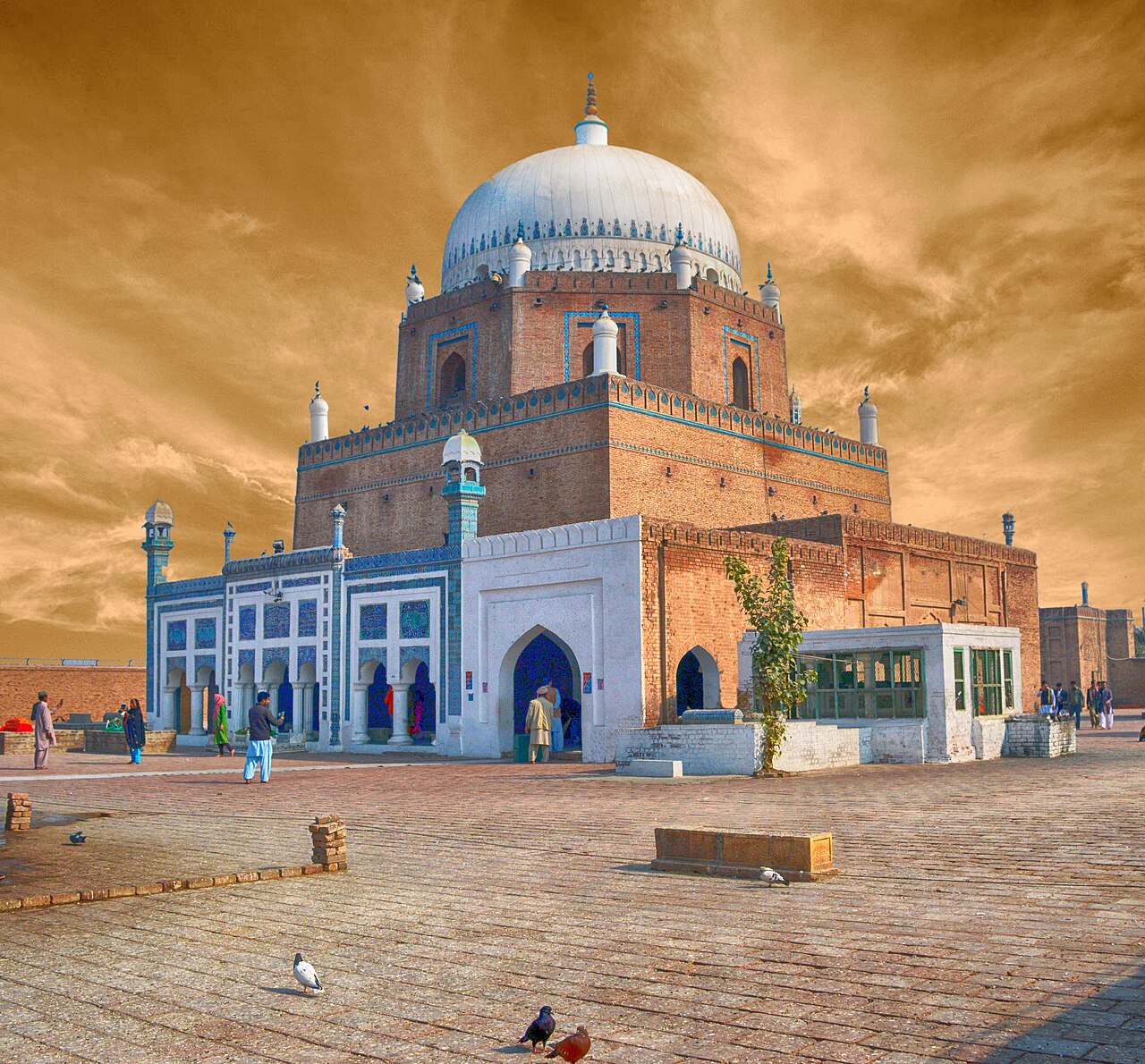
Mausoleum of Bahauddin Zakariya
30.1950° N · 71.4317° E · Mausoleum
Mausoleum of Bahauddin Zakariya is the 13th-century tomb of the revered Sufi saint Bahauddin Zakariya, featuring red brick architecture and intricate tilework. It is in Gulshan, Pakistan. Most visitors spend 40–50 min here. The free Lokali audio guide runs 5 minutes.
✓ Verified August 2026 · how we write these guides
Visitor facts
| Time needed | 40–50 min |
|---|---|
| Lokali audio guide | 5 min · free |
| Type | Mausoleum |
| Best for | History |
| Location | Gulshan, Pakistan |
| Coordinates | 30.1950, 71.4317 |
| Languages | 45, in the Lokali app |
The story
Pigeons rise from a sunlit courtyard on top of the old fort mound. Their wings flash past a white dome and walls of red brick and blue tile. Under that dome sleeps a man who died more than 750 years ago, and whom Multan has never stopped visiting. His name was Bahauddin Zakariya, and he was this city's first great teacher.
He was born around 1170 in a village near Multan. As a young man he traveled for knowledge, studying in Khorasan, Bukhara, Medina, and finally Baghdad. There he became a student of Shihab al-Din Suhrawardi, one of the great Sufi masters of the age. The teacher saw his gift quickly and sent him home to Punjab with a single task: teach.
Multan was then a frontier city, a gate between Central Asia and India. Caravans passed through with silk, horses, and dried fruit, and ideas traveled with them. A teacher in Multan could speak to Persia, Arabia, and Hindustan at once. Zakariya understood this. He chose this mound above the river, built his school, and never left.
His school was called a khanqah, and it grew into one of the most important centers of learning in South Asia. Here he founded the Suhrawardiyya order on Indian soil. Students came from distant cities. Unlike many Sufis, Zakariya did not preach poverty. He farmed, traded, and stored grain, and when famine came, his kitchen fed the hungry of the whole region.
Poets loved this place. The Persian poet Fakhruddin Iraqi arrived as a wandering dervish, fell silent before the teacher, and stayed for close to 25 years. In this compound he wrote verses of divine love that qawwali singers still perform across Pakistan and India today. Music, poetry, trade, and prayer all met in one busy courtyard, gathered around one calm teacher.
Zakariya died in 1262, and his mausoleum rose over his grave soon after. Its plan is simple and strong. A square base carries an octagonal middle level, and the octagon lifts a white hemispherical dome. Later tombs across Punjab and Sindh repeated this three-part formula for centuries. Some historians call this building the mother of Multani tomb architecture.
The walls show the crafts this city is known for. Fired red brick is trimmed with glazed tile in cobalt, turquoise, and white, laid out in geometric bands and panels of flowers. The tilework is not only decoration. The glazed surface throws back the fierce summer sun and shields the brick beneath. Beauty and engineering share the same skin.
The tomb you see is partly a survivor and partly a faithful reconstruction. In 1848, during the British siege of Multan, shellfire struck the mound and badly damaged the mausoleum. When the fighting ended, devotees rebuilt it with their own money, following the old design closely. Much of the dome and tilework dates from that repair.
Step inside. The chamber is cool and dim. The saint's cenotaph stands beneath the center of the dome, draped in green and gold cloth, surrounded by the graves of sons and successors. Visitors recite quietly, touch the screen, and step back with care. On many Thursday evenings, qawwali music rises in the courtyard outside.
Take time with the courtyard itself. Marble underfoot holds the day's heat. Sparrows and pigeons argue in the shade trees. Old men sit against the wall with prayer beads, unhurried, as if time were a friend. The bazaar hums somewhere below, but the sound arrives softened, like news from another country.
Notice how people enter. Many pause at the threshold, touch the doorframe, and step in with the right foot. Families share sweets when a wish has been granted. A caretaker offers water from a clay pot. These small rituals are older than any guidebook, passed down by simple repetition, generation after generation.
The saint's name is everywhere in modern Multan. In 1979, the city's main university was renamed Bahauddin Zakariya University in his honor. Streets, hospitals, and markets carry his name too. For a man who died in the thirteenth century, he remains a remarkably active citizen.
From the courtyard, look across the mound. A short walk away rises the great dome of Shah Rukn-e-Alam, his own grandson. Grandfather and grandson anchor the two ends of this sacred hill, with seven centuries of pilgrims walking between them. Stand still a moment in the shade. The khanqah fed the hungry, taught the curious, and calmed the restless. In its quiet way, it still does.
Key facts
What to look for
Practical tips
Common questions
How long do you need at Mausoleum of Bahauddin Zakariya?
Plan 40–50 min. That is the time most visitors spend at Mausoleum of Bahauddin Zakariya. The free Lokali audio guide adds about 5 minutes of narration you can listen to as you walk, so it fits inside your visit rather than adding to it.
Is there a free audio guide to Mausoleum of Bahauddin Zakariya?
Yes — the Lokali app narrates Mausoleum of Bahauddin Zakariya free of charge in 50+ languages. It covers the history, what to look for on site and practical tips, and it works offline once downloaded.
Where is Mausoleum of Bahauddin Zakariya?
Mausoleum of Bahauddin Zakariya is in Gulshan, Pakistan, at 30.1950, 71.4317. Tap the map link on this page for directions from where you are.
What should you know before visiting Mausoleum of Bahauddin Zakariya?
Remove shoes at the entrance and dress modestly.
What is Mausoleum of Bahauddin Zakariya known for?
Born around 1170 near Multan, died in 1262.
What is the best time to visit Mausoleum of Bahauddin Zakariya?
The shrine complex includes courtyards where pilgrims rest.
On the map
Opens directions to Mausoleum of Bahauddin Zakariya from your location.
More to see in Gulshan

Hear Mausoleum of Bahauddin Zakariya in your language
The full story, narrated, in 50+ languages. Download it before you go and it plays offline, at your own pace, with no ticket and no tour group.