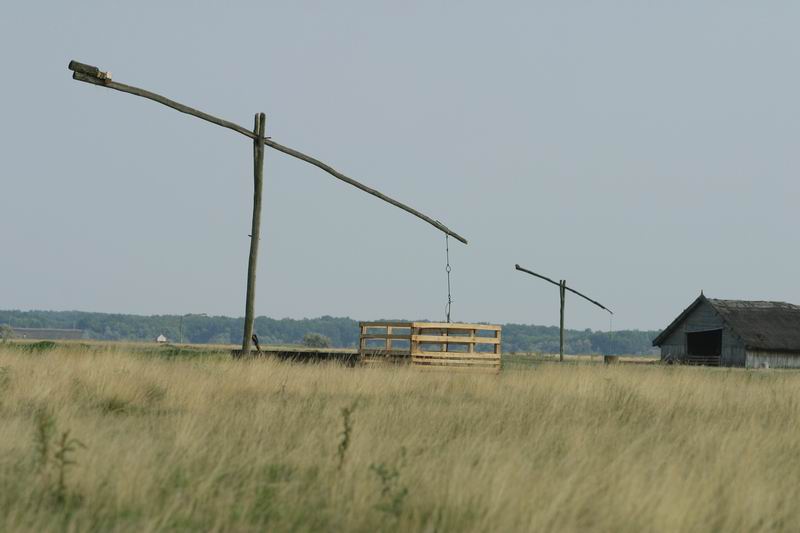
Hortobágy National Park
47.5946° N · 21.1568° E · National Park
Photo: Andreas Poeschek, fotografikus.hu · CC BY 2.0 at · Wikimedia Commons
Hortobágy National Park is a national park of Hungary. Hungary's first national park, established in 1973. The free Lokali audio guide runs 8 minutes.
✓ Published October 2026 · how we write these guides
Visitor facts
| Lokali audio guide | 8 min · free |
|---|---|
| Type | National Park |
| Location | Hajdú-Bihar County, Hungary |
| Coordinates | 47.5946, 21.1568 |
| Official website | hnp.hu |
| Languages | 50+, in the Lokali app |
The story
Listen for a moment. The wind moves across the grass with a low, steady hiss, and there is almost nothing to stop it. No hills. No forest. Just a long, flat horizon that seems to bend at the edges. Overhead, a lark climbs and sings. Somewhere far off, a cowbell sounds once, then again. This is the Hortobágy, the great Hungarian puszta. The word puszta means something close to empty or bare, and standing here, you can feel why.
Hortobágy became Hungary's first national park in 1973. In 1999, UNESCO added it to the World Heritage list. Notice the category, though. It was not listed only for its wildlife or its grassland. It was listed as a cultural landscape. That means the place matters because people and land shaped each other here, over many centuries of herding. The open plain you see is not wilderness in the usual sense. It is a working landscape, kept open by grazing animals and the herders who follow them.
That is the first surprise for many visitors. It is easy to imagine that this plain has always looked like this. The real story is more complicated. Over centuries, wars, settlement and grazing changed the land. Then, in the nineteenth century, engineers regulated the Tisza River and its tributaries to stop the floods. The wetlands that once covered much of the area began to dry out. Salty soils rose to the surface. The result was the dry, alkaline grassland you see today, with wetter patches scattered across it.
Look down at the ground near your feet. In some places the soil looks pale, almost white, as if someone dusted it with flour. That is salt. These alkaline soils are hard for crops, which is one reason the plain stayed as pasture instead of becoming farmland. The plants that grow here are tough and specialised. In late summer, some of the grassland turns a soft purple and grey. In spring, after rain, shallow pools can appear and vanish within weeks.
Now look for the animals. The large, pale cattle with long, curving horns are Hungarian Grey cattle. For centuries, herds of these cattle were driven on foot from the Hungarian plains to markets in Western Europe. The breed came close to disappearing in the twentieth century, and it survives today partly thanks to herds kept here. Nearby you may also see racka sheep. Their horns grow straight out in long spirals, like corkscrews. Once you notice them, you will not forget them.
The people who herded these animals formed a world of their own. There was a clear order among them. Horse herders, the csikós, held the most status. Below them came the cattle herders, then the shepherds, then the swineherds. Each group had its own clothing, tools and habits. Today, horse shows near the park keep the csikós tradition visible. Riders crack long whips, and some make their horses lie flat in the grass on command. It is a show now, but it grew from real skill.
As you scan the horizon, you will probably see a tall wooden pole tilted against the sky. This is a sweep well. A long beam balances on an upright post, with a bucket hanging from one end. A herder could pull it down, lift water, and fill a trough for the animals. On a plain with few landmarks, these wells also helped people find their way. They are still one of the strongest images of the puszta, and photographers love them at dusk.
You may also notice low, rounded mounds rising slightly above the flat ground. Locals call them kunhalom. Many of them are ancient burial mounds, built by people who lived on these steppes thousands of years ago. Others may have served as boundary markers or lookout points. On such level land, even a small rise gives a long view. Because these mounds were rarely ploughed, some still carry original steppe vegetation, like small islands of the old grassland.
If you are here on a hot summer afternoon, watch the horizon carefully. The air above the plain sometimes shimmers, and you may see what looks like a lake, or trees floating above the ground. This is a mirage. Hungarians call it délibáb, and it has a special place in national poetry and painting. It happens because heated air near the ground bends the light. Nothing is really there... but on the Hortobágy, the illusion has become part of the place's identity.
Now, a second surprise. For birdwatchers, this is one of the most important sites in Central Europe. The fishponds, marshes and wet meadows draw hundreds of bird species across the year. The best known visitors come in autumn. Tens of thousands of common cranes stop here on their migration south. At dawn and dusk, they fly between their resting places and feeding fields in long, loose lines. Their calls carry for a great distance. Many visitors hear the cranes long before they see them.
In the village of Hortobágy, you will find the Nine-Arch Bridge. It is a stone road bridge that crosses the small Hortobágy River, and it was built in the first half of the nineteenth century. It is long and low, with a gentle curve, and it is often called the longest stone road bridge in Hungary. Close by stands the old Hortobágy inn, the csárda, a traditional roadside tavern where travellers and herders once stopped to eat and rest.
The park also protects some unusual guests. In one fenced reserve, a herd of Przewalski's horses lives in semi-wild conditions. These stocky, sand-coloured horses come originally from the steppes of Central Asia, and they were once extinct in the wild. Herds kept in places like this help scientists study how the species lives on open grassland. Elsewhere, water buffalo graze in the wetlands. Their grazing keeps reeds and shrubs from taking over, so the animals do conservation work simply by eating.
It helps to know that the park is not one fenced area with a single entrance. It is a patchwork of protected land spread across a very wide region. Some parts are open to walkers. Others are protected and can only be seen with a guide, or from watchtowers and marked trails. The visitor centre in Hortobágy village is a good place to start. Staff can tell you which areas are open and where the animals and birds are likely to be.
Before you leave, stand still once more and look toward the horizon. Notice how large the sky is here, and how small everything under it seems. A sweep well, a grey cow, a line of birds. Listen again for the wind in the grass. This plain was shaped by floods, by engineers, and by many generations of herders and their animals. As you walk back, watch the light change across the grass. On the puszta, the sky is often the most important thing to see.
Key facts
What to look for
Practical tips
Common questions
Is there a free audio guide to Hortobágy National Park?
Yes — the Lokali app narrates Hortobágy National Park free of charge in 50+ languages. The guide runs about 8 minutes, covers the history, what to look for on site and practical tips, and works offline once downloaded.
Where is Hortobágy National Park?
Hortobágy National Park is near Hajdú-Bihar County, Hungary, at 47.5946, 21.1568. Tap the map link on this page for directions from where you are.
What is Hortobágy National Park known for?
Hungary's first national park, established in 1973. UNESCO World Heritage cultural landscape since 1999.
What should you look for at Hortobágy National Park?
Spiral corkscrew horns on the racka sheep. Long curving horns of the Hungarian Grey cattle. Tilted wooden sweep wells against the horizon.
What should you know before visiting Hortobágy National Park?
Start at the Hortobágy village visitor centre for current trail advice. Bring binoculars for cranes and distant herds.
When is the best time to visit Hortobágy National Park?
Come at dawn or dusk in autumn for crane flights.
On the map
Opens directions to Hortobágy National Park from your location.
Hear Hortobágy National Park in your language
The full story, narrated, in 50+ languages. Download it before you go and it plays offline, at your own pace, with no ticket and no tour group.