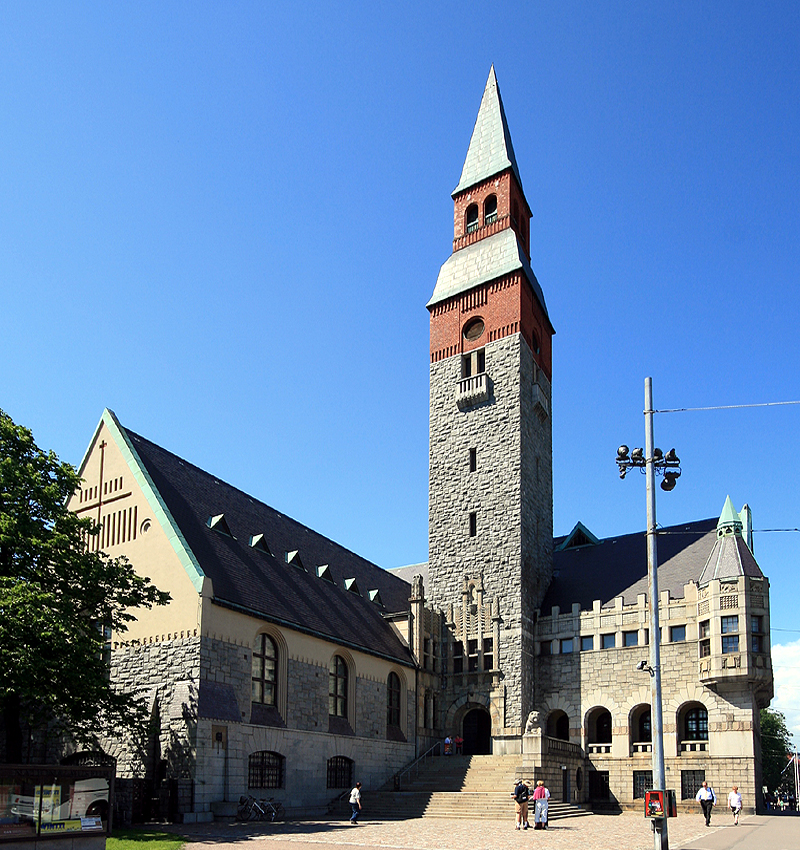
National Museum of Finland
60.1897° N · 24.9341° E · Museum
National Museum of Finland is a museum in Helsinki, Finland. Finland's primary history museum, housed in a castle-like 1912 building. Most visitors spend 1–2 hours here. The free Lokali audio guide runs 5 minutes.
✓ Verified August 2026 · how we write these guides
Visitor facts
| Time needed | 1–2 hours |
|---|---|
| Lokali audio guide | 5 min · free |
| Type | Museum |
| Best for | History |
| Location | Helsinki, Finland |
| Coordinates | 60.1897, 24.9341 |
| Languages | 45, in the Lokali app |
The story
A stone tower rises above the avenue. It looks like part of a medieval castle or an old stone church. Heavy walls, narrow windows, a steep roof. Yet this building is barely more than a hundred years old. A small stone bear sits guard near the doors. This is the National Museum of Finland, the country's main museum of its own long past.
The museum sits on Mannerheimintie, one of the main avenues of central Helsinki. From the street it seems far older than it truly is. That look is on purpose. The architects reached back to Finland's medieval churches and castles for their ideas. They wanted the building itself to speak of the nation's history before a visitor stepped inside.
Three architects designed it together. Their names were Herman Gesellius, Armas Lindgren, and Eliel Saarinen. They worked in a style known as National Romanticism. Around 1900 this style was at its height in Finland. It used rough local stone, heavy forms, and shapes drawn from the country's past. The result was a building that felt rooted in Finnish soil.
The doors opened to the public in 1916. That was a charged moment in the nation's story, just one year before Finland declared its independence. The museum was meant to gather and protect the objects of a people who were beginning to define themselves. From the start it carried more than artifacts. It carried a sense of identity.
One of its architects became known far beyond Finland. Eliel Saarinen later moved to the United States. His son, Eero Saarinen, grew up to design famous landmarks there, including great arches and airports. But this early museum shows the father's roots, here in the country where his work began.
Before you go in, look down at the entrance. A bear carved from stone sits near the doors. The bear is an old and powerful animal in Finnish folklore, treated almost as a sacred creature. The sculptor Emil Wikstrom made it. Many visitors reach out to touch it as they pass, and parts of the stone have worn smooth.
Step into the entrance hall and look up. The ceiling holds a series of frescoes. They were painted by Akseli Gallen-Kallela, one of the most loved of all Finnish artists. The scenes come from the Kalevala, the national epic poem. Heroes, journeys, and old magic fill the vault above your head in strong lines and earthy color.
The collections move forward through time. The first rooms cover prehistory. You see tools of stone and bone, simple jewelry, and clay pots left by the earliest people of the region. Some of these objects were dug from Finnish soil. Others arrived through trade from distant lands. From there the displays carry you onward, through the Iron Age, the medieval centuries, and into the early modern world.
Other halls cover the long years when Finland was ruled first from Sweden and later from Russia. You see church carvings, weapons, coins, and the plain objects of daily work. Together they trace how the land and its people changed under different crowns. Few countries lay out their whole story so plainly in one place.
There are also rooms about ordinary life. Furniture, clothing, farm tools, and household goods show how Finnish people lived across the centuries. These quieter displays often stay with visitors as long as the grand ones. They show not kings and battles but the daily round of an ordinary home.
The museum went through a large renovation in recent years. A new wing was dug underground to give more room for exhibitions and events. The work took several years to complete. The old stone building and the new section now work as one. The change added modern, open space without harming the heavy stone shell that gives the museum its character.
For families, there is a special area where children can take part. They can touch certain objects, try on old-style clothing, and handle copies of ancient tools. It turns a visit into something done with the hands, not only seen through glass. For many young visitors this room becomes the part they remember best long after they leave.
When you leave, pause by the stone bear once more. Behind you now sits the whole story of a nation, told in stone, paint, and quiet rows of cases. The tower, the painted ceiling, the worn tools, the simple clothes. The National Museum gathers a country's memory and keeps it safe inside one tall and watchful building.
Key facts
What to look for
Practical tips
Common questions
How long do you need at National Museum of Finland?
Plan 1–2 hours. That is the time most visitors spend at National Museum of Finland. The free Lokali audio guide adds about 5 minutes of narration you can listen to as you walk, so it fits inside your visit rather than adding to it.
Is there a free audio guide to National Museum of Finland?
Yes — the Lokali app narrates National Museum of Finland free of charge in 50+ languages. It covers the history, what to look for on site and practical tips, and it works offline once downloaded.
Where is National Museum of Finland?
National Museum of Finland is in Helsinki, Finland, at 60.1897, 24.9341. Tap the map link on this page for directions from where you are.
What should you know before visiting National Museum of Finland?
Allow about two hours for the full visit.
What is National Museum of Finland known for?
Opened to the public in 1916.
What is the best time to visit National Museum of Finland?
The interior woodwork is as memorable as the exhibits—carved ceilings and period rooms transport you.
On the map
Opens directions to National Museum of Finland from your location.
More to see in Helsinki


Hear National Museum of Finland in your language
The full story, narrated, in 50+ languages. Download it before you go and it plays offline, at your own pace, with no ticket and no tour group.