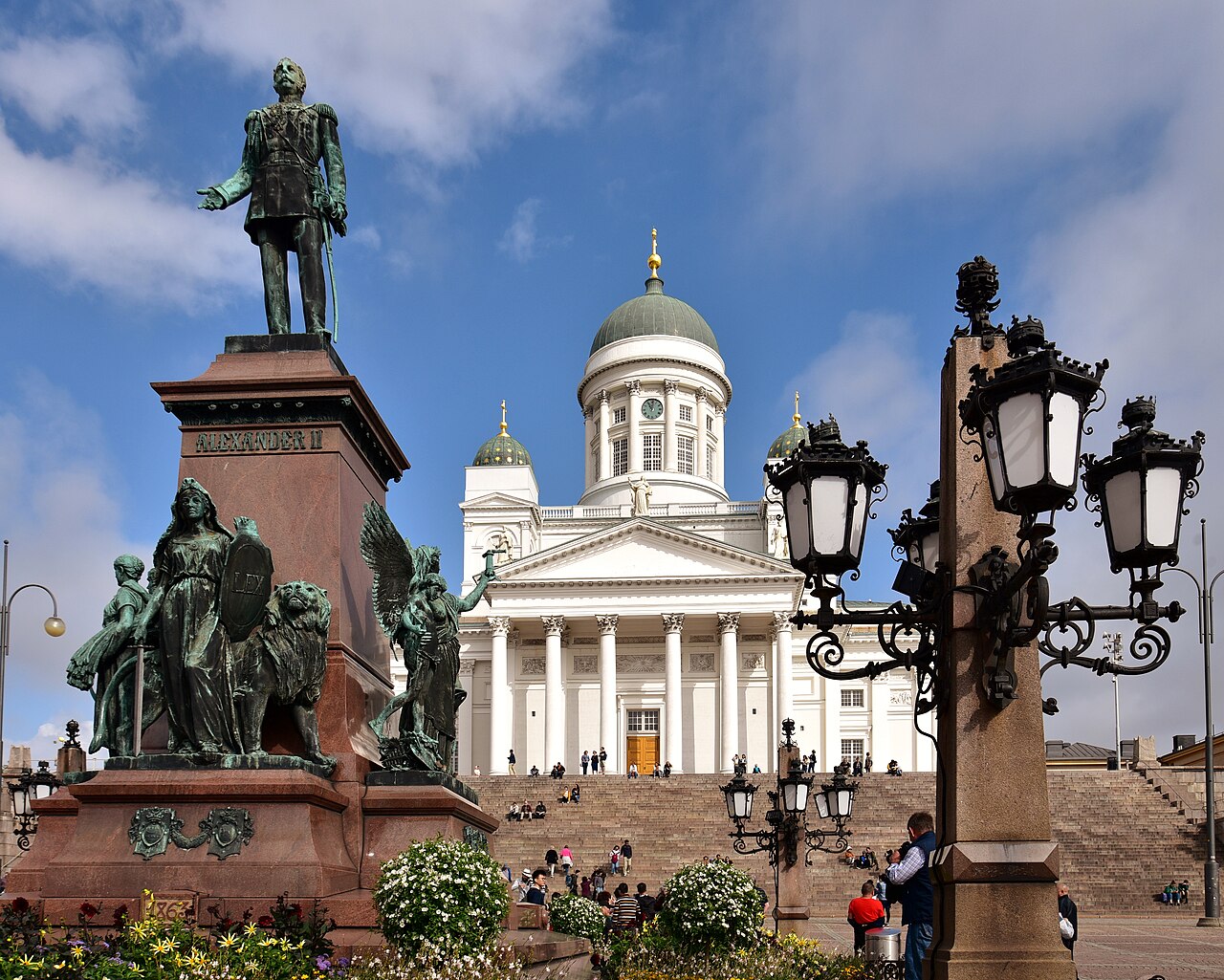
Senate Square is a square in Helsinki, Finland. Neoclassical heart of Helsinki, ringed by white Empire-style buildings including the Lutheran Cathedral. Most visitors spend 30–45 min here. The free Lokali audio guide runs 5 minutes.
✓ Verified August 2026 · how we write these guides
Visitor facts
| Time needed | 30–45 min |
|---|---|
| Lokali audio guide | 5 min · free |
| Type | Square |
| Best for | Photography |
| Location | Helsinki, Finland |
| Coordinates | 60.1704, 24.9528 |
| Languages | 45, in the Lokali app |
The story
You walk into a wide open square, and the space suddenly opens above you. Pale yellow buildings stand on every side. In front of you, a long flight of steps climbs to a white church with a green dome. The stone under your feet is gray granite, set in careful patterns. This is Senate Square, the oldest heart of central Helsinki.
The square took its modern shape in the early nineteenth century. In 1812, it was chosen as the main square of Helsinki. At that time, Finland had just become a grand duchy under the Russian Empire. The Russian tsar wanted a capital that looked grand and orderly. A planner named Johann Albrecht Ehrenstrom drew the new street grid. This square sat at its center.
To turn the plan into stone, one architect did most of the work. His name was Carl Ludvig Engel. He came from Germany. He was the first architect of international standing to work in Finland. Over many years, he designed the main buildings around this square. He gave them a shared style, calm and balanced, in the neoclassical manner.
Look first at the church on the north side. This is Helsinki Cathedral. Engel worked on its design from 1818 until his death in 1840. The building was not finished until 1852, twelve years after he died. So the architect never saw it complete. Its tall green dome rises above the city, with four smaller domes around it.
Now look closely at the roofline. Twelve statues stand there against the sky. They are the apostles, the closest followers of Jesus. They were cast in zinc in Berlin and shipped to Helsinki in 1847 and 1848. Together they form one of the largest groups of zinc statues anywhere. From the square they look small, but each one is larger than a person.
Climb a few of the steps and turn around. From here you can see how the square works as a whole. Engel designed four buildings to frame this space. The cathedral stands for the church. Across the square, the Government Palace stands for the state. On another side, the main building of the University of Helsinki stands for learning. Beside it, the National Library stands for knowledge.
Together these four buildings tell a quiet story. They speak of faith, government, learning, and the life of the city. The square was built to show the world that a new Finland had taken shape. Most of the walls wear a warm pale yellow, with white columns and trim. The style is restrained. The effect comes from order and repetition, not decoration.
In the center of the square stands a statue. It honors Tsar Alexander the Second of Russia. Finns remembered him for steps that gave the country more self-rule. The statue was raised in 1894. People still meet at its base. It marks the middle of the open space.
Look to one corner of the square for a plain yellow house. This is Sederholm House. A merchant named Johan Sederholm built it in 1757. It is the oldest stone building in the center of Helsinki, older than the grand plan around it. Today it holds part of the city museum. It survived from a time when most of the town was still made of wood.
The sounds here shift with the seasons. In summer, you hear footsteps, cameras, and the voices of guides. Street musicians sometimes play near the steps. In winter, snow covers the square, and the sound softens. The cathedral steps become a place to sit and watch the city move.
The cathedral steps are one of the best places in Helsinki to pause. From the top, you look down across the whole square. Beyond the rooftops, you can sense the harbor and the sea. Markets, parades, and concerts have filled this space for many years. It remains a gathering place.
Step inside the cathedral if the doors are open. The interior is plain and bright, in keeping with its Lutheran faith. There is little gold and little color. White walls and simple lines carry the eye upward. After the open square, the quiet inside can feel like a held breath.
When you leave, walk to the lower edge of the square and look back one more time. The white church, the steps, the yellow walls all line up into a single calm picture. This was a city built on purpose, designed to be a capital. Two centuries later, the plan still holds. You are standing inside an idea made of stone.
Key facts
What to look for
Practical tips
Common questions
How long do you need at Senate Square?
Plan 30–45 min. That is the time most visitors spend at Senate Square. The free Lokali audio guide adds about 5 minutes of narration you can listen to as you walk, so it fits inside your visit rather than adding to it.
Is there a free audio guide to Senate Square?
Yes — the Lokali app narrates Senate Square free of charge in 50+ languages. It covers the history, what to look for on site and practical tips, and it works offline once downloaded.
Where is Senate Square?
Senate Square is in Helsinki, Finland, at 60.1704, 24.9528. Tap the map link on this page for directions from where you are.
What should you know before visiting Senate Square?
Sit on the cathedral steps for the best view.
What is Senate Square known for?
Laid out as the main square in 1812.
What is the best time to visit Senate Square?
Stand at the base of the steps facing the cathedral and notice how the square's geometry frames the building perfectly.
On the map
Opens directions to Senate Square from your location.
More to see in Helsinki


Hear Senate Square in your language
The full story, narrated, in 50+ languages. Download it before you go and it plays offline, at your own pace, with no ticket and no tour group.