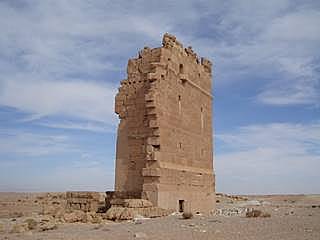
Photo: Hovalp at en.wikipedia · CC BY-SA 3.0 · Wikimedia Commons
Qasr al-Hayr al-Gharbi is a villa in Syria. Built under Umayyad caliph Hisham ibn Abd al-Malik, around 727. The free Lokali audio guide runs 7 minutes.
✓ Published October 2026 · how we write these guides
Visitor facts
| Lokali audio guide | 7 min · free |
|---|---|
| Type | Castle |
| Location | Homs, Syria |
| Coordinates | 34.3744, 37.6058 |
| Languages | 50+, in the Lokali app |
The story
The wind out here carries fine grit. It settles on your sleeves and in the creases of your hands. Underfoot the ground is hard, pale and scattered with stone, and the horizon is flat in almost every direction. In the middle of this open steppe stand the low remains of walls and a squat, square tower. It is very quiet. Then you start to notice the outlines of rooms, gateways and courtyards. Thirteen centuries ago, this was a busy place.
You are standing at Qasr al-Hayr al-Gharbi, the Western Palace of the Enclosure. It lies in the Syrian desert, southwest of Palmyra, along the old route toward Damascus. The name separates it from a sister complex, Qasr al-Hayr al-Sharqi, which stands far to the east. Both belong to the Umayyad era. The Umayyads were the first great dynasty of the Islamic caliphate. They ruled from Damascus from the mid-seventh century until 750, and they left a scatter of country residences across these dry lands.
An inscription found at the site dates the palace to the reign of the caliph Hisham ibn Abd al-Malik. It places the work around 727. Hisham was one of the longest-ruling Umayyad caliphs, and he was known as a careful administrator. He also seems to have liked building in the countryside. Several desert residences are linked to his reign. This one combined a residence with agriculture, water management and a stop for travellers crossing the steppe.
Here is the first surprise. The Umayyads did not start from empty ground. That square tower at the heart of the complex is older than the palace. An inscription connects it to the Ghassanids, Arab Christian allies of the Byzantine Empire, in the sixth century. The tower seems to have belonged to a monastery. The Umayyad builders kept it and wrapped their new palace around it. Old and new were joined together in one structure.
Look at the walls closely. The lower courses are stone, cut and fitted with care. Above them the builders used fired and unfired brick, a cheaper and faster material. Over time, sun, wind and rare heavy rains have worn the upper levels away. That is why so much of what you see today is low and broken. The ground plan, however, stays readable. The palace was a square block of rooms set around a central courtyard, a layout common to Umayyad desert residences.
Now imagine the walls covered in decoration. Excavators found large amounts of carved stucco here. Stucco is a plaster that can be shaped while wet and carved when dry. There were vine scrolls, geometric patterns, rosettes and even human figures. The style mixed many traditions. You can see Byzantine and Roman ideas next to Persian Sasanian motifs, from the empire that ruled Iran before Islam. The Umayyad court drew on all the cultures it now governed.
The second surprise is about where the finest pieces went. In the 1930s, French archaeologists excavated the site under Daniel Schlumberger. Afterwards, the great decorated gateway of the palace was taken down, block by block. It was rebuilt in Damascus as the main entrance of the National Museum of Syria. So the facade that once faced this empty steppe now greets museum visitors in the capital. What you see here is the place it came from.
Painted floors were found here too. Two large plaster floor paintings were recovered and also moved to Damascus. One shows a female figure who is often identified with the classical earth goddess, surrounded by sea creatures. Another shows musicians and a horseman hunting deer. These images are rare survivals. They show that the Umayyad elite enjoyed music, hunting and late classical imagery inside their private spaces. Picture them under your feet as you walk the courtyard.
The palace was only one part of a larger estate. Nearby stood a bathhouse, where visitors could wash and relax after a journey. There was also a building that is usually read as a caravan inn, with rooms around a courtyard for travellers and their animals. Beyond these lay a large walled enclosure, a garden or farmland watered by channels. This is where the name comes from. Hayr refers to an enclosed area, a protected piece of cultivated land in the desert.
Water made all of this possible. In a place this dry, nothing grows without careful planning. The Umayyads used an old dam to the south, built in the Roman period, which collected seasonal runoff in a reservoir. A long channel then carried water toward the estate. Fields, orchards and the bath depended on it. When you look across the dry ground today, try to picture green rows of crops inside the walls. It must have looked very surprising to travellers arriving from the steppe.
Why build here at all? Historians suggest several reasons. Desert estates let the caliphs keep close ties with the Arab tribes of the steppe. They could serve as hunting lodges and seasonal retreats from the city. They also supported farming, trade and the movement of people between Damascus, Palmyra and the Euphrates region. A complex like this was a statement of power, but it was also practical. It fed people, sheltered caravans and helped control the land.
After the fall of the Umayyads in 750, the new Abbasid rulers moved the centre of power east to Iraq. Sites like this lost their purpose. Some activity continued for a time, but slowly the estate emptied. Sand drifted into the rooms. The garden walls crumbled. For centuries the place was known mainly to herders and passing travellers. Only in the twentieth century did careful excavation bring its story back into view.
Before you leave, stand still for a moment near the old tower. Turn slowly and follow the line of the walls with your eyes. Notice how the wind moves the dust along the ground, and how the light changes the colour of the stone. Then look out at the open steppe. It is the same horizon that the caravans and the caliph's guests once saw. As you walk away, listen to the quiet. It is the sound this place has kept for a very long time.
Key facts
What to look for
Practical tips
Common questions
Is there a free audio guide to Qasr al-Hayr al-Gharbi?
Yes — the Lokali app narrates Qasr al-Hayr al-Gharbi free of charge in 50+ languages. The guide runs about 7 minutes, covers the history, what to look for on site and practical tips, and works offline once downloaded.
Where is Qasr al-Hayr al-Gharbi?
Qasr al-Hayr al-Gharbi is near Homs, Syria, at 34.3744, 37.6058. Tap the map link on this page for directions from where you are.
What is Qasr al-Hayr al-Gharbi known for?
Built under Umayyad caliph Hisham ibn Abd al-Malik, around 727. Reuses a sixth-century Ghassanid monastery tower at its core.
What should you look for at Qasr al-Hayr al-Gharbi?
The older square tower standing within the palace walls. Cut stone lower courses beneath worn brick upper walls. The central courtyard outline framed by surrounding rooms.
What should you know before visiting Qasr al-Hayr al-Gharbi?
Check current security advice before travelling to this remote area. Travel with a local driver who knows the desert roads.
When is the best time to visit Qasr al-Hayr al-Gharbi?
Come early morning for softer light and cooler air.
On the map
Opens directions to Qasr al-Hayr al-Gharbi from your location.
Hear Qasr al-Hayr al-Gharbi in your language
The full story, narrated, in 50+ languages. Download it before you go and it plays offline, at your own pace, with no ticket and no tour group.