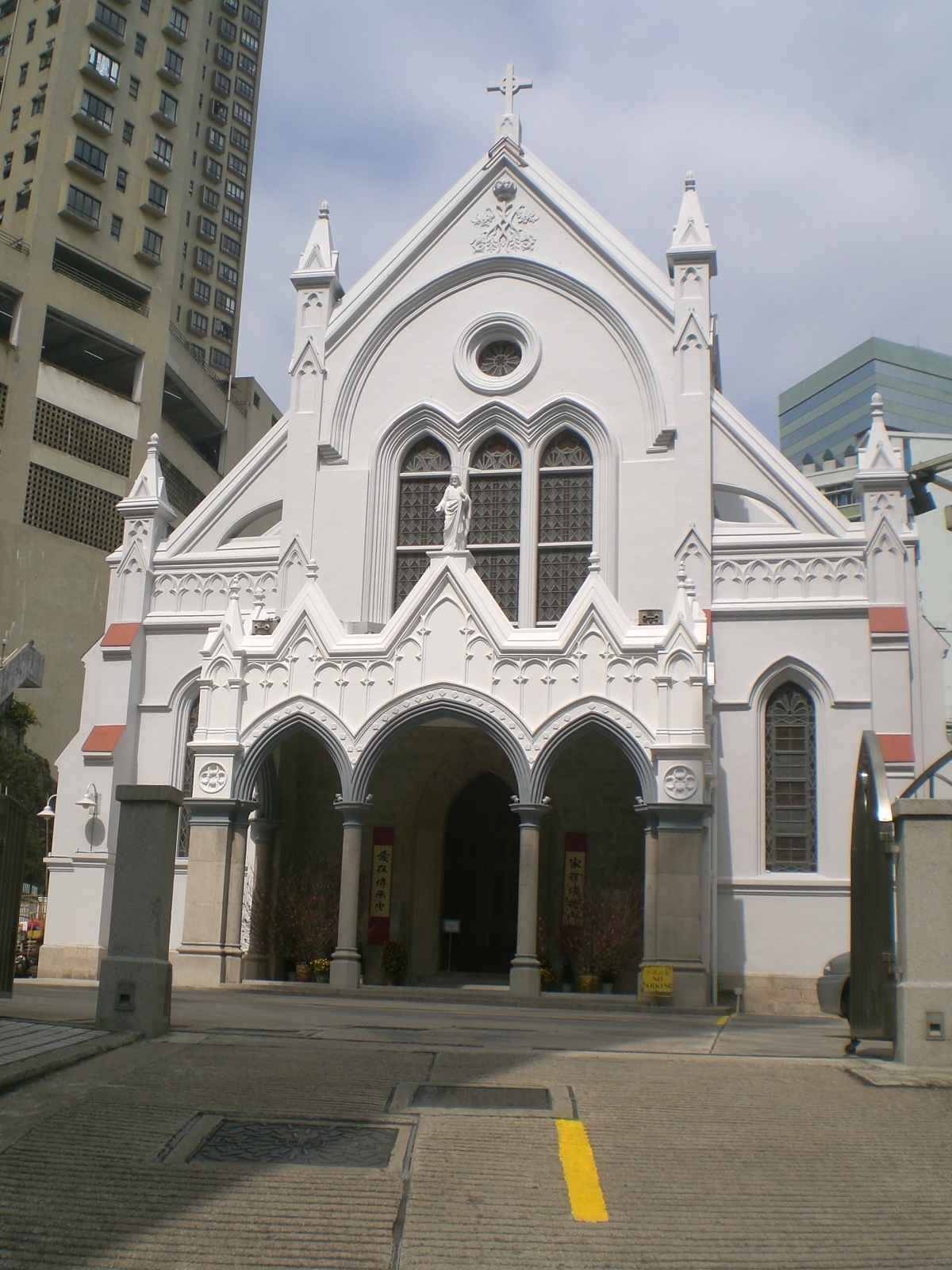
Cathedral of the Immaculate Conception
22.2787° N · 114.1539° E · Cathedral
Photo: No machine-readable author provided. JackieCheu assumed (based on copyright claims). · CC BY-SA 3.0 · Wikimedia Commons
Cathedral of the Immaculate Conception is a cathedral in Hong Kong. Consecrated in 1888 after an earlier church grew too small. The free Lokali audio guide runs 6 minutes.
✓ Published October 2026 · how we write these guides
Visitor facts
| Lokali audio guide | 6 min · free |
|---|---|
| Type | Cathedral |
| Location | Hong Kong, China |
| Coordinates | 22.2787, 114.1539 |
| Official website | cathedral.catholic.org.hk |
| Languages | 50+, in the Lokali app |
The story
Stand still for a moment on Caine Road. Behind you, minibuses grind uphill and the air carries the heat of Hong Kong traffic. In front of you, there is grey stone, tall pointed windows, and a quiet that seems almost too deep for this city. Step through the gate, and the sound of the street drops away. The air inside the church is cooler. It smells faintly of wax and old wood.
This is the Cathedral of the Immaculate Conception, the mother church of the Roman Catholic Diocese of Hong Kong. It sits in the Mid-Levels, the steep band of hillside between the financial towers of Central and the green slopes of the Peak. Around it, apartment blocks rise thirty and forty storeys high. The cathedral is much older than its neighbours, and from many angles they nearly hide it. That contrast is one of the first things to notice here.
The church you see was completed and consecrated in 1888. It was not the first Catholic cathedral in the colony. An earlier, smaller church stood lower down the hill, closer to the old commercial streets. As the Catholic community grew, that building became too small, and the church leaders looked uphill for open land. In the late nineteenth century, this slope was still on the edge of the settled city. Today it feels like the middle of everything.
The style is Gothic Revival. That means nineteenth-century architects borrowed the look of medieval European cathedrals: pointed arches, tall narrow windows, buttresses that brace the walls from outside. British builders carried this style across their empire, from India to Australia. Here it arrived on a subtropical hillside, far from the cold northern climate where Gothic first developed. Look at the walls and ask yourself how a building like this copes with typhoons, monsoon rain, and summer humidity.
From above, the cathedral has the shape of a Latin cross. The long arm is the nave, where the congregation sits. The shorter arms cross it near the altar. Walk slowly down the central aisle and you follow the line of that cross. The ceiling rises above you in dark timber, and the columns lead the eye forward. Everything in the plan points you toward the sanctuary at the far end.
Now for something many visitors miss. A missionary bishop named Timoleon Raimondi pushed hard for this building. He was an Italian priest who led the Catholic mission in Hong Kong in the second half of the nineteenth century. Raising money for a cathedral in a young trading port was not easy. Much of the support came from overseas and from the mixed local congregation of Portuguese, Chinese, Irish, and other families who worshipped here.
That mix of people is the real story of this church. In its early decades, many parishioners were Portuguese families from Macau, who had moved to Hong Kong to work as clerks, merchants, and printers. Irish soldiers from the British garrison also came to Mass. Chinese Catholics formed a growing share of the community. The cathedral was built for all of them, and you can still feel that range of languages and backgrounds today.
Here is a second surprise. In 1970, Pope Paul VI came to Hong Kong and visited this cathedral. It was a short stop on a long journey through Asia, but for local Catholics it was a moment they still remember. A papal visit to a small diocese on the southern coast of China was a rare event. Some older parishioners will tell you where they stood that day.
Take a moment with the windows. The stained glass fills the nave with colour when the sun is high, and patches of red and blue move slowly across the floor. Much of the original glass did not survive the twentieth century. War, weather, and age all took their toll, and pieces have been replaced and repaired over the years. What you see now is a building that has been patched and cared for many times.
The cathedral did go through hard years. During the Japanese occupation of Hong Kong in the Second World War, life for the church community was difficult, and the city around it suffered greatly. After the war, the building needed serious repair. Later, around the turn of the twenty-first century, the cathedral went through a major restoration. Workers cleaned the stone, strengthened the structure, and renewed the interior so it could serve another century.
If you come on a Sunday, you will see a different side of this place. Masses are held in several languages, including Cantonese and English. On Sundays, many Filipino domestic workers attend, since Sunday is often their one day off. The steps and the courtyard fill with conversation, families on video calls, and friends sharing food afterward. This is not a museum. It is a working parish, and it is busy.
Please remember that people come here to pray. Walk softly, keep your voice low, and avoid taking photos during services. If a Mass is under way, it is best to sit quietly at the back or come back later. Outside, the buildings next to the cathedral hold diocesan offices, which shows that this site is still the centre of Catholic life in the city, not only its past.
Before you leave, turn around at the door and look back down the nave. Notice the dark wooden beams overhead, the soft light through the coloured glass, the rows of worn pews. Then step out onto Caine Road again. Listen to the traffic return, look up at the towers that surround this old stone church, and carry that small pocket of quiet with you down the hill.
Key facts
What to look for
Practical tips
Common questions
Is there a free audio guide to Cathedral of the Immaculate Conception?
Yes — the Lokali app narrates Cathedral of the Immaculate Conception free of charge in 50+ languages. The guide runs about 6 minutes, covers the history, what to look for on site and practical tips, and works offline once downloaded.
Where is Cathedral of the Immaculate Conception?
Cathedral of the Immaculate Conception is in Hong Kong, China, at 22.2787, 114.1539. Tap the map link on this page for directions from where you are.
What is Cathedral of the Immaculate Conception known for?
Consecrated in 1888 after an earlier church grew too small. Mother church of the Roman Catholic Diocese of Hong Kong.
What should you look for at Cathedral of the Immaculate Conception?
Pointed Gothic arches framing the long central nave. Coloured light from stained glass moving across the floor. Dark timber beams across the high ceiling.
What should you know before visiting Cathedral of the Immaculate Conception?
Visit on a weekday morning for the quietest interior. Avoid photography while a Mass is in progress.
When is the best time to visit Cathedral of the Immaculate Conception?
Visit on a weekday morning for the quietest interior.
On the map
Opens directions to Cathedral of the Immaculate Conception from your location.
More to see in Hong Kong


Hear Cathedral of the Immaculate Conception in your language
The full story, narrated, in 50+ languages. Download it before you go and it plays offline, at your own pace, with no ticket and no tour group.