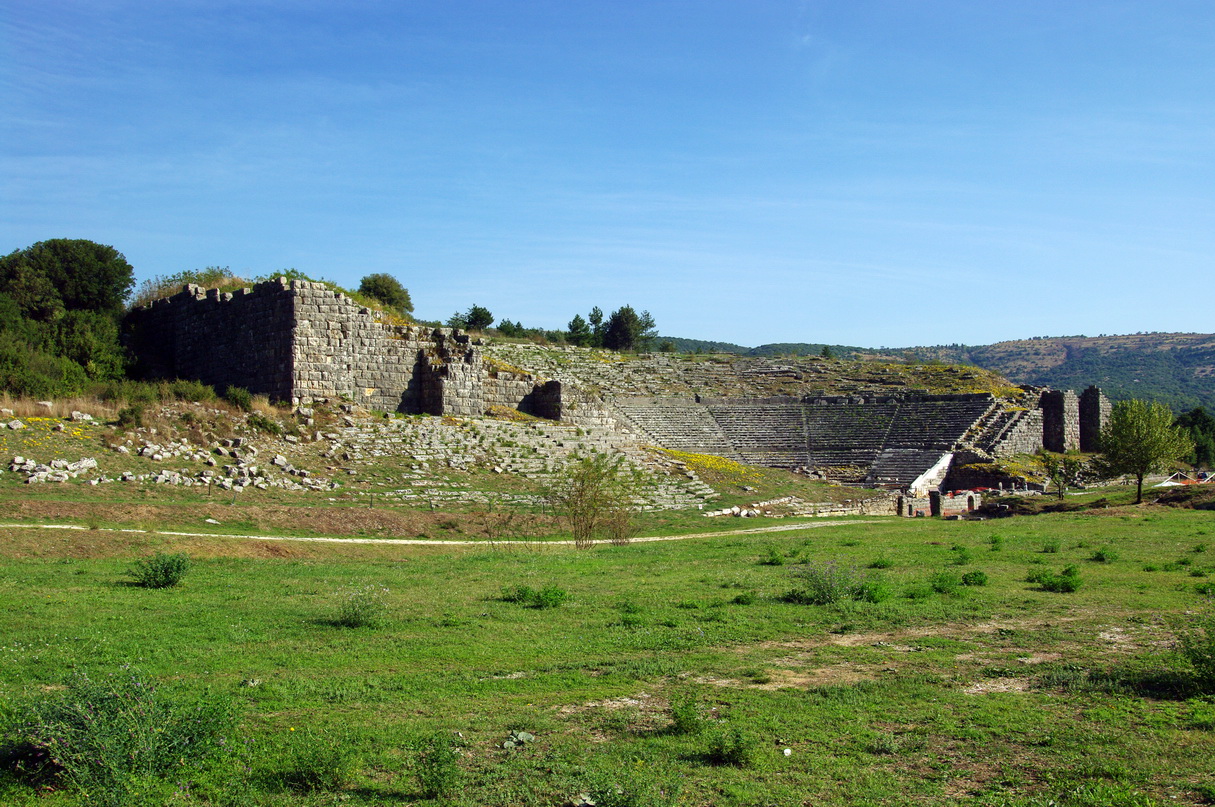
Photo: Bgabel · CC BY-SA 3.0 · Wikimedia Commons
Dodona is an ancient Greek sanctuary and oracle. It is near Ioannina, Greece. Herodotus called Dodona the oldest oracle in Greece. The free Lokali audio guide runs 7 minutes.
✓ Published October 2026 · how we write these guides
Visitor facts
| Lokali audio guide | 7 min · free |
|---|---|
| Type | Archaeological Site |
| Location | Ioannina, Greece |
| Coordinates | 39.5464, 20.7878 |
| Languages | 50+, in the Lokali app |
The story
Listen to the wind. Here, in a quiet valley below a long grey mountain, the air moves through the grass and the trees with a low, steady rustle. Gravel crunches under your feet. Somewhere a bell clinks on a goat's neck. For more than a thousand years, people walked into this valley to hear that same sound. They believed it was the voice of a god. Welcome to Dodona, the ancient oracle of Zeus, about half an hour's drive southwest of Ioannina.
An oracle was a place where people asked the gods questions and received answers. Most visitors today know Delphi, the oracle of Apollo further south. But Dodona is older. The Greek historian Herodotus, writing in the fifth century before Christ, called it the most ancient oracle in Greece. Homer mentions it too. In the Odyssey, Odysseus says he travelled to Dodona to learn the will of Zeus from the god's tall oak tree. So even in Homer's time, this valley already had a reputation.
That oak is the heart of the story. Zeus was believed to speak through a sacred tree. When the wind moved its leaves, priests and priestesses listened and interpreted the sound. There was no grand temple at first, only the tree, open ground, and the mountain behind. The mountain is called Tomaros. Look up at it now. Its long ridge closes the valley and holds the clouds. On many afternoons, you can watch weather build along its crest.
Homer also gives us a strange detail about the priests. He calls them the Selloi, and he says they slept on the bare ground and did not wash their feet. Scholars still debate what this meant. Perhaps the priests needed constant contact with the earth. Perhaps it was simply an old local custom. Either way, it is a reminder that Dodona began as something rough and rural, far from the polished marble of Athens.
Later, priestesses took a central role. They were called the Peleiades, which means the doves. Herodotus tells a story about their origin. According to a tale he heard from the priestesses themselves, a black dove flew from Thebes in Egypt, landed on the oak, and spoke in a human voice. It told the people to found an oracle of Zeus here. Herodotus himself was doubtful. He offered a more practical explanation, but the legend of the dove stayed with Dodona.
Now for the detail most visitors miss. The god did not speak only through leaves. The sanctuary was ringed with bronze cauldrons on tripods, standing close together. Ancient writers say that when one was struck, the sound passed from cauldron to cauldron and kept ringing. Later, a city gave a famous offering: a bronze figure of a boy holding a whip with chains. In the wind, the chains struck a bronze bowl. The phrase "the bronze of Dodona" came to describe someone who never stopped talking.
So what did people actually ask? Here the archaeology is wonderful. Excavators found many small sheets of lead, folded and scratched with questions. The site was first dug in 1875 by Konstantinos Karapanos, and work has continued since. The questions are surprisingly human. Should I marry? Is this child really mine? Will my journey go well? Should I change my trade? These are not kings planning wars. They are ordinary people with ordinary worries, just like us.
Many of these lead tablets are now in the archaeological museum in Ioannina. If you have time, it is worth seeing them after this visit. Holding the image of this valley in your mind while reading those scratched words makes the whole place feel close. A farmer once stood near where you are standing, waiting for the leaves to move. He wanted to know if his sheep would do well this year.
Now turn toward the largest structure on the site — the theatre. Its stone seats climb steeply up the slope, set into the hillside. It was built in the third century before Christ, in the age of King Pyrrhus of Epirus, the ruler who gave us the phrase "Pyrrhic victory" — a win that costs too much. It is one of the largest ancient theatres in Greece. Thousands of spectators sat here for the festival held in honour of Zeus, with games and performances.
Look closely at the bottom of the theatre. In the Roman period, the lower rows were changed. A wall was added around the performance area, so the theatre could host fights with wild animals. Many Greek theatres went through a similar change under Roman rule. Here you can still see how a space built for drama became a space for spectacle. In summer, the theatre is sometimes used again for performances, and the acoustics carry voices clearly up the slope.
Dodona was not always peaceful. In the late third century before Christ, an enemy army from Aetolia, a region further south, attacked and burned the sanctuary. It was rebuilt. Then, in the second century before Christ, Roman armies devastated Epirus. The oracle survived in a reduced form for centuries more. In early Christian times, a basilica was built inside the sanctuary. By the end of the fourth century after Christ, when pagan worship was banned, the voice in the oak had gone quiet.
Between the theatre and the trees, walk among the low foundations. You will find the remains of public buildings, including a council house where local officials met. Further on is the small sacred house of Zeus. Near it grows an oak tree. It is not the original, of course. It was planted in modern times to mark the spot. But stand under it for a moment. The leaves sound the same as any oak leaves. That is exactly the point.
As you leave, take one more slow look across the valley. Notice how quiet it is. There is no city here now, no crowd of pilgrims, no ringing bronze. Just the slope of the theatre, the scattered stones, the mountain, and the wind. Listen to the oak once more as you walk back toward the gate. For a thousand years, people heard an answer in that sound. Perhaps, today, you can simply hear a question.
Key facts
What to look for
Practical tips
Common questions
Is there a free audio guide to Dodona?
Yes — the Lokali app narrates Dodona free of charge in 50+ languages. The guide runs about 7 minutes, covers the history, what to look for on site and practical tips, and works offline once downloaded.
Where is Dodona?
Dodona is near Ioannina, Greece, at 39.5464, 20.7878. Tap the map link on this page for directions from where you are.
What is Dodona known for?
Herodotus called Dodona the oldest oracle in Greece. Homer's Odyssey mentions Odysseus consulting the oak here.
What should you look for at Dodona?
The steep stone seats set into the hillside. The Roman wall added around the theatre's lower area. The modern oak planted near the house of Zeus.
What should you know before visiting Dodona?
Visit Ioannina's archaeological museum to see the lead tablets. Come in the morning for softer light on the theatre.
When is the best time to visit Dodona?
Come in the morning for softer light on the theatre.
On the map
Opens directions to Dodona from your location.
Hear Dodona in your language
The full story, narrated, in 50+ languages. Download it before you go and it plays offline, at your own pace, with no ticket and no tour group.