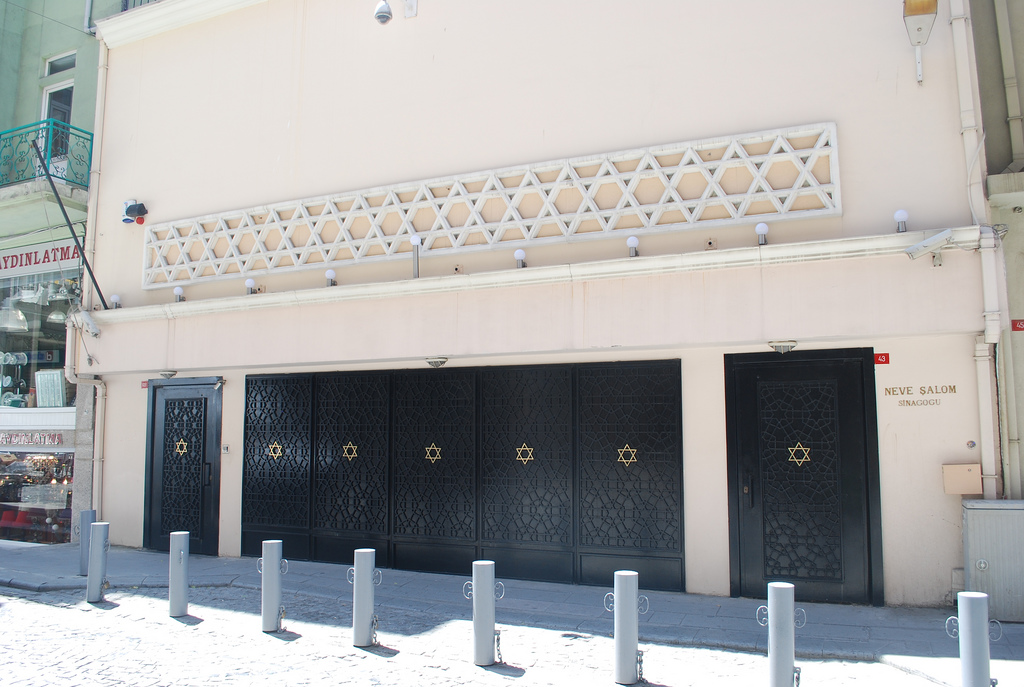
Neve Shalom Synagogue
41.0267° N · 28.9724° E · Synagogue
Photo: Flickr user Chadica · CC BY 2.0 · Wikimedia Commons
Neve Shalom Synagogue is a synagogue. It is in Istanbul, Türkiye. Largest Sephardic synagogue in Istanbul. The free Lokali audio guide runs 6 minutes.
✓ Published October 2026 · how we write these guides
Visitor facts
| Lokali audio guide | 6 min · free |
|---|---|
| Type | Synagogue |
| Location | Istanbul, Türkiye |
| Coordinates | 41.0267, 28.9724 |
| Official website | nevesalom.org |
| Languages | 50+, in the Lokali app |
The story
Listen first. A street vendor calls out somewhere up the hill. A delivery scooter whines past on the cobbles. Footsteps echo between tall, close buildings. You are on a narrow, sloping lane in the old Galata quarter, a short walk from the stone cone of Galata Tower. The street feels ordinary. Then you notice the security barrier, the guarded gate, and the quiet seriousness of the people who watch it. This is Neve Shalom, the largest Sephardic synagogue in Istanbul.
The name comes from Hebrew. It is often translated as Oasis of Peace. Hold that phrase in your mind as you stand here, because this building has carried both meanings of its story. It is a place of weddings, holidays and ordinary Saturday prayer. It is also a place that has been attacked more than once. Both truths live behind these walls, and the community that gathers here has chosen, again and again, to keep the doors open.
To understand why a synagogue stands in Galata at all, we need to travel back more than five centuries. In 1492, Spain expelled its Jewish population. Many families fled east by sea. The Ottoman Sultan Bayezid the Second allowed them to settle in his empire, and large numbers came to Istanbul, then the Ottoman capital. These newcomers were Sephardic Jews, a name that comes from Sefarad, the Hebrew word for the Iberian Peninsula.
They brought their own language with them. It is called Ladino, or Judeo-Spanish, a form of old Castilian Spanish mixed with Hebrew, Turkish and other words picked up over the centuries. For generations, Ladino filled the courtyards and kitchens of this part of the city. Grandparents sang lullabies in it. Merchants bargained in it. Today it is spoken by far fewer people, but older members of Istanbul's Jewish community still remember it, and some families still use its songs and sayings.
Galata itself has a long history as a district of mixed communities. Across the centuries, Genoese traders, Greeks, Armenians, Jews and Turks all lived and worked on these slopes above the Golden Horn. Churches, synagogues and mosques stood within a few streets of one another. As you walk this neighbourhood, you can still find that layered character in the street names, the old stone facades and the small houses of worship tucked between shops.
Neve Shalom is younger than many visitors expect. It is not an Ottoman building. The synagogue was inaugurated in 1951, in the years after the Second World War, when the community wanted a larger, modern place of worship. So the building you see is a mid-twentieth-century structure. Its lines are cleaner and plainer than the ornate religious buildings in the old city across the water. That simplicity is part of its character.
Inside, the main prayer hall is spacious and light. As in most synagogues, the focus of the room is the Ark, the cabinet that holds the Torah scrolls. The Torah is the handwritten scroll of the Five Books of Moses, read aloud during services. Here is something many visitors miss. Sephardic synagogues often place the reading platform, called the tevah, in a way that draws the congregation around the reading. The room is designed for listening together.
Now we come to the hardest part of this place. On the sixth of September, 1986, gunmen attacked the congregation during a Saturday morning service. Twenty-two worshippers were killed. The attack was linked to the Abu Nidal organisation, a militant group active at that time. It was one of the deadliest attacks on a Jewish community in modern Turkish history, and it shocked the whole city, not only its Jewish residents.
The violence did not end there. The synagogue was targeted again in the early 1990s. Then, on the fifteenth of November, 2003, truck bombs exploded outside Neve Shalom and another Istanbul synagogue, Beth Israel, on the same morning. Many people died, and many of the victims were Muslim passers-by and neighbours on the surrounding streets. The tragedy fell on the whole neighbourhood. This is why security here is so careful today.
And yet, here is the second surprise. After each attack, the community repaired the building and returned. Services continued. Families still hold bar mitzvahs and weddings here. For many people in Istanbul, that return is the real meaning of the name Neve Shalom. Peace here is not an absence of danger. It is a decision to keep living a normal religious life, in the same place, in the same city.
Next to the synagogue, you may find the Jewish Museum of Turkey, which has moved to this complex in recent years. It tells the long story of Jewish life in the region, from Byzantine times through the Ottoman centuries to the modern republic. Look for the everyday objects as well as the religious ones. Wedding dresses, family photographs and household items help you picture the people who once filled these streets with Ladino conversation.
If you plan to go inside, prepare in advance. Visits are usually arranged ahead of time, and you should expect an identity check and security screening at the entrance. Bring your passport. Dress modestly, and men may be asked to cover their heads. Be respectful with your camera, especially near the guards and during prayer. Remember that this is a working house of worship first, and a visitor site second.
Before you leave, take one more look at the street around you. Notice how close the buildings stand, how the lane tilts down toward the water, how the tower rises just above the rooftops. Notice the guards, too, and the calm way locals walk past them. Then walk on slowly. Somewhere in these streets, five centuries ago, refugees from Spain began a new life. Their descendants still pray here, behind this gate, in this quiet lane.
Key facts
What to look for
Practical tips
Common questions
Is there a free audio guide to Neve Shalom Synagogue?
Yes — the Lokali app narrates Neve Shalom Synagogue free of charge in 50+ languages. The guide runs about 6 minutes, covers the history, what to look for on site and practical tips, and works offline once downloaded.
Where is Neve Shalom Synagogue?
Neve Shalom Synagogue is in Istanbul, Türkiye, at 41.0267, 28.9724. Tap the map link on this page for directions from where you are.
What is Neve Shalom Synagogue known for?
Largest Sephardic synagogue in Istanbul. Inaugurated in 1951 in the Galata quarter.
What should you look for at Neve Shalom Synagogue?
The Ark holding the Torah scrolls. The central reading platform called the tevah. Clean mid-twentieth-century lines of the facade.
What should you know before visiting Neve Shalom Synagogue?
Arrange your visit in advance through the community. Bring your passport for the security check.
On the map
Opens directions to Neve Shalom Synagogue from your location.
More to see in Istanbul


Hear Neve Shalom Synagogue in your language
The full story, narrated, in 50+ languages. Download it before you go and it plays offline, at your own pace, with no ticket and no tour group.