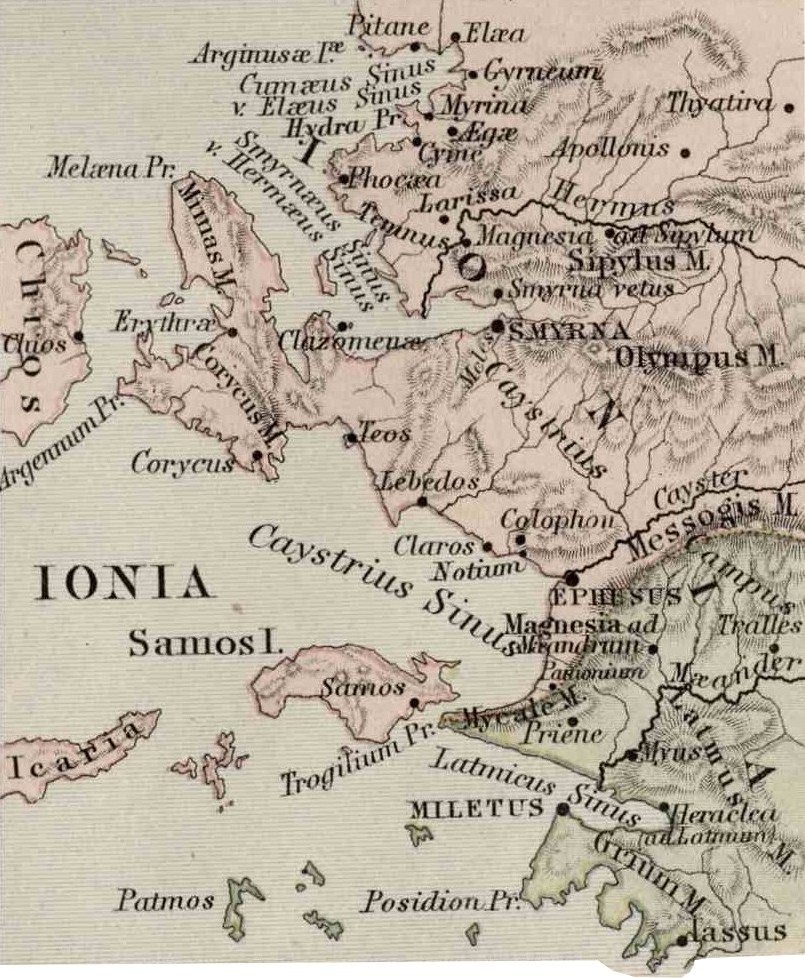
Photo: Asia_Minor_Map,_Classical_Atlas,_1886,_Keith_Johnston.jpg: Keith Johnston derivative work: · Public domain · Wikimedia Commons
Colophon is an ancient city of Ionia, in modern-day Turkey. Colophon was one of twelve ancient Ionian Greek cities. The free Lokali audio guide runs 7 minutes.
✓ Published October 2026 · how we write these guides
Visitor facts
| Lokali audio guide | 7 min · free |
|---|---|
| Type | Archaeological Site |
| Location | İzmir, Türkiye |
| Coordinates | 38.1156, 27.1422 |
| Languages | 50+, in the Lokali app |
The story
Start with the ground under your feet. It is dry earth, scattered with pale stones and broken pottery, and wild thyme and dry grass grow between them. Insects buzz in the brush. A light wind comes in from the west, from the direction of the Aegean. There are no grand columns here and no ticket gates. There is only a quiet hill above farmland. Once, this was one of the proudest cities of the ancient Greek world.
This is Colophon. It lies inland in İzmir Province, near the village of Değirmendere, between the modern city of İzmir and the coast to the south. In its day it was one of the twelve cities of Ionia. Ionia was a league of Greek communities along this shore of Asia Minor, and it produced some of the earliest Greek poetry, philosophy and science. Many towns in the league are well known today, and Ephesus is the most famous. Colophon was once equal to them.
So why is so little left? That question shapes your visit. Colophon did not end in one dramatic disaster. It faded over generations. Its people were attacked, absorbed and finally moved away. What remains is a landscape more than a ruin. The traces are faint, but they are real. Low terraces, scattered building stones and a scatter of sherds show where houses and streets once stood.
In its early centuries, the city was known above all for its wealth and for its horses. Ancient writers describe Colophon's cavalry as formidable. The geographer Strabo repeated a saying about these horsemen. Whenever they joined a battle, they decided it. Some later writers tie this saying to the English word colophon. In publishing, a colophon is the final note at the end of a book, the finishing touch. That link is a tidy story, but scholars treat it with caution. It is better to hear it as a popular tale than as settled fact.
Wealth brought comfort, and comfort brought critics. The most famous critic was a son of the city. Xenophanes of Colophon was a poet and thinker of the sixth century before Christ. He mocked his fellow citizens for walking to the assembly in purple robes and perfumed hair. Purple dye was rare and very expensive in the ancient world, so it was a clear sign of luxury. Xenophanes later left Ionia and travelled widely in the Greek west.
His ideas still feel bold today. Xenophanes noticed that people imagine their gods in their own image. He said that if horses or oxen could draw, they would draw gods that looked like horses and oxen. It was one of the earliest known challenges to inherited religion. Think about that for a moment. A man who grew up on this hillside asked a question that philosophers still debate.
Colophon also produced poets. Mimnermus was one of the early writers of elegy, a form of Greek verse often sung to the flute. He wrote about love, youth and the sadness of growing old, and fragments of his work survive. The city also claimed a far larger name. In antiquity, several cities argued that Homer was born within their walls, and Colophon was one of them. Nobody can prove where Homer came from. Still, the claim shows how highly the Colophonians thought of their own culture.
Here is a detail that surprises many visitors. You may have met the city's name in an unexpected place. Rosin, the sticky resin that violinists rub on their bows, is also called colophony. The Roman writer Pliny linked a prized resin with this region, and the name has stayed in use for centuries. The next time you hear a cello or a violin, a small trace of this hillside goes with the sound.
The city's fortunes changed with its powerful neighbours. In the seventh century before Christ, the kings of Lydia pushed toward the coast. Lydia was a rich kingdom inland, with its capital at Sardis. Colophon was among the Greek cities it attacked. Later, Persian rulers controlled the region. Through these changes, Colophon survived. Its people kept their temples, their festivals and their sense of who they were.
The decisive blow came after Alexander the Great. One of his successors, Lysimachus, wanted to build up Ephesus as a great city. In the early third century before Christ, he moved people from nearby towns to settle there, and Colophon was one of them. Ancient sources say the Colophonians resisted. Over time, life shifted toward the coast. The harbour town of Notion, down by the sea, came to be called New Colophon. This old site on the hill slowly emptied.
Colophon also held a famous sacred place. Not far from here, near the coast, stood the sanctuary of Apollo at Claros. Claros was an oracle, a place where people came to ask the god about the future. It was closely connected to Colophon, and its fame lasted into Roman times. If you have time, visit it as well. The ruins at Claros are more visible, and they help you picture the religious life of the people who lived on this hill.
Archaeologists have studied Colophon several times. American excavators worked here in the 1920s and recorded houses, streets and public buildings. More recent survey work has mapped the city's layout across the slopes. Much of the ancient city still lies under the soil and the fields. For you, this means the experience is about reading the land. Notice the terracing, the cut stones in field walls and the way the hill commands the valley.
Before you leave, stand still for a minute. Look out over the olive groves and the farmland below. Listen to the wind in the dry grass. Horsemen once rode out from this hill, and poets wrote verses here that people still read. A philosopher who grew up here first asked who made the gods. When you walk back down, look at the stones at the edge of the path. Some of them may once have been part of Colophon.
Key facts
What to look for
Practical tips
Common questions
Is there a free audio guide to Colophon?
Yes — the Lokali app narrates Colophon free of charge in 50+ languages. The guide runs about 7 minutes, covers the history, what to look for on site and practical tips, and works offline once downloaded.
Where is Colophon?
Colophon is near İzmir, Türkiye, at 38.1156, 27.1422. Tap the map link on this page for directions from where you are.
What is Colophon known for?
Colophon was one of twelve ancient Ionian Greek cities. Philosopher Xenophanes was born here in the sixth century BCE.
What should you look for at Colophon?
Faint terraces cut into the hillside slopes. Ancient cut stones reused in modern field walls. Scattered pottery sherds on the ground; leave them.
What should you know before visiting Colophon?
Wear sturdy shoes for uneven, stony hillside ground. Bring water and sun protection; shade is very limited.
When is the best time to visit Colophon?
Come in early morning or late afternoon for softer heat.
On the map
Opens directions to Colophon from your location.
More to see near Colophon


Hear Colophon in your language
The full story, narrated, in 50+ languages. Download it before you go and it plays offline, at your own pace, with no ticket and no tour group.