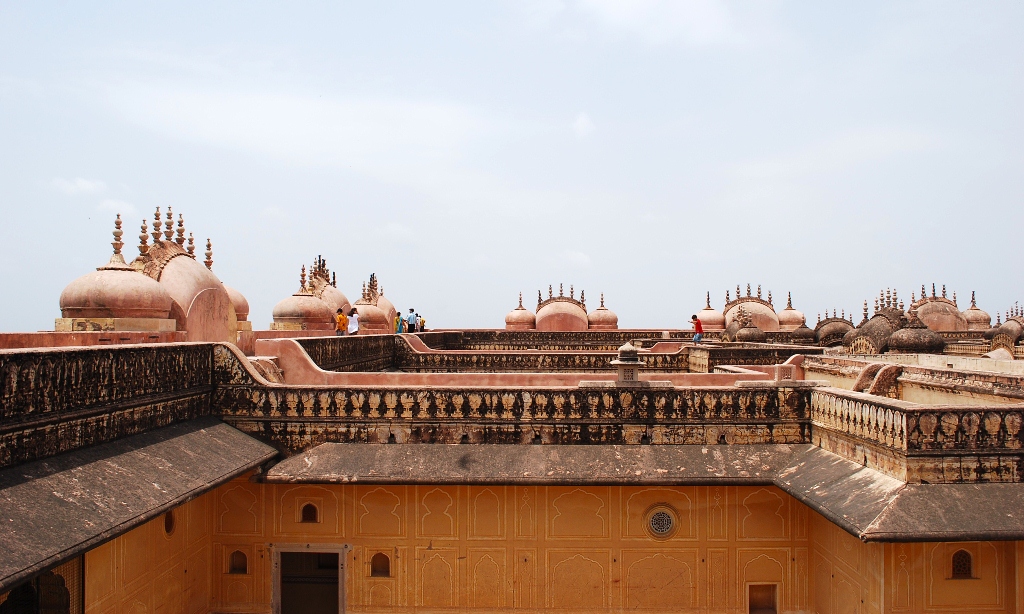
Nahargarh Fort is a fort in Jaipur, India. Perched on the Aravalli Hills above Jaipur, this 18th-century fort offers panoramic views of the city and surrounding landscape. Most visitors spend 1.5–2 hours here. The free Lokali audio guide runs 5 minutes.
✓ Verified August 2026 · how we write these guides
Visitor facts
| Time needed | 1.5–2 hours |
|---|---|
| Lokali audio guide | 5 min · free |
| Type | Fort |
| Best for | Photography |
| Location | Jaipur, India |
| Coordinates | 26.9500, 75.8500 |
| Languages | 45, in the Lokali app |
The story
The road climbs and climbs. The city falls away below you. The air grows cooler and thinner. Then the walls appear, running along the top of the ridge. Behind them, Jaipur spreads out in a wide pink sheet. This is Nahargarh Fort, the watcher on the hill.
The fort was built in 1734. The same king who founded Jaipur ordered it. His name was Sawai Jai Singh II. He set the fort high on the Aravalli hills. From up here, guards could see far in every direction. The fort kept watch over the new city below. It also served as a calm retreat for the royal family. When the heat or the crowds of the city grew heavy, the rulers came up here. The high air was cooler, and the views were wide.
At first the fort had a different name. People called it Sudarshangarh. Later it took the name Nahargarh. The word means the abode of tigers. The new name stayed, and the old one slipped away. Today everyone knows it simply as Nahargarh.
A legend explains the name. The story tells of a prince named Nahar Singh Bhomia. He was a Rathore prince who had died long before. People said his spirit lived on the hill. They said it broke down the fort walls each night, as fast as the workers built them. This is only a legend, passed down through the years.
To calm the spirit, the king acted. He built a small shrine inside the fort, in the prince's honor. After that, the story says, the walls stood firm. The work went on without trouble. Whether the tale is true or not, the shrine and the name both remain today.
Nahargarh never fell to an enemy in battle. Instead, it served the rulers in quieter ways. The fort joined hands with other forts on nearby hills. Long walls run across the ridges to connect them. Together they formed a ring of defense around the city of Jaipur. From these heights, no army could approach unseen. Yet the chain of forts was never truly tested in a great siege. Its strength alone was enough to keep the city calm.
The fort also saw real history. In the year 1857, a great revolt spread across India. During that troubled time, the fort gave shelter to a number of European families. Its strong walls and high place kept them safe. For a while, it was a refuge above the storm.
Later, a palace was added inside the fort. It is called Madhavendra Bhawan. A king built it as a summer retreat. The palace has many suites of rooms. One suite was for the king. The others were for his queens. The rooms are nearly the same, set side by side.
Walk through this palace and notice the plan. Long corridors link the suites. Each queen had her own set of rooms. The king could reach any of them through linking passages. The walls still carry old paintings and fine plasterwork. The colors have faded, but the care still shows in every room.
Step out onto the walls again. This is what people climb for. Below you lies all of Jaipur. You can pick out the old city, packed and pink. You see lakes, gardens, and far hills. The whole shape of the city becomes clear from this height. You begin to understand the plan of Jaipur. The streets run in a neat grid. The old city was laid out with care, block by block. From above, that careful order is easy to see.
The best time here is the end of the day. As the sun drops, the light turns gold, then soft red. The city below begins to glow. Lamps switch on, one by one. People gather on the walls to watch in near silence. The view rewards the long climb.
There is a calm up here that the city lacks. The wind is steady. The noise of the streets is gone. Old stone holds the heat of the day. Birds ride the air below the walls. The fort feels far above the rush of ordinary life. Time moves slowly on the hill. There is no reason to hurry here.
Nahargarh has watched over Jaipur for nearly three hundred years. It guarded the city, sheltered the frightened, and rested kings and queens. Now it offers its view to anyone who climbs the hill. Stand on the wall as the sun sets. Look down at the city the fort was built to protect.
Key facts
What to look for
Practical tips
Common questions
How long do you need at Nahargarh Fort?
Plan 1.5–2 hours. That is the time most visitors spend at Nahargarh Fort. The free Lokali audio guide adds about 5 minutes of narration you can listen to as you walk, so it fits inside your visit rather than adding to it.
Is there a free audio guide to Nahargarh Fort?
Yes — the Lokali app narrates Nahargarh Fort free of charge in 50+ languages. It covers the history, what to look for on site and practical tips, and it works offline once downloaded.
Where is Nahargarh Fort?
Nahargarh Fort is in Jaipur, India, at 26.9500, 75.8500. Tap the map link on this page for directions from where you are.
What should you know before visiting Nahargarh Fort?
Come before sunset for the best light and views.
What is Nahargarh Fort known for?
Built in 1734 by Maharaja Sawai Jai Singh II.
What is the best time to visit Nahargarh Fort?
Hike up at sunset for views of the pink city turning gold as light fades.
On the map
Opens directions to Nahargarh Fort from your location.
More to see in Jaipur


Hear Nahargarh Fort in your language
The full story, narrated, in 50+ languages. Download it before you go and it plays offline, at your own pace, with no ticket and no tour group.