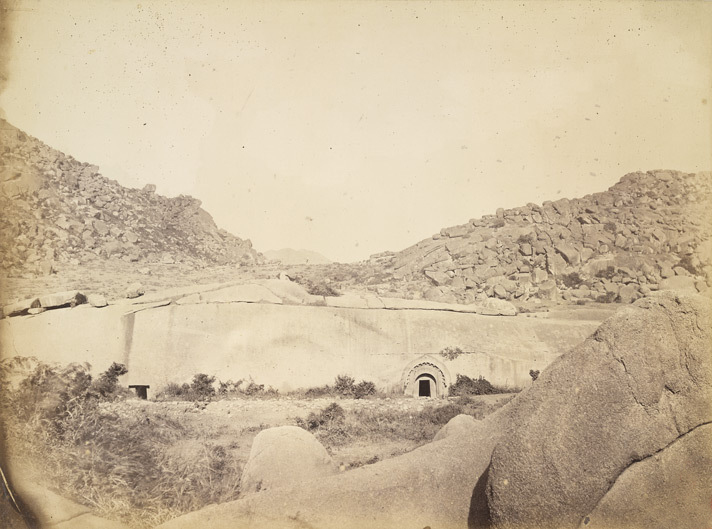
Barabar Caves
25.0050° N · 85.0630° E · Archaeological Site
Photo: Thomas Fraser Peppé · Public domain · Wikimedia Commons
Barabar Caves are rock-cut caves in Bihar, India. Oldest surviving rock-cut caves in India, third century BCE. The free Lokali audio guide runs 7 minutes.
✓ Published October 2026 · how we write these guides
Visitor facts
| Lokali audio guide | 7 min · free |
|---|---|
| Type | Archaeological Site |
| Location | Jehanabad district, India |
| Coordinates | 25.0050, 85.0630 |
| Languages | 50+, in the Lokali app |
The story
Lay your palm flat against the wall. The granite is cool, and it is smooth. It is so smooth that it shines like glass in the light from the doorway. Now say something softly, even a single word. The sound comes back to you, and it keeps coming back, humming around the chamber long after you have stopped. This is the first thing most people notice here. It is the sound of a room cut from solid rock more than two thousand years ago.
You are standing in the Barabar Caves, in the Jehanabad district of Bihar, in eastern India. The surrounding hills rise out of the flat farmland as rough, rounded humps of granite. From a distance they look like nothing special, just boulders and scrub. But inside them are the oldest surviving rock-cut chambers in India. They date to the Mauryan period, the third century BCE. That is the era of the emperor Ashoka, one of the most important rulers in Indian history.
Think about what that means for a moment. Before these caves, Indian builders worked mostly in wood, bamboo and thatch. Very little of that work survives. Here, for the first time on this scale, craftsmen decided to carve a building directly into living rock. Granite is one of the hardest stones there is. They had no power tools. They had iron chisels, abrasive sand, water and patience... a great deal of patience.
The group in these hills has four main caves. Their names are Lomas Rishi, Sudama, Karan Chaupar and Visva Zopri. A short distance away, in the Nagarjuni hills, there are three more caves from the same period. Together they form a small family of chambers. Each one has its own plan. Some are simple rectangular halls. Others add a round inner room with a domed ceiling, shaped from a single mass of stone.
Now look again at that shine on the walls. Historians call it the Mauryan polish. It appears on stone pillars and sculpture from Ashoka's time, and it is one of the signatures of the period. Nobody fully agrees on the exact method. Most likely it took long hours of grinding and rubbing with finer and finer abrasives. The result has lasted through more than twenty centuries of monsoons and heat. In places, you can almost see your reflection.
That polish also explains the echo. Hard, smooth surfaces bounce sound with very little loss. Inside the domed chambers, a low hum can seem to fill the whole space and hang there. Some scholars suggest the effect was intended, because chanting and meditation were central to the people who used these rooms. Others think it was a side effect of the polish. Either way, you are hearing roughly what the first occupants heard.
And who were those occupants? Here is the first surprise. They were not Buddhist monks, as many visitors assume. Inscriptions in some of the caves record that they were given to the Ajivikas. The Ajivikas were an ascetic sect, active in the same era as the Buddha and Mahavira, the great teacher of Jainism. They believed that fate governs everything, and that human effort cannot change it. The sect later disappeared, and almost none of its own writings survive.
Those inscriptions are carved in Brahmi, one of the earliest scripts of India. The Sudama Cave carries a dedication from Ashoka himself, made in the twelfth year of his reign. Karan Chaupar has another Ashokan dedication from a few years later. In the Nagarjuni caves nearby, similar gifts are recorded in the name of Dasharatha, Ashoka's grandson. So these walls carry a direct record of royal patronage, in the words of the donors.
Now walk to the Lomas Rishi Cave and stand before its entrance. This doorway is the most famous feature of the whole site. The stone is carved to look like a wooden building, with curved beams and a pointed arch above the door. Inside the arch, a frieze of elephants moves in a line toward a central point. It is a stone copy of timber architecture. That design became a model for many later rock-cut halls across India.
Here is the second surprise. Lomas Rishi appears to be unfinished. Look closely inside, and parts of the interior are rough rather than polished. Many scholars believe that a fault or a collapse in the rock stopped the work. The finest facade at the site may lead into an incomplete room. Later, around the sixth century, new inscriptions were added in some of these caves, as different religious groups used the old chambers.
These caves also have a life in English literature. The novelist E. M. Forster visited this region, and he used the caves as the model for the Marabar Caves in his novel A Passage to India. In the book, the echo becomes a turning point in the story. Forster describes it as a sound that reduces every word to the same dull boom. Stand inside, make a sound, and you can judge his description for yourself.
Before you leave, look outward as well as inward. The hills around you are bare and rocky, with goats and scrub and wide views over the fields. On the summit there is a Hindu temple dedicated to Shiva, and pilgrims climb to it, especially during festival seasons. So this landscape is not only an archaeological site. It is still a living place of worship, as it has been, in different forms, for a very long time.
As you step back out into the daylight, notice the change in sound. Outside, your voice simply disappears into the open air. Behind you, the dark doorways sit quietly in the granite. Their appearance has barely changed in more than two thousand years. Somewhere in that stone are the chisel marks of people whose names we will never know. Take one last look at the shine on the walls... and listen to the quiet.
Key facts
What to look for
Practical tips
Common questions
Is there a free audio guide to Barabar Caves?
Yes — the Lokali app narrates Barabar Caves free of charge in 50+ languages. The guide runs about 7 minutes, covers the history, what to look for on site and practical tips, and works offline once downloaded.
Where is Barabar Caves?
Barabar Caves is near Jehanabad district, India, at 25.0050, 85.0630. Tap the map link on this page for directions from where you are.
What is Barabar Caves known for?
Oldest surviving rock-cut caves in India, third century BCE. Several caves were donated to the Ajivika ascetic sect.
What should you look for at Barabar Caves?
Mirror-like Mauryan polish on the interior granite walls. Elephant frieze inside the Lomas Rishi doorway arch. Stone arch carved to imitate curved wooden beams.
What should you know before visiting Barabar Caves?
Hum softly inside a domed chamber to hear the echo. Wear sturdy shoes for the rocky granite paths.
On the map
Opens directions to Barabar Caves from your location.
More to see near Barabar Caves

Hear Barabar Caves in your language
The full story, narrated, in 50+ languages. Download it before you go and it plays offline, at your own pace, with no ticket and no tour group.