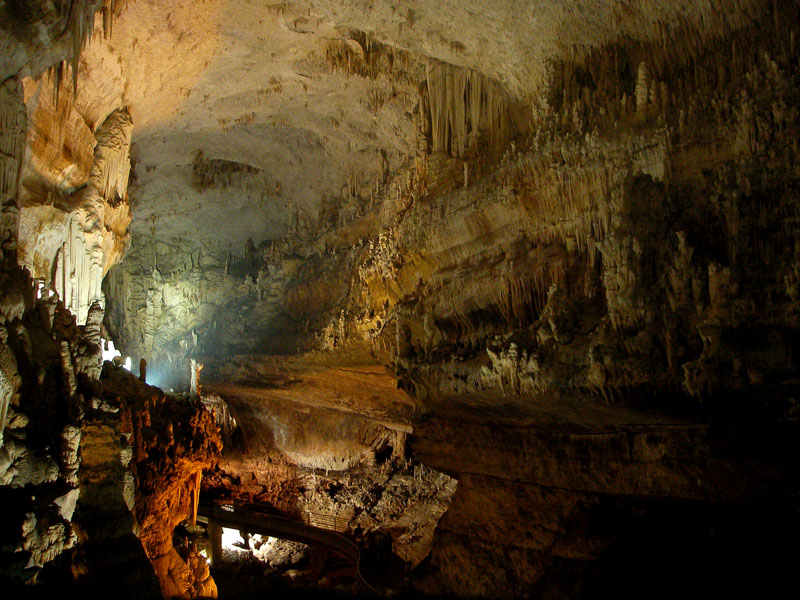
Photo: kcakduman · CC BY 2.0 · Wikimedia Commons
Jeita Grotto is a system of two separate, but interconnected, karstic limestone caves 18 km north of Beirut. Two cave levels: a dry upper gallery and flooded lower cave. The free Lokali audio guide runs 7 minutes.
✓ Published October 2026 · how we write these guides
Visitor facts
| Lokali audio guide | 7 min · free |
|---|---|
| Type | Cave |
| Location | Jounieh, Lebanon |
| Coordinates | 33.9439, 35.6406 |
| Languages | 50+, in the Lokali app |
The story
The air changes first. A few steps inside the mountain, the warmth of the Lebanese afternoon falls away. A cool, damp stillness takes its place, and it carries the faint mineral smell of wet stone. Somewhere ahead, water drips. Each drop lands with a small, clear note, then another, then another. Your eyes need a moment to adjust. When they do, the rock around you seems to grow, fold, and hang in shapes that took far longer to form than any human story.
You are standing in Jeita Grotto, a system of limestone caves in the valley of the Nahr al-Kalb, the Dog River. It sits in the hills a short drive inland from the coast, between Beirut and Jounieh. The grotto has two levels. There is an upper gallery, which you explore on foot, and a lower cave, which is flooded by an underground river. The two are connected inside the mountain, but they feel like two different worlds.
To understand what you are seeing, it helps to picture the rock itself. Limestone is made from the remains of ancient marine life, pressed together over millions of years. Rainwater picks up a little carbon dioxide as it falls and soaks through the soil. That makes the water slightly acidic. Slowly, patiently, it dissolves the limestone and carves out channels. Over immense spans of time, those channels became the halls and passages around you.
Then the process reversed. As water drips from the ceiling, it leaves behind a tiny ring of mineral. Ring by ring, a hollow straw forms, and the straw thickens into a stalactite. The drop that falls to the floor builds a stalagmite rising to meet it. Some pairs finally touch and become columns. The growth is so slow that a lifetime adds almost nothing you could measure by eye. Everything here is the result of patience on a scale that is hard to imagine.
The modern story of the grotto begins in the nineteenth century. In 1836, an American missionary named William Thomson ventured some distance into the lower cave. According to the account that is usually told, he fired a shot into the darkness. The echo rolled back from deep within the mountain, and he understood that the cave went much further than he could see. He could not go on, but word of the cave had begun to spread.
Over the following decades, explorers pushed further along the underground river. Some of them were engineers working on Beirut's water supply. This is the first detail most visitors miss. The river that flows through the lower cave feeds the Dog River, and that water has long been an important source of drinking water for the capital. The cave is not only a natural wonder. It is also part of the working plumbing of a city.
The upper gallery came much later. Lebanese cavers discovered these dry halls in the 1950s, high above the river. Reaching them was not simple, so a tunnel was cut into the hillside to let visitors walk in. The upper gallery opened to the public at the end of the 1960s. Its opening was marked in an unusual way — with a concert of electronic music performed inside the cave, using the halls themselves as a vast, echoing chamber.
Walk slowly along the path here. The formations take on colours you might not expect. Pure calcite is white, but traces of iron and other minerals tint the stone cream, honey, rust and soft orange. Some surfaces look like frozen curtains. Others look like melted wax, or like organ pipes. In places, thin sheets of rock hang in folds, and lighting from behind shows how translucent they are. Notice how the sound of your footsteps softens and returns.
This gallery holds one of the longest stalactites known anywhere in the world. Look for a single, slender form hanging far down from the ceiling, much longer than its neighbours. It is worth stopping to take in the scale. Every centimetre of it was built drop by drop. Many visitors walk past it while looking at the wider hall. If you find it, you have seen the second thing most people miss.
Now to the lower cave, which you visit by small boat. The water is dark and very still, and in places it is remarkably clear. The boats move quietly, and the guides keep their voices low. The ceiling rises and falls above you. Reflections double every formation, so the cave seems to open both upward and downward at once. It is cooler here than in the upper gallery, and the air feels heavier with moisture.
Because the lower cave carries a living river, it responds to the seasons. After heavy winter rain and snowmelt in the mountains, the water can rise high and run fast. At those times the boat route is often closed for safety. So if you visit in the colder months, the upper gallery may be your whole experience. It is still a full and rewarding visit, but it is worth checking the boat situation before you arrive.
The grotto has also lived through Lebanon's difficult years. During the long civil war of the late twentieth century, the site was closed for a long period. It reopened after the fighting ended, and it has since become a source of real national pride. In 2011 it was named among the finalists in a global public vote to choose new natural wonders of the world. Many Lebanese families have their own memories of school trips here.
One rule surprises many visitors. Photography is not allowed inside the caves, and you will be asked to leave cameras and phones in lockers. This can feel strange at first. But it changes how you experience the place. Without a screen in your hand, you look longer. You notice the drip, the colour, the cool air on your arms. The memory you carry out is your own, not a photograph.
As you come back out into the daylight, pause for a moment. Feel the warmth return to your skin, and listen to the valley — the birds, the traffic far below, perhaps the sound of the river. Somewhere behind you, inside the mountain, a single drop is falling onto stone. It will fall again in a few seconds, and again after that. Long after you have left, the grotto will keep growing, very slowly, in the dark.
Key facts
What to look for
Practical tips
Common questions
Is there a free audio guide to Jeita Grotto?
Yes — the Lokali app narrates Jeita Grotto free of charge in 50+ languages. The guide runs about 7 minutes, covers the history, what to look for on site and practical tips, and works offline once downloaded.
Where is Jeita Grotto?
Jeita Grotto is near Jounieh, Lebanon, at 33.9439, 35.6406. Tap the map link on this page for directions from where you are.
What is Jeita Grotto known for?
Two cave levels: a dry upper gallery and flooded lower cave. Missionary William Thomson entered the lower cave in 1836.
What should you look for at Jeita Grotto?
One exceptionally long, slender stalactite in the upper gallery. Thin rock curtains glowing where light shines through them. Rust and honey tints from iron in the calcite.
What should you know before visiting Jeita Grotto?
Bring a light layer because the caves feel noticeably cooler. Expect to store your phone and camera in a locker.
When is the best time to visit Jeita Grotto?
Check whether the boat ride runs after heavy winter rain.
On the map
Opens directions to Jeita Grotto from your location.
More to see near Jeita Grotto


Hear Jeita Grotto in your language
The full story, narrated, in 50+ languages. Download it before you go and it plays offline, at your own pace, with no ticket and no tour group.