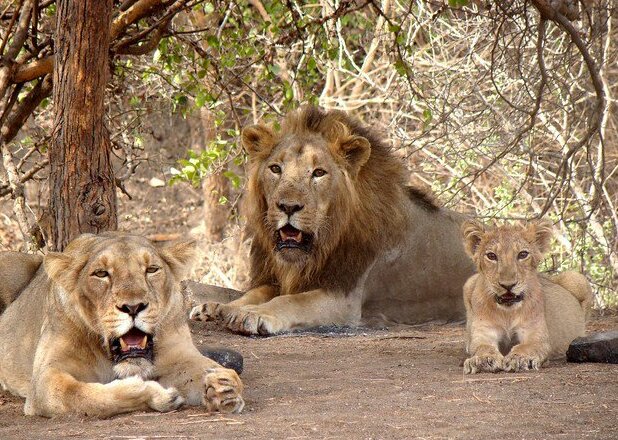
Photo: Mayankvagadiya · CC BY-SA 3.0 · Wikimedia Commons
Gir National Park is the forest, national park, and wildlife sanctuary in Gujarat, India. Gir is the last wild home of the Asiatic lion. The free Lokali audio guide runs 6 minutes.
✓ Published October 2026 · how we write these guides
Visitor facts
| Lokali audio guide | 6 min · free |
|---|---|
| Type | National Park |
| Location | Junagadh district, India |
| Coordinates | 21.1356, 70.7967 |
| Official website | girnationalpark.info |
| Languages | 50+, in the Lokali app |
The story
Listen first. A dry rustle of teak leaves underfoot, the sharp alarm call of a spotted deer, then a long stillness. The air smells of dust and warm bark. Somewhere in this scrubby forest, a lion may be resting in the shade, watching the track. You are in Gir, in the Saurashtra peninsula of Gujarat, in western India.
This forest holds something no other place on Earth can claim. It is the last wild home of the Asiatic lion. Lions once ranged from the Middle East across Persia and much of northern India. Over the centuries, hunting and the loss of open land pushed them back. By the start of the twentieth century, Gir was the final refuge. Every wild Asiatic lion alive today descends from the small group that survived here.
The story of that survival is a little surprising. Much of the early protection came from the Nawabs of Junagadh, the Muslim rulers of this princely state before Indian independence. At a time when lion numbers had fallen to a very small population, the Nawab's administration restricted hunting in these forests. Estimates from that period vary, and some early counts were rough. But historians agree that the population came perilously close to vanishing.
After independence, the state took up the task. Gir was declared a wildlife sanctuary in 1965, and a central core was later given national park status. The protected area today covers more than 1,400 square kilometres across Junagadh and neighbouring districts. The recovery has been remarkable. The most recent official count, in 2025, put the number of lions at close to nine hundred. So many lions now live here that some have spread far beyond the forest edge, onto farmland and even toward the coast.
Look at the landscape around you. This is not the dense green jungle many visitors expect. Gir is a dry deciduous forest. Teak trees dominate, along with acacia, jamun and flame of the forest. In the hot months, many trees drop their leaves, and the ground turns pale gold and brown. Low rocky hills rise and fall. Seasonal rivers, including the Hiran, cut through the land and leave pools that become precious as the dry season deepens.
If you see a lion, take a moment to study it. The Asiatic lion is a little smaller than its African cousin. The male's mane is usually shorter and sparser, so his ears often stay visible. Look along the belly, too. Many Asiatic lions have a long fold of skin running underneath — one of the features scientists use to tell the two apart. Here, male lions often move in small groups, while females and cubs keep to their own prides.
The lions are only part of the story. Gir also holds a large population of leopards, which are often harder to spot because they prefer cover and move at dusk. Spotted deer, called chital, graze in open patches. You may also see sambar, the large dark deer, and nilgai, the blue bull, which is actually India's largest antelope. Watch for the small four-horned antelope too. It is shy and rarely seen elsewhere.
Now for a detail many visitors miss. People live inside this forest. The Maldharis are traditional cattle herders, and their families have grazed buffalo here for generations. They live in small settlements called nesses, often simple homes with thorny fences around the cattle enclosures. Lions sometimes take their livestock. Yet the relationship is more complex than conflict alone. Many Maldharis speak of the lions with respect, and their long presence is part of why this shared landscape works.
There is a second human story here, and it surprises almost everyone. Near the forest live the Siddi people, a community of African descent. Their ancestors came to western India centuries ago, through trade across the Indian Ocean. Today they are Gujarati speakers, but they keep their own music and a lively dance tradition, called dhamal, with drums and shell ornaments. If you have the chance to see a performance nearby, it is worth your time.
Water shapes life in Gir. Kamleshwar Dam, inside the protected area, created a large reservoir. It is a good place to look for mugger crocodiles, a broad-snouted freshwater species, basking on the banks. Herons, storks and kingfishers work the shallows. Gir is also rich in birdlife beyond the water. Peacocks cross the tracks, and in quiet moments you may hear the crested serpent eagle calling high above the canopy.
Most visitors enter through Sasan Gir, the small village that serves as the main gateway. Safaris run in open vehicles along fixed routes, with a forest guide on board. The number of permits each day is limited, and it is wise to book well ahead. The forest closes to safaris during the monsoon months, when rains turn the tracks to mud and the animals breed. If you miss a permit, the nearby Devalia safari area offers a fenced zone where sightings are more likely.
On safari, patience matters more than luck. Guides read the forest constantly. They listen for alarm calls from deer and langur monkeys, and they look for fresh pugmarks, the paw prints, in the soft dust of the track. Keep your voice low and stay seated. The lions here are used to vehicles, but they are wild animals, and the rules exist to protect both of you.
Before you leave, pause and listen again. Notice the dry leaves, the shifting light through the teak, the distant bell of a herder's buffalo. Somewhere nearby, a lion may still be lying in the shade, unbothered by your passing. Every animal in this forest carries the legacy of a population that almost disappeared. As your vehicle rolls back toward the gate, look at the dust on the track. Sometimes the freshest pawprint is the closest you will come.
Key facts
What to look for
Practical tips
Common questions
Is there a free audio guide to Gir National Park?
Yes — the Lokali app narrates Gir National Park free of charge in 50+ languages. The guide runs about 6 minutes, covers the history, what to look for on site and practical tips, and works offline once downloaded.
Where is Gir National Park?
Gir National Park is near Junagadh district, India, at 21.1356, 70.7967. Tap the map link on this page for directions from where you are.
What is Gir National Park known for?
Gir is the last wild home of the Asiatic lion. Declared a wildlife sanctuary in 1965.
What should you look for at Gir National Park?
The fold of skin along an Asiatic lion's belly. Shorter, sparser manes that leave the male's ears visible. Fresh pugmarks pressed into the soft dust of the track.
What should you know before visiting Gir National Park?
Book safari permits well in advance through the official forest portal. Choose an early morning safari for cooler air and active animals.
When is the best time to visit Gir National Park?
Choose an early morning safari for cooler air and active animals.
On the map
Opens directions to Gir National Park from your location.
Hear Gir National Park in your language
The full story, narrated, in 50+ languages. Download it before you go and it plays offline, at your own pace, with no ticket and no tour group.