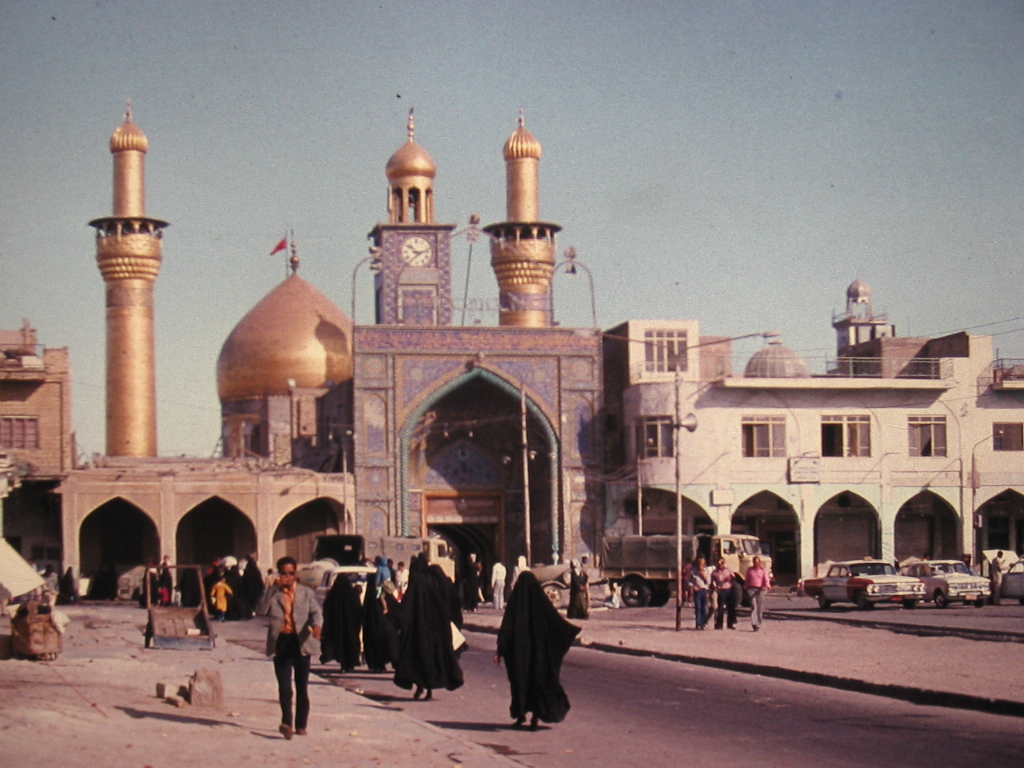
Photo: User:HerbertReichart germany · Public domain · Wikimedia Commons
Imam Husayn Shrine is a burial site of Husayn ibn Ali, the third Imam of Islam, in the city of Karbala, Iraq. Husayn was the Prophet Muhammad's grandson. The free Lokali audio guide runs 6 minutes.
✓ Published October 2026 · how we write these guides
Visitor facts
| Lokali audio guide | 6 min · free |
|---|---|
| Type | Mosque |
| Location | Karbala, Iraq |
| Coordinates | 32.6164, 44.0325 |
| Languages | 50+, in the Lokali app |
The story
Listen for a moment before you look up. You will hear bare feet on cool marble, a low murmur of prayer in many languages, and somewhere the clink of a metal cup as water is poured for a stranger. Then lift your eyes. A golden dome rises above the courtyard. Two golden minarets stand on either side of it, and in strong sun they are almost too bright to watch.
This is the Shrine of Imam Husayn, in the heart of Karbala, in central Iraq. For millions of Shia Muslims, it is one of the holiest places on earth. Many Sunni Muslims honour this ground too. People come here to grieve, to give thanks, and to feel close to a man who died nearby more than thirteen centuries ago. Whatever your own beliefs, you are standing at the centre of a story still told with real emotion.
Husayn ibn Ali was the grandson of the Prophet Muhammad. His mother was Fatima, the Prophet's daughter. His father was Ali, the Prophet's cousin and son-in-law. In the year 680, Husayn refused to give his allegiance to the Umayyad ruler Yazid. Yazid's dynasty governed the Muslim world from Damascus. Husayn's choice put him on a collision course with the state, and it brought him here, to the plain of Karbala.
He arrived with a small group of family members and companions. A much larger army surrounded them. According to the traditional accounts, the camp was cut off from the waters of the Euphrates for several days in the desert heat. On the tenth day of the month of Muharram, Husayn and most of the men with him were killed. That day is known as Ashura. Believers mark it every year with mourning, recitation, and processions through these streets.
Now notice the water stations and the people offering drinks. This is not ordinary hospitality. Giving water to visitors here remembers the thirst of Husayn's camp. Volunteers often hand out water, tea, or food freely. Accepting with a word of thanks is the gracious response. It is one of the quiet surprises of Karbala. The city's deepest memory is of suffering, yet its daily habit is generosity.
Turn toward the other golden dome, a short walk away. That is the Shrine of Abbas ibn Ali, Husayn's half-brother. Tradition remembers him as the standard-bearer of the camp. He is said to have died while trying to bring water from the river. The open space between the two shrines is called Bayn al-Haramayn, which means 'between the two sanctuaries'. Pilgrims often walk this stretch slowly, greeting one brother and then the other.
The building around you is not the original structure. A tomb has marked this place since early Islamic centuries. It has been built, destroyed, and rebuilt many times. In the ninth century, the Abbasid caliph al-Mutawakkil ordered the shrine torn down and tried to stop people from visiting. In 1802, raiders from Arabia sacked Karbala and damaged the sanctuary. The shrine was hit again during the uprising of 1991. Each time, it was restored.
This means what you see is many layers of devotion. Rulers and patrons from Persia, from Ottoman lands, from South Asia, and from Iraq itself added domes, tiles, and gold over the centuries. Much of the decoration follows Persian tradition. Look for glazed tiles in deep blue and turquoise, covered with flowers and calligraphy. Large-scale restoration and expansion continue today. You may see scaffolding, new courtyards, or fresh marble beside older surfaces.
If you step inside the prayer halls, the light changes completely. Many ceilings and walls are covered in mirror mosaic. Thousands of small pieces of glass are set into patterns, so every lamp breaks into countless points of light. At the centre is the tomb itself, enclosed by a large screen of silver and gold called a zarih. Pilgrims press their hands against it, touch it with cloth, or simply stand and weep. Tradition holds that some of Husayn's family and companions are buried close to him.
Watch the hands of the people praying. Many place their forehead on a small tablet of pressed clay before they bow. These tablets are often made from the soil of Karbala. Pilgrims carry them home all over the world. For them, a little of this earth travels into prayer rooms in Beirut, Mumbai, London, and Detroit. It is a small detail, but it shows how far this place reaches beyond Iraq.
Once a year, Karbala swells far beyond its normal size. Forty days after Ashura comes Arbaeen, which means 'forty' in Arabic. Millions of pilgrims arrive. Many walk the long road from the city of Najaf, where Husayn's father Ali is buried. Families along the route set up tents and offer food, rest, and a place to sleep. Arbaeen is often described as one of the largest peaceful gatherings anywhere in the world.
A few practical notes will help your visit go smoothly. Expect security checks at the entrances. Shoes are left at shoe stations before you enter the sacred areas. Women are expected to cover their hair and body, and a cloak is often available at the women's entrance. Men and women usually enter through separate gates. Ask before you photograph worshippers, and keep your voice low inside the halls.
Before you leave, find a quiet place on the marble and simply sit. Watch an old man run his fingers along a line of calligraphy. Watch a child carry a tray of tea through the crowd. Look again at the gold on the dome as the light shifts. As you walk out toward the street, you may notice how the murmur of prayer follows you a little way... and then slowly blends into the ordinary sounds of the city.
Key facts
What to look for
Practical tips
Common questions
Is there a free audio guide to Imam Husayn Shrine?
Yes — the Lokali app narrates Imam Husayn Shrine free of charge in 50+ languages. The guide runs about 6 minutes, covers the history, what to look for on site and practical tips, and works offline once downloaded.
Where is Imam Husayn Shrine?
Imam Husayn Shrine is in Karbala, Iraq, at 32.6164, 44.0325. Tap the map link on this page for directions from where you are.
What is Imam Husayn Shrine known for?
Husayn was the Prophet Muhammad's grandson. Husayn was killed near here in the year 680.
What should you look for at Imam Husayn Shrine?
Mirror mosaic ceilings scattering lamplight in the prayer halls. The silver and gold zarih screen around the tomb. Blue and turquoise tiles with flowing Arabic calligraphy.
What should you know before visiting Imam Husayn Shrine?
Leave your shoes at a shoe station before entering. Women should bring or borrow a full-length cloak.
When is the best time to visit Imam Husayn Shrine?
Visit outside Ashura and Arbaeen for smaller crowds.
On the map
Opens directions to Imam Husayn Shrine from your location.
Hear Imam Husayn Shrine in your language
The full story, narrated, in 50+ languages. Download it before you go and it plays offline, at your own pace, with no ticket and no tour group.