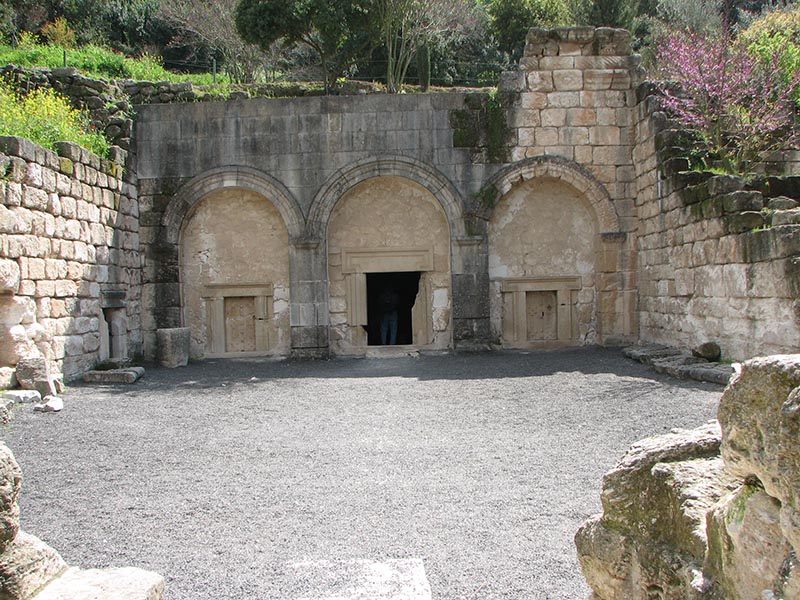
Beit She'arim Necropolis
32.7042° N · 35.1281° E · Archaeological Site
Photo: Wikimedia Commons contributor · CC BY-SA 3.0 · Wikimedia Commons
Beit She'arim Necropolis is an archaeological site and national park in Israel. Jewish necropolis used mainly in the Roman period. The free Lokali audio guide runs 6 minutes.
✓ Published October 2026 · how we write these guides
Visitor facts
| Lokali audio guide | 6 min · free |
|---|---|
| Type | Archaeological Site |
| Location | Kiryat Ata, Israel |
| Coordinates | 32.7042, 35.1281 |
| Languages | 50+, in the Lokali app |
The story
Cool air meets you at the mouth of the first cave. Outside, the sun warms pale limestone and the scent of pine and dry grass. Inside, the light drops away. The temperature falls, and the sound of your footsteps comes back to you from carved stone walls. This is Beit She'arim, a city of the dead cut into a low green hillside on the edge of the Lower Galilee, a short drive from Kiryat Ata.
Before we go deeper, picture this ridge about eighteen centuries ago. On the hilltop stood a Jewish town. In the slopes below, families and craftsmen dug chamber after chamber into the soft rock. Over time the hillside became one of the largest Jewish burial grounds of the ancient world. People were carried here from across the region, and from far beyond it. Today the site is a national park, and in 2015 it was added to the UNESCO World Heritage List.
Why here? The answer begins with one man. Rabbi Judah ha-Nasi, often called Judah the Prince, was the leading Jewish sage of his time. He is remembered as the editor of the Mishnah, the first great written collection of Jewish oral law. Tradition holds that the Sanhedrin, the central Jewish council, sat in this town for a period while he led it. When he died, tradition says, he was buried here.
That burial changed the hillside. If the great teacher rested at Beit She'arim, many Jews wanted to rest near him. Over the following generations, the catacombs spread across the slopes. Wealthy families commissioned grand halls. Others bought a single niche in a shared chamber. The necropolis turned into a kind of address — a place where your name would sit close to a famous name for eternity.
Now look at the doorways as you walk. Many entrances are carved from solid stone to look like wooden doors. You can see panels, studs that copy nail heads, and even imitation knockers and handles. They do not open on hinges in the normal way. They are heavy stone slabs, made to seal the dead inside. Run your eyes along the edges and you may see the grooves where they once turned.
Inside the main catacombs, the real surprise is the sarcophagi. In the largest cave, often called the Cave of the Sarcophagi, well over a hundred stone coffins fill the passages and side rooms. Some are plain. Others carry lions, eagles, bulls' heads, wreaths, and shells. Some show the menorah, the seven-branched lamp of the Temple. A few even carry scenes from Greek mythology — a reminder of how deeply Roman and Greek culture touched daily life here.
That mix of images puzzles many visitors. We often imagine ancient Jewish communities as closed off from the world around them. Beit She'arim shows something more complicated. The people buried here lived inside the Roman Empire. They spoke its languages and used its artistic styles. At the same time, they kept their own faith and symbols. A lion from the pagan workshop and a menorah from the Temple sit on the same hillside.
The walls carry that story too. Archaeologists have recorded hundreds of inscriptions here, most of them in Greek, with others in Hebrew and Aramaic, and a few in Palmyrene, the language of the desert city of Palmyra in Syria. Some name the dead and their home towns along the coast of Lebanon and beyond. Others are short wishes for peace. A few warn that anyone who disturbs the grave will face punishment. Even in death, people worried about thieves.
Here is a detail most visitors miss. Look for the small scratched drawings between the formal carvings. Over the years, people in the caves left rough images on the walls — menorahs, figures, and even what looks like a ship. These are not the work of master stone carvers. They are quick, human marks. They feel closer to graffiti than to art, and that is exactly what makes them moving.
The modern rediscovery has its own story. In the 1930s, a watchman named Alexander Zaid was guarding land in this area. He noticed openings in the hillside and found his way into the caves. Excavations followed, first under Benjamin Mazar and later, in the 1950s, under Nahman Avigad. On the hill above the park, a statue of Zaid on horseback looks out over the valley he once patrolled.
Another surprise lies near the caves. During the excavations, archaeologists found a huge slab of raw glass, weighing several tonnes. It appears to be the result of an ancient attempt to melt glass in one massive batch. Something went wrong, and the slab was left behind. Today it reminds us that this town was not only a place of burial. It was also a place of work, trade, and industry.
As you move between the caves, notice the landscape itself. The hillside is covered with oak and pine. The Jezreel Valley spreads out to the south, flat and patterned with fields. Birds call from the trees, and the paths are quiet away from the cave mouths. The ancient people who chose this place could see the same broad valley, the same soft line of hills, under the same strong light.
When you step out of the last cave, pause for a moment at the entrance. Feel the warm air return to your skin. Behind you, the darkness holds names, symbols, and prayers carved by people who hoped to be remembered. Ahead of you, the green slope and the open valley carry on as they always have. Take one last look at the stone doors as you walk away... they were built to stay closed, and they have kept their silence for a very long time.
Key facts
What to look for
Practical tips
Common questions
Is there a free audio guide to Beit She'arim Necropolis?
Yes — the Lokali app narrates Beit She'arim Necropolis free of charge in 50+ languages. The guide runs about 6 minutes, covers the history, what to look for on site and practical tips, and works offline once downloaded.
Where is Beit She'arim Necropolis?
Beit She'arim Necropolis is near Kiryat Ata, Israel, at 32.7042, 35.1281. Tap the map link on this page for directions from where you are.
What is Beit She'arim Necropolis known for?
Jewish necropolis used mainly in the Roman period. Tradition places Rabbi Judah the Prince's burial here.
What should you look for at Beit She'arim Necropolis?
Stone doors carved to imitate studded wooden doors. Lions and eagles carved on the stone sarcophagi. Menorah symbols etched into cave walls.
What should you know before visiting Beit She'arim Necropolis?
Bring a light layer for the cool air inside caves. Wear shoes with grip for uneven stone floors.
When is the best time to visit Beit She'arim Necropolis?
Visit the Cave of the Sarcophagi first, before crowds.
On the map
Opens directions to Beit She'arim Necropolis from your location.
More to see near Beit She'arim Necropolis


Hear Beit She'arim Necropolis in your language
The full story, narrated, in 50+ languages. Download it before you go and it plays offline, at your own pace, with no ticket and no tour group.