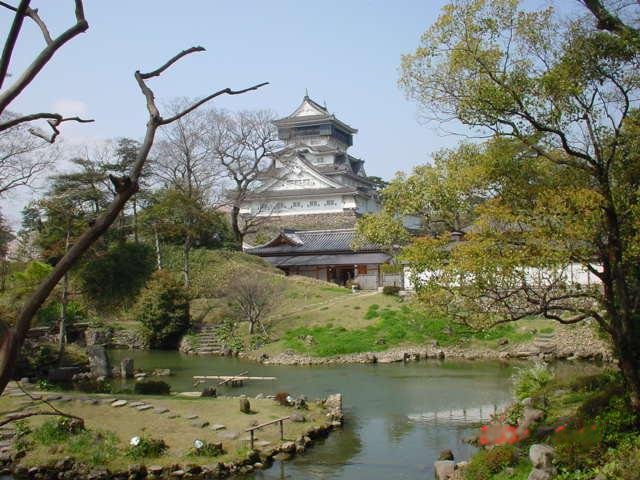
Photo: No machine-readable author provided. Historian~commonswiki assumed (based on copyright cla · CC BY 2.5 · Wikimedia Commons
Kokura Castle is a Japanese castle in Kokura, Kitakyushu City, Japan. Hosokawa Tadaoki began building the castle in 1602. The free Lokali audio guide runs 7 minutes.
✓ Published October 2026 · how we write these guides
Visitor facts
| Lokali audio guide | 7 min · free |
|---|---|
| Type | Castle |
| Location | Kitakyūshū, Japan |
| Coordinates | 33.8844, 130.8743 |
| Official website | kokura-castle.jp |
| Languages | 50+, in the Lokali app |
The story
Listen first. Gravel crunches under your shoes, and somewhere beyond the walls a train hums across the city. Then you notice the stone. The castle walls rise in rough, uneven blocks, grey and brown, with dark gaps between them. Moss grows in the shadowed joints. Above them, a white keep stands against the sky, its dark roofs layered one over another. This is Kokura Castle, in the heart of Kitakyūshū, at the northern tip of the island of Kyūshū.
Before we climb anything, put your hand near those walls. The builders used a method called nozura-zumi, which means stacking stones in close to their natural shape. They did not cut them into neat blocks. Larger stones lock against smaller ones, and the weight of the whole wall holds it together. It looks almost careless at first. It is not. Walls built this way have survived centuries of rain, storms and earthquakes, and they are some of the oldest things you will touch today.
The story of this site begins at the start of the seventeenth century. Japan had just come out of a long era of civil war. A warlord named Hosokawa Tadaoki received this territory and began building a new castle here in 1602. He chose the spot with care. Kokura sits where Kyūshū almost touches Honshū, the main island of Japan. Whoever held this ground watched the narrow strait between the two islands, and every road and ship that passed through it.
Tadaoki was a cultured man as well as a soldier. He studied the tea ceremony, the formal ritual of preparing and serving tea, under the famous master Sen no Rikyū. His wife, Hosokawa Gracia, is remembered as one of the best-known Christian converts of her time in Japan. She died before the castle was built. But her name still travels with the Hosokawa family, and you may find her story told in local exhibitions.
In 1632, the Hosokawa clan moved south to a larger domain. The Ogasawara family arrived in their place. They held Kokura for more than two centuries, through the long and mostly peaceful Edo period, when the shoguns ruled Japan from the city now called Tokyo. During these years the castle became less a fortress and more a centre of government. Samurai families lived in the streets around it. Merchants grew rich on the traffic between the islands.
Now look up at the keep. Something about its shape may seem strange. Most Japanese castle towers grow narrower as they rise, like a stack of shrinking boxes. Here, the top floor is wider than the floor beneath it. It sticks out over the lower level, and there is no roof between them. This style is called karazukuri, often translated as Chinese style. It is rare in Japan, and it is the detail most visitors walk past without noticing.
Here is the first surprise. The keep you are looking at is not the original. The first tower burned in a fire in 1837, and it was never rebuilt during the Edo period. Then, in 1866, came a far more dramatic moment. The shogunate was fighting the rebel domain of Chōshū, just across the strait. When Chōshū forces advanced, the Ogasawara defenders set fire to the castle themselves, so the enemy could not take it.
For almost a century, there was no tower here at all. Only the stone walls and the moats remained. The keep you see today was rebuilt in 1959 from reinforced concrete, a modern material shaped to look like the old timber structure. Some purists find that disappointing. But think of it another way. The walls are genuine. The moat is genuine. And the reconstruction tells you how much the city wanted its symbol back after a hard century.
That hard century brings us to the second surprise. During the Second World War, Kokura was an important industrial and military city, with a large army arsenal close to the castle grounds. On the ninth of August, 1945, Kokura was the primary target for the second atomic bomb. Clouds and smoke covered the city that morning. The crew could not see their target, and they flew on to Nagasaki instead. People in Japan still use the phrase "the luck of Kokura" for a disaster narrowly avoided.
Inside the keep, the floors now hold exhibitions about the castle and the old town. Displays change over time, but they usually explain the samurai society and the daily life of the domain. As you climb the stairs, the windows grow more interesting than the exhibits. At the top, the view opens over the whole city. You can see the river, the rooftops, office towers, and on a clear day, the hills that circle Kitakyūshū.
When you come back down, walk around the outer grounds. Close to the keep you will find a small Shinto shrine, with its wooden gate and paper streamers. Nearby is Kokura Castle Garden, a traditional Japanese garden laid out around a pond, with a building in the style of a samurai residence. It is a quiet place to sit. Across the moat, the curved modern towers of the Riverwalk shopping complex rise in bright colours. The contrast is part of the experience.
In spring, the grounds change completely. Cherry trees line the moats and paths, and for about a week the whole castle sits inside a cloud of pale pink. Local families spread blue tarps under the branches for picnics, a custom called hanami, which means flower viewing. In autumn, the maple leaves turn red around the garden. In winter, the keep looks sharper and whiter against a cold sky.
Standing here, it is easy to forget how many lives this ground has held. Warlords planned campaigns here. Officials collected taxes here. Defenders burned their own home rather than surrender it. And one summer morning, a cover of clouds decided the fate of a whole city. None of that is written on the walls. But the walls were here for all of it.
Before you leave, look once more at the stones near the gate. Notice how the rough blocks fit together, and how the moss finds every gap. Listen for the gravel under other people's feet, and the traffic beyond the moat. The keep is a careful copy. The ground beneath it is the real thing. As you walk back into the city, you are walking out through the same gates the samurai used, four centuries ago.
Key facts
What to look for
Practical tips
Common questions
Is there a free audio guide to Kokura Castle?
Yes — the Lokali app narrates Kokura Castle free of charge in 50+ languages. The guide runs about 7 minutes, covers the history, what to look for on site and practical tips, and works offline once downloaded.
Where is Kokura Castle?
Kokura Castle is in Kitakyūshū, Japan, at 33.8844, 130.8743. Tap the map link on this page for directions from where you are.
What is Kokura Castle known for?
Hosokawa Tadaoki began building the castle in 1602. The Ogasawara clan ruled Kokura from 1632.
What should you look for at Kokura Castle?
Rough natural stones stacked in the old castle walls. Top floor wider than the floor below it. No roof dividing the fourth and fifth floors.
What should you know before visiting Kokura Castle?
Climb to the top floor for views across the city. Visit in cherry blossom season for the fullest grounds.
When is the best time to visit Kokura Castle?
Come early on spring weekends to avoid picnic crowds.
On the map
Opens directions to Kokura Castle from your location.
More to see near Kokura Castle

Hear Kokura Castle in your language
The full story, narrated, in 50+ languages. Download it before you go and it plays offline, at your own pace, with no ticket and no tour group.