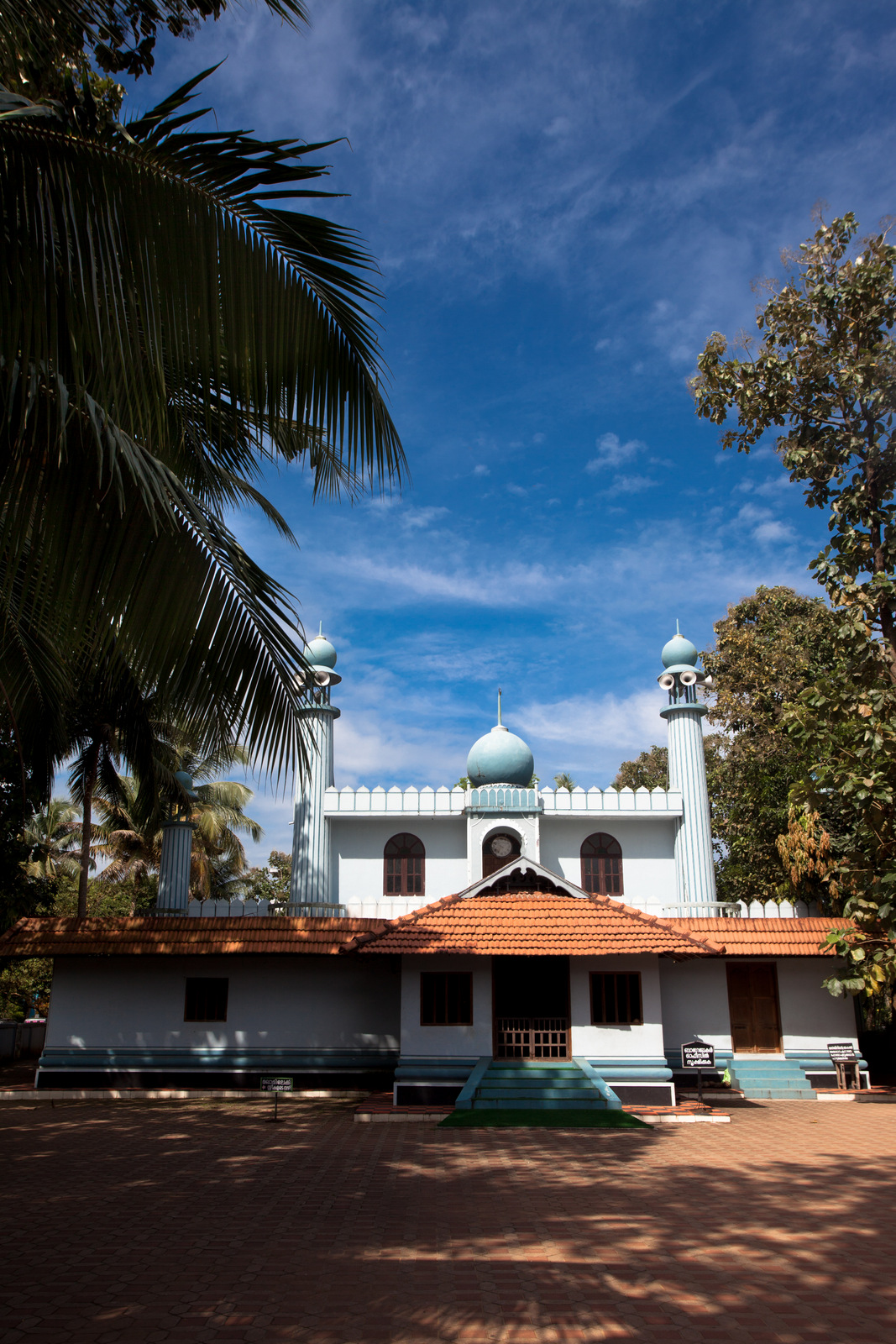
Photo: Shahinmusthafa · CC BY-SA 3.0 · Wikimedia Commons
Cheraman Juma Mosque is a mosque in India. Often described as the oldest mosque in India. The free Lokali audio guide runs 7 minutes.
✓ Published October 2026 · how we write these guides
Visitor facts
| Lokali audio guide | 7 min · free |
|---|---|
| Type | Mosque |
| Location | Kodungallur, India |
| Coordinates | 10.2128, 76.2021 |
| Languages | 50+, in the Lokali app |
The story
Slip off your shoes at the threshold and feel the floor under your bare feet. It is cool, smooth, and slightly worn, the kind of surface that thousands of footsteps have polished over many generations. Above you, a roof of dark clay tiles slopes down in layers. Coastal Kerala light falls soft and green through the trees. If you came here expecting domes and tall minarets, look again. This is a mosque, but its shape belongs to the Kerala coast.
You are standing at the Cheraman Juma Mosque, in Methala, on the edge of Kodungallur. Many people in Kerala, and many visitors from across the Muslim world, describe it as the oldest mosque in India. That claim rests partly on history and partly on a very old story. Both are worth hearing. It also helps to know which is which, so let us take them one at a time.
First, the story. Legend has it that a Chera king, remembered as Cheraman Perumal, once saw the moon split in two in the night sky. The Cheras were a dynasty that ruled much of this coast in early times. According to the tale, Arab traders later told the king that this sign was linked to the Prophet Muhammad. Moved by what he heard, the king is said to have sailed to Arabia and embraced Islam there.
The tradition continues. Locals say the king never returned home, and that he died far away on the Arabian coast. Before his death, the story goes, he wrote letters to the rulers back in Kerala. A group of companions, led by a man remembered as Malik ibn Dinar, carried those letters across the sea. With the support of local rulers, they are said to have built this mosque. The traditional date places this in the seventh century, within the Prophet's own lifetime.
Now, the history. Historians treat that early date with caution, and the details of the legend cannot be confirmed from records of the period. What is not in doubt is the setting. Kodungallur sits near the site of Muziris, an ancient port. Traders from the Roman world, Arabia and beyond sailed here for pepper and spices. Arab merchants were part of this coast's life long before Islam began, so an early Muslim community here is entirely plausible.
That old trade network also explains something surprising about this town. Kodungallur is linked by tradition to the arrival of Christianity in India, and an early Jewish community also lived along this coast. Within a short distance, you can find a famous Hindu temple, Christian sites, and this mosque. The sea brought all of them here. The same monsoon winds that carried pepper ships also carried ideas and faiths.
Look at the building itself. The sloping, layered roof, the wooden gables and the low verandas are features of traditional Kerala architecture. Hindu temples and old homes in this region use them too. Builders here worked with local timber and laterite stone. Laterite is a reddish rock that hardens after it is cut and exposed to air. These materials and roof shapes suit heavy monsoon rain, which can pour down for weeks at a time.
Here is a detail many visitors miss. For part of the twentieth century, the mosque did not look like this at all. A modern extension added a concrete front with domes and minarets, in a more international style. In recent years, a restoration linked to the Muziris Heritage Project removed much of that concrete. The aim was to bring back the older Kerala form. So the building you see is in some ways closer to its past than it was a few decades ago.
Step inside if you are permitted, and let your eyes adjust to the dimmer light. The interior is mostly wood. Look for carved timber, old pillars and a carved pulpit near the prayer niche. The prayer niche, called the mihrab, points the faithful towards Mecca. In the hush, you may notice how the thick roof keeps out the heat. Ceiling fans move the air, and voices drop on their own.
There is a brass oil lamp here that people talk about with real affection. It is a tall Kerala lamp, of the type you also see in temples and homes. Locals say it has been kept burning for centuries. Visitors of different faiths bring oil for it as an offering. Whether or not the flame has truly never gone out, the habit of sharing it says a great deal about this place.
That sharing goes further. The mosque is known in Kerala for welcoming people of all religions. Some non-Muslim families bring their young children here for Vidyarambham. This is a traditional ceremony in which a child writes their first letters, often on a tray of rice. It usually happens during an autumn festival season. Seeing a Hindu ritual of learning take place in a mosque surprises many visitors, but here it feels natural.
Outside, take a moment with the grounds. Mosques in this region often have a pool or tank of water for ritual washing before prayer, and a small burial area nearby. Listen for the call to prayer, carried across the rooftops of Methala. Between prayers, the sounds are ordinary ones. You may hear crows, a passing scooter, and conversation from the tea stalls along the road.
It is worth remembering that this is a working place of worship, not a museum. Families pray here every day. Dress modestly, keep your voice low, and step aside during prayer times. If you are unsure where you may go, simply ask. People here are used to visitors, and many are happy to explain what you are looking at.
Before you leave, stand back and look once more at that tiled roof against the sky. It carries a long story. There is a king who may or may not have sailed west, and a port that faded into silt and legend. There is also a community that has kept this place for many generations. Put your shoes back on slowly. Notice the warmth of the ground outside, and the smell of the coast in the air.
Key facts
What to look for
Practical tips
Common questions
Is there a free audio guide to Cheraman Juma Mosque?
Yes — the Lokali app narrates Cheraman Juma Mosque free of charge in 50+ languages. The guide runs about 7 minutes, covers the history, what to look for on site and practical tips, and works offline once downloaded.
Where is Cheraman Juma Mosque?
Cheraman Juma Mosque is near Kodungallur, India, at 10.2128, 76.2021. Tap the map link on this page for directions from where you are.
What is Cheraman Juma Mosque known for?
Often described as the oldest mosque in India. Tradition links it to Chera king Cheraman Perumal.
What should you look for at Cheraman Juma Mosque?
Layered clay-tiled roof in Kerala temple style. Tall brass oil lamp kept burning inside. Carved wooden pulpit beside the prayer niche.
What should you know before visiting Cheraman Juma Mosque?
Dress modestly with shoulders and knees covered. Remove your shoes before entering the mosque area.
On the map
Opens directions to Cheraman Juma Mosque from your location.
Hear Cheraman Juma Mosque in your language
The full story, narrated, in 50+ languages. Download it before you go and it plays offline, at your own pace, with no ticket and no tour group.