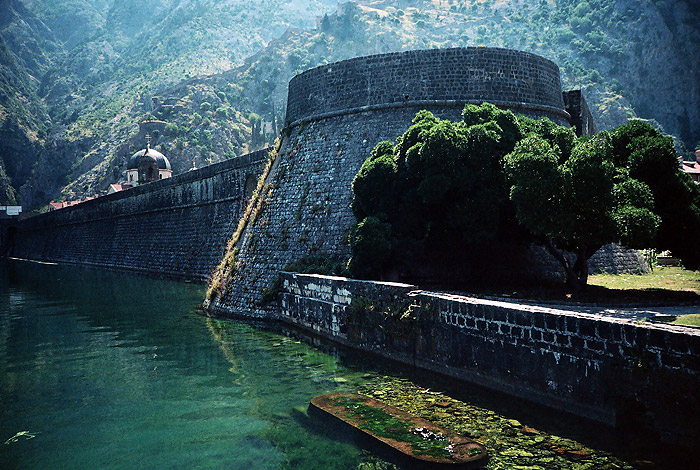
Photo: Asta · Public domain · Wikimedia Commons
Fortifications of Kotor is an UNESCO World Heritage Site. It is in Kotor, Montenegro. Kotor joined the UNESCO World Heritage list in 1979. The free Lokali audio guide runs 8 minutes.
✓ Published October 2026 · how we write these guides
Visitor facts
| Lokali audio guide | 8 min · free |
|---|---|
| Type | Monument |
| Location | Kotor, Montenegro |
| Coordinates | 42.4249, 18.7710 |
| Languages | 50+, in the Lokali app |
The story
Put your hand on the wall beside you. The stone is grey limestone, rough and cool, and in places it is smooth from centuries of passing shoulders. Somewhere below, a church bell rings across the water. Above you, the walls climb straight up the mountain in a long zigzag, like a stitch sewn into the rock. This is where Kotor meets its mountain. For most of its history, this line of stone was the only thing that stood between the town and everyone who wanted it.
The fortifications of Kotor are not one building. They are a system. The walls wrap around the old town at sea level. Then they leave the streets behind and climb the steep slope of the hill behind it, Saint John's Hill. At the top sits the Fortress of Saint John, often called San Giovanni. The full circuit runs for several kilometres. On a map, the shape looks like a long, narrow triangle, with its point high on the mountain and its base on the edge of the bay.
To understand why anyone built walls up a near-vertical slope, look out at the water. The Bay of Kotor winds deep inland between high mountains. People often call it a fjord, but geologists describe it differently — it is a flooded river canyon, not a valley carved by glaciers. For sailors, it was a perfect natural harbour. For a town at its innermost corner, it was also a trap. Enemies could arrive by sea, and they could arrive over the mountains behind. The walls had to face both ways.
The oldest layers here go back a very long way. Defences on this site are generally traced to the early medieval period, when the Byzantine Empire held this coast. Over the following centuries, the town passed between different rulers, and each one added, repaired, or rebuilt. But the shape you see today belongs mostly to one power. From the fifteenth century until 1797, Kotor was part of the Venetian Republic, the great trading state centred on Venice. The Venetians turned these walls into a modern fortress of their time.
That Venetian work is why the fortifications have a special international status. Kotor's old town and its surrounding bay were added to the UNESCO World Heritage list in 1979. Later, in 2017, the walls were also included in a shared listing with other Venetian defence works across Italy, Croatia, and Montenegro. Together, these sites show how Venice protected its trade routes across the Adriatic Sea. So the wall under your hand is one piece of a chain that once stretched across a whole sea.
Now here is something many visitors miss. Look at how the walls change as they rise. Down in the town, they are thick and heavy, built to resist ships and cannon fire from the bay. Higher up, they grow thinner in places and follow every fold of the rock. The builders used the mountain itself as part of the defence. Where the cliff was steep enough to stop an army, the wall could be lighter. Where the slope eased, the stone grew thicker again.
If you climb, you will soon understand the effort involved. The path is a long series of stone steps and ramps, switching back and forth across the slope. Guidebooks often say there are well over a thousand steps to the top, and your legs will believe it. The fortress at the summit stands roughly two hundred and sixty metres above the sea. That does not sound very high. On a hot afternoon, with the sun on the bare rock, it feels much higher.
About a third of the way up, you reach a small church perched on a ledge. This is the Church of Our Lady of Remedy, built in the sixteenth century. It is a modest building, with a simple bell and a little terrace in front. It is often said that the church was built as thanks for the end of a plague, which is one reason for its name. Many climbers stop here to rest. It is also one of the best places to look down onto the roofs of the old town.
From this height, the town below looks like a puzzle of terracotta roofs, bell towers, and narrow lanes. You can see how tightly the houses press together inside the walls. Space was precious. Everything had to fit inside the protected line. Beyond the roofs, the bay opens out in shades of green and blue. Cruise ships sometimes sit in the harbour, and they look strangely large beside the small stone town they have come to visit.
Keep climbing, and the path grows rougher. Some sections are worn and uneven, and parts of the walls have collapsed or been only partly restored. This is not a museum with polished floors. A strong earthquake struck this coast in 1979 and damaged much of Kotor, including parts of the fortifications. Repairs have continued in stages since then. As you walk, you can often see where newer stone meets older stone — the colour and the mortar are slightly different.
At the summit, the Fortress of Saint John is mostly a shell. You walk among roofless rooms, broken arches, and gun platforms that face out over the bay. A flag usually flies from the highest point. The wind is stronger up here, and the sounds of the town fade. What remains is the view. On a clear day, you can follow the bay as it bends away toward the open sea, with mountains rising on every side.
Look behind the fortress, toward the mountain wall. There, an old path climbs even higher, in tight switchbacks across the bare slope. This is the Ladder of Kotor, a historic trail that once linked the coast with the Montenegrin highlands. For centuries, traders and travellers walked it with goods and animals. It reminds you that these walls did not only keep people out. Kotor also depended on the people and the trade that came down from those mountains.
One more detail, for the walk back down. Kotor is famous among visitors for its cats. You will likely meet some on the steps, sleeping in patches of shade or watching you from the top of the wall. Locals feed them, and many cats seem to treat the fortifications as their own territory. In a way, they are the current guards of these walls, and they take the job very lightly.
So pause for a moment before you go. Look along the line of stone as it runs down the mountain and into the town. Every block was carried up this slope by hand, by people who never saw the finished whole. Listen for the bells again, and the voices in the squares below. As you walk back through the gates, notice the thickness of the walls around you. You are stepping out of a fortress that is still, quietly, doing its job.
Key facts
What to look for
Practical tips
Common questions
Is there a free audio guide to Fortifications of Kotor?
Yes — the Lokali app narrates Fortifications of Kotor free of charge in 50+ languages. The guide runs about 8 minutes, covers the history, what to look for on site and practical tips, and works offline once downloaded.
Where is Fortifications of Kotor?
Fortifications of Kotor is in Kotor, Montenegro, at 42.4249, 18.7710. Tap the map link on this page for directions from where you are.
What is Fortifications of Kotor known for?
Kotor joined the UNESCO World Heritage list in 1979. Venice ruled Kotor until the republic fell in 1797.
What should you look for at Fortifications of Kotor?
Zigzag wall line climbing the bare mountain slope. Small bell on the Church of Our Lady of Remedy. Newer repair stone beside older, darker wall blocks.
What should you know before visiting Fortifications of Kotor?
Start the climb early morning to avoid heat and crowds. Wear shoes with good grip for worn, uneven stone steps.
When is the best time to visit Fortifications of Kotor?
Start the climb early morning to avoid heat and crowds.
On the map
Opens directions to Fortifications of Kotor from your location.
More to see near Fortifications of Kotor

Hear Fortifications of Kotor in your language
The full story, narrated, in 50+ languages. Download it before you go and it plays offline, at your own pace, with no ticket and no tour group.