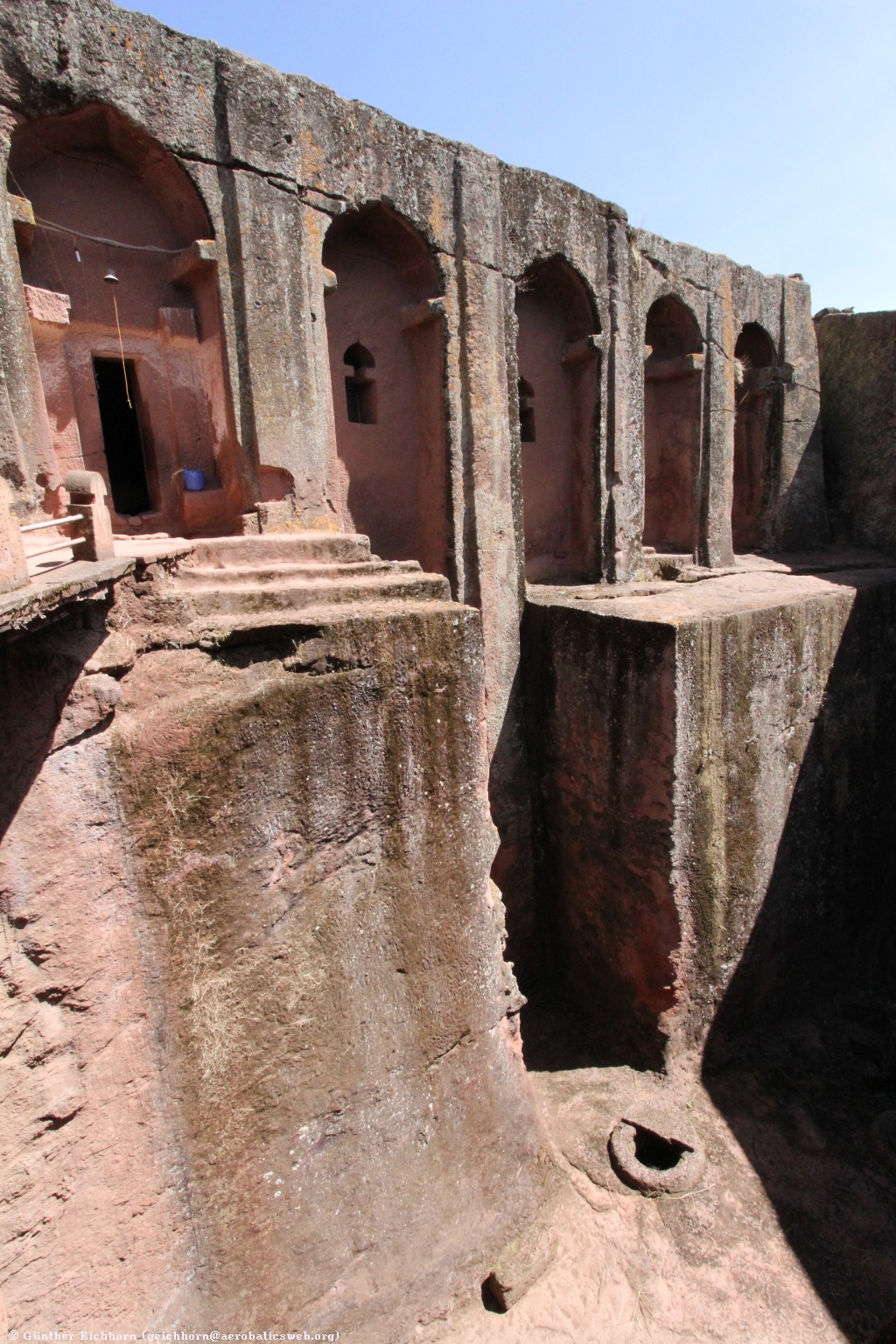
Church of Saint Gabriel and Saint Raphael
12.0245° N · 39.0428° E · Church
Photo: Geichhorn2000 · CC BY-SA 4.0 · Wikimedia Commons
Church of Saint Gabriel and Saint Raphael is a rock-cut church with a basilica layout, featuring three aisles divided by rows of pillars. It is in Lalibela, Ethiopia. Most visitors spend 30–45 min here. The free Lokali audio guide runs 5 minutes.
✓ Verified August 2026 · how we write these guides
Visitor facts
| Time needed | 30–45 min |
|---|---|
| Lokali audio guide | 5 min · free |
| Type | Church |
| Best for | Photography |
| Location | Lalibela, Ethiopia |
| Coordinates | 12.0245, 39.0428 |
| Languages | 45, in the Lokali app |
The story
The path narrows, and suddenly the ground falls away on both sides. You cross a slim rock walkway over a deep, dry moat, with a carved cliff face rising ahead of you. This is the entrance to Bete Gabriel-Rufael, the Church of Saint Gabriel and Saint Raphael. No other church at Lalibela greets you quite like this.
The church is dedicated to two archangels, Gabriel and Raphael, and it holds twin sanctuaries in their honor. It anchors the southeastern group of Lalibela's eleven rock-hewn churches, a cluster with its own maze of trenches, tunnels, and courtyards, a short walk from the better-known northern group.
Stop on the walkway and study the facade. A tall wall of carved rock rises above the moat, marked by a row of high, pointed arch niches. Many visitors consider this the most imposing face at Lalibela. It looks less like a church front and more like the wall of a fortress, and that impression may hold a clue.
Unlike the famous freestanding churches, this one was never fully cut loose from the mountain. The carvers freed its front and sides but left it joined to the living rock behind. Architects call this a semi-monolithic church. The deep moat below your feet was carved out by hand, one basket of stone at a time.
Here is the puzzle that makes this building special. Some archaeologists argue that it did not begin as a church at all. The fortified layout, the moat, and the elevated entrance suggest a stronghold, perhaps a royal residence. Some date its earliest parts centuries before King Lalibela, possibly as early as the seventh or eighth century. Scholars still debate this, and the rock keeps its secret.
Tradition, meanwhile, folds it into the great story of the site. King Lalibela of the Zagwe dynasty, who reigned around the year 1200, is credited with the complex as a whole, a new Jerusalem carved into the highlands. If the older dating is right, his workers may have converted an ancient fortress into a house of prayer.
Cross the walkway and step inside. The interior is unlike the tidy, basilica-like halls of the northern group. The floor plan is irregular, the ceiling heights change, and the floor itself slopes beneath your feet. Rooms open into shadowed corners. It feels less designed and more discovered, as if the building grew by need rather than by plan.
From here, a famous passage leads toward the neighboring church of Bet Merkorios. It is a long tunnel through the rock, and it is completely dark. Pilgrims walk it without light, one hand on the wall. Priests describe the walk as a passage from darkness into light, an image of moving through death toward heaven. Walk it with your guide if you are willing.
Nearby, connected by trench and tunnel, lies a small chamber known as Bethlehem, or Bete Lehem. It is said that priests once prepared the sacramental bread there before carrying it to the churches. The name repeats a pattern you find all over Lalibela, where places borrow their names from the Holy Land.
This is still a working church of the Lalibelan Orthodox Tewahedo faith. On the feast days of the archangels, the courtyards fill with chanting and white-robed pilgrims. On quieter days, a priest may bring out a processional cross or an old manuscript, holding it patiently in the dim light for you to see.
Give your senses a moment here. The air in the trenches is cool and smells of dust and incense. Light falls in hard shafts between high rock walls. Footsteps echo. Above the moat, swallows cut through the strip of sky. Eight hundred years of feet have smoothed the path you are standing on.
Before you leave, look back at the facade one last time from the walkway. Fortress or church, palace or shrine, this building has outlived every argument about it. The moat still guards it. The archangels still hold their twin rooms. And visitors still arrive the old way, one careful step at a time, across a bridge of stone.
Key facts
What to look for
Practical tips
Common questions
How long do you need at Church of Saint Gabriel and Saint Raphael?
Plan 30–45 min. That is the time most visitors spend at Church of Saint Gabriel and Saint Raphael. The free Lokali audio guide adds about 5 minutes of narration you can listen to as you walk, so it fits inside your visit rather than adding to it.
Is there a free audio guide to Church of Saint Gabriel and Saint Raphael?
Yes — the Lokali app narrates Church of Saint Gabriel and Saint Raphael free of charge in 50+ languages. It covers the history, what to look for on site and practical tips, and it works offline once downloaded.
Where is Church of Saint Gabriel and Saint Raphael?
Church of Saint Gabriel and Saint Raphael is in Lalibela, Ethiopia, at 12.0245, 39.0428. Tap the map link on this page for directions from where you are.
What should you know before visiting Church of Saint Gabriel and Saint Raphael?
Watch your footing on the narrow entrance walkway.
What is Church of Saint Gabriel and Saint Raphael known for?
Dedicated to the archangels Gabriel and Raphael.
What is the best time to visit Church of Saint Gabriel and Saint Raphael?
This church is less crowded than Saint George.
On the map
Opens directions to Church of Saint Gabriel and Saint Raphael from your location.
More to see in Lalibela


Hear Church of Saint Gabriel and Saint Raphael in your language
The full story, narrated, in 50+ languages. Download it before you go and it plays offline, at your own pace, with no ticket and no tour group.