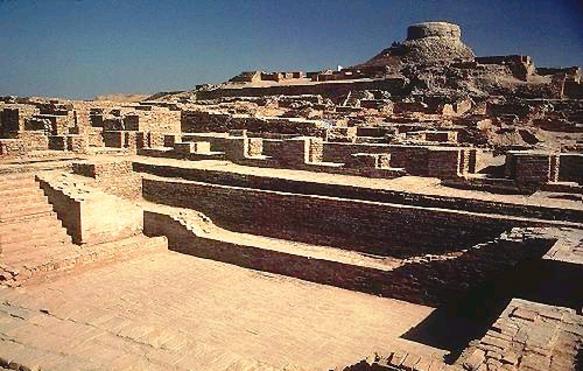
Mohenjo-daro
27.3292° N · 68.1389° E · Archaeological Site
Photo: The original uploader was M.Imran at English Wikipedia. · CC SA 1.0 · Wikimedia Commons
Mohenjo-daro is an archaeological site in the province of Sindh, Pakistan. Peak around the middle of the third millennium BCE. The free Lokali audio guide runs 6 minutes.
✓ Published October 2026 · how we write these guides
Visitor facts
| Lokali audio guide | 6 min · free |
|---|---|
| Type | Archaeological Site |
| Location | Larkana, Pakistan |
| Coordinates | 27.3292, 68.1389 |
| Languages | 50+, in the Lokali app |
The story
Listen to the ground under your feet. It crunches softly. That sound is dust, salt, and the crumbled edges of bricks fired more than four thousand years ago. The air over the plain of Sindh shimmers with heat, and the mounds around you rise low and brown against a pale sky. There are no towering columns here and no carved gateways. There is only brick, laid in long, patient lines, and a silence that feels very old.
This is Mohenjo-daro, one of the great cities of the Indus Valley Civilisation. That civilisation flourished along the Indus River and its tributaries, in what is now Pakistan and northwest India. It was a contemporary of ancient Egypt and Mesopotamia. Archaeologists generally date the city's peak to around the middle of the third millennium BCE. In other words, people were walking these streets while the pyramids of Giza were still fairly new.
The name itself is not ancient. Mohenjo-daro is usually translated from Sindhi as the Mound of the Dead Men. Local people gave the place that name long before anyone understood what lay beneath it. We do not know what the city's own inhabitants called it. That gap is the first surprise of this place... a city this large, and its true name is simply lost.
The ruins came to wider attention in the early 1920s. The Indian archaeologist R. D. Banerji first identified the site's great age, and excavations followed under John Marshall, who led the Archaeological Survey of India at the time. Their work, alongside discoveries at Harappa far to the north, showed the world something unexpected. South Asia had a planned, urban civilisation as old as any on Earth. Later digs, including work by Mortimer Wheeler, added more layers to the story.
Now look at the streets. They run mostly in straight lines, crossing one another at near right angles. The city was divided into two main parts. To the west rises a raised mound that archaeologists call the Citadel. To the east lies the larger Lower Town, where most people lived and worked. This kind of deliberate layout is rare for its age. Someone, or some shared tradition, planned this city with care.
The bricks deserve a closer look. Most are baked in a kiln rather than dried in the sun, which made them hard and long-lasting. Across the Indus world, bricks were made in consistent proportions, roughly one unit high, two wide, and four long. Builders hundreds of kilometres apart seem to have followed the same standard. Run your eyes along a wall, and you will see how neatly the courses stack, layer upon layer.
Here is the second surprise, and many visitors walk past it. Look down at the edges of the lanes. You will see brick-lined channels running alongside the houses. These were drains. Many homes had bathing areas, and waste water flowed out into covered street drains. Some houses also had their own wells. For a city of its age, this attention to water and cleanliness is remarkable, and it is one reason Mohenjo-daro is studied so closely today.
On the Citadel mound stands the structure most people come to see — the Great Bath. It is a large, rectangular tank, sunk into the ground, with steps leading down at each end. The builders sealed it carefully, using tightly fitted bricks and a layer of natural tar called bitumen to keep the water in. Many scholars think it had a ritual purpose, perhaps for purification. But no written record confirms this, so its exact use remains an open question.
That silence of the written record runs through the whole site. The people of the Indus used a script, carved on small square seals of stone. These seals often show animals, such as a bull or a creature that looks like a unicorn. Yet the script has never been deciphered. We can read the city's walls and drains, but not its words. We do not know the names of its rulers, its gods, or even whether it had kings at all.
Some of the most famous objects from this city are no longer here. A small bronze figure known as the Dancing Girl is now held in the National Museum in New Delhi. A stone bust often called the Priest-King, with a patterned cloak over one shoulder, is in the National Museum in Karachi. The site museum here displays other finds, such as pottery, seals, beads, and tools. Together they show a society of skilled craftspeople and long-distance traders.
As you look across the Citadel, you may notice a rounded brick mound rising higher than the rest. This is a Buddhist stupa, a dome-shaped shrine, built here many centuries after the Indus city had faded. It is a reminder that people returned to this high ground long after its first builders were gone. Two very different worlds sit stacked on the same spot, separated by perhaps two thousand years.
Why did the city decline? No single answer is agreed. Scholars point to changes in the river, shifting climate, and the gradual weakening of trade networks. The decline seems to have been slow rather than sudden. Today, the ruins face a quieter threat. Salt rises from the ground water and crusts the old bricks, slowly breaking them apart. That pale white bloom you may see on some walls is the reason. In 1980, UNESCO listed the site as a World Heritage Site.
Before you leave, stand still for a moment and look along one of the straight streets. Picture doorways opening onto it, the smell of cooking fires, the sound of carts and voices. Then notice what is really here now — the heat, the wind, the soft crunch of dust. This city kept its secrets for four thousand years. As you walk back, watch the brick lines under your feet, and remember that a family once swept this very doorstep.
Key facts
What to look for
Practical tips
Common questions
Is there a free audio guide to Mohenjo-daro?
Yes — the Lokali app narrates Mohenjo-daro free of charge in 50+ languages. The guide runs about 6 minutes, covers the history, what to look for on site and practical tips, and works offline once downloaded.
Where is Mohenjo-daro?
Mohenjo-daro is near Larkana, Pakistan, at 27.3292, 68.1389. Tap the map link on this page for directions from where you are.
What is Mohenjo-daro known for?
Peak around the middle of the third millennium BCE. Name usually translated as Mound of the Dead Men.
What should you look for at Mohenjo-daro?
Brick-lined drains running beside the old lanes. Steps descending into each end of the Great Bath. The rounded Buddhist stupa crowning the Citadel mound.
What should you know before visiting Mohenjo-daro?
Visit early morning to avoid the fierce midday Sindh heat. Carry plenty of water and a wide-brimmed hat.
When is the best time to visit Mohenjo-daro?
Visit early morning to avoid the fierce midday Sindh heat.
On the map
Opens directions to Mohenjo-daro from your location.
Hear Mohenjo-daro in your language
The full story, narrated, in 50+ languages. Download it before you go and it plays offline, at your own pace, with no ticket and no tour group.