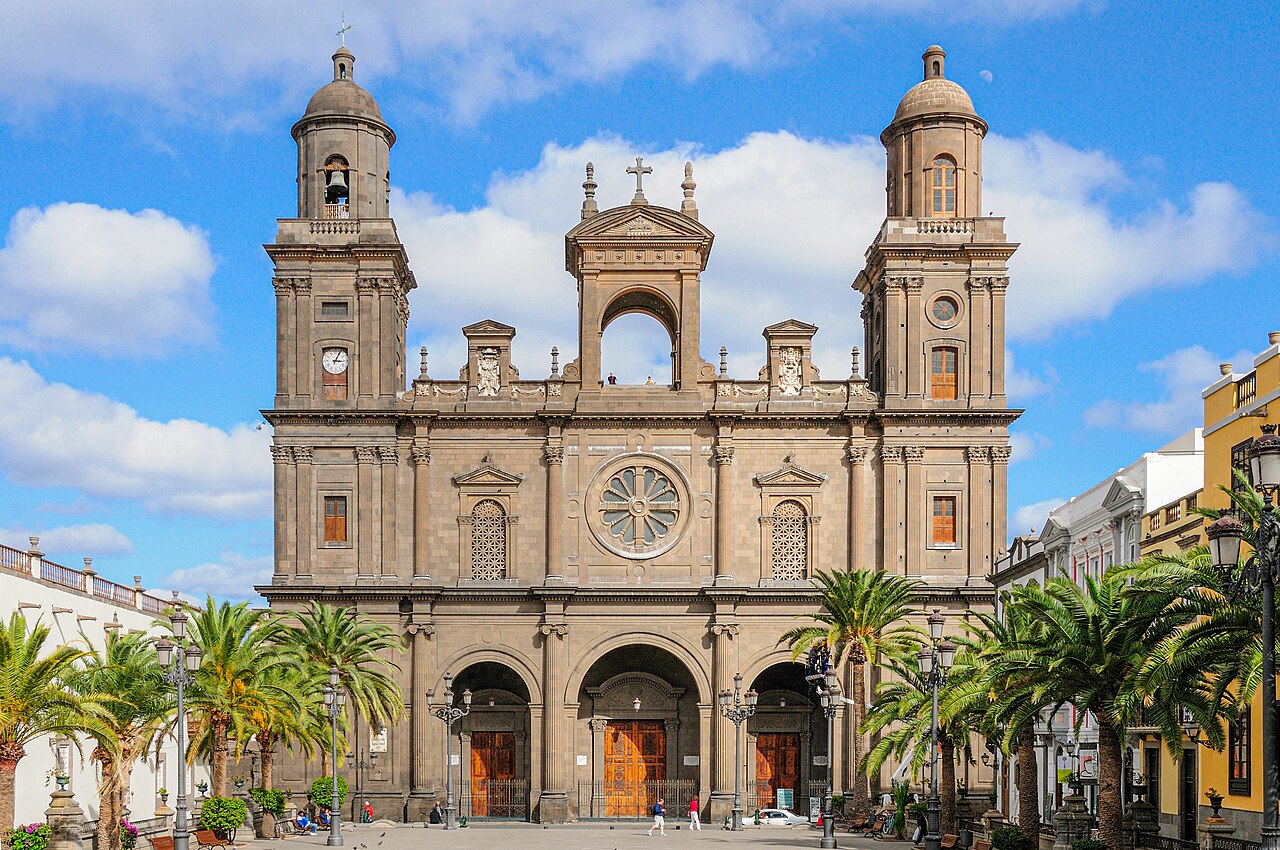
Cathedral of Santa Ana
28.1024° N · 15.4127° W · Cathedral
Cathedral of Santa Ana is the principal church of Las Palmas, begun in the 15th century and completed across three centuries. It is in Las Palmas, Spain. Most visitors spend 30–45 min here. The free Lokali audio guide runs 5 minutes.
✓ Verified August 2026 · how we write these guides
Visitor facts
| Time needed | 30–45 min |
|---|---|
| Lokali audio guide | 5 min · free |
| Type | Cathedral |
| Best for | History |
| Location | Las Palmas, Spain |
| Coordinates | 28.1024, -15.4127 |
| Languages | 45, in the Lokali app |
The story
Step into the square and look up. The stone face of the cathedral rises above you, pale and weathered. Two bell towers stand against the sky. The air is cooler here, held in shade by the old buildings around the plaza. Your footsteps echo on the worn paving stones. Pigeons lift and settle again.
This is the Cathedral of Santa Ana, the heart of the old quarter of Las Palmas. It stands in Vegueta, the district the city first grew from. For more than five centuries, people have crossed this square to reach its doors. The building has watched the whole life of the city pass before it.
Work on the cathedral began at the close of the fifteenth century, soon after the island came under Castilian rule. But it was not finished in one lifetime, or even in several. Builders worked on it across more than four hundred years. Wars, money, and time all slowed the work. Towers were raised, paused, and finished by much later hands.
Because of that long building, the cathedral wears more than one style at once. Step inside and the ceiling lifts away into pointed arches. The columns rise tall and then spread at the top, like the fronds of palm trees opening overhead. The space is cool, gray, and very quiet. Light falls in long shafts from the high windows and moves slowly across the floor.
Walk back outside and study the main front. Here the lines are different. The facade is calm and balanced, with even columns and clean, plain stone. The ordered front and the soaring interior belong to different ages. They were joined, slowly, into one single building.
Look closely at the stone itself. Much of it was cut from the island's own volcanic rock, pale and full of tiny holes. Centuries of salt wind have softened the carved edges. In bright sun the walls look almost golden. In shade they turn a cool gray. The cathedral seems to change its color with the hour of the day.
In front of the cathedral spreads the Plaza de Santa Ana. Look for the bronze dogs that rest along its edge. They have sat here for generations, facing the church. Some say the islands took their name from dogs, from the old Latin word for them, though no one can be fully certain.
This square was the center of power in the early city. The cathedral stands on one side. Across from it rose the halls of the council and the home of the bishop. To stand here is to stand where the affairs of the island were once decided. Markets and gatherings once filled this open ground. Today it is calm, crossed by visitors and the occasional cat.
Go back inside and let your eyes adjust to the dim light. Side chapels open along the walls, each one in shadow. Candlelight catches on gold and on carved dark wood. A faint smell of wax and old stone hangs in the air. The sound of the street falls away behind you. Visitors lower their voices without being asked.
The cathedral is the seat of the Diocese of the Canary Islands. From this building, the church ordered its life across the whole island chain for hundreds of years. It holds religious paintings and silver gathered over that long time. Among the pieces are old robes and processional silver, carried through the streets on feast days.
If you have the energy, climb toward the tower. A lift carries visitors up inside one of the towers to a viewing point near the top. From there the old town opens below you. Flat rooftops run in tight rows. Painted house fronts line the narrow lanes. Beyond the last roofs lies the wide ocean. Seabirds turn below you, and the city sounds rise faint and far.
Down again at street level, walk the lanes around the cathedral. The streets of Vegueta are narrow and paved with stone. Wooden balconies lean out over your head. Small shops and cafes fill the ground floors, and the smell of coffee drifts from open doors. The cathedral towers appear at the end of a lane, then vanish, then appear once more as you turn the next corner.
Stand in the square again before you leave. The stone has held the marks of wind and salt for hundreds of years. Generation after generation has crossed this same ground, looked up, and passed on. The cathedral simply remains, patient, gathering the quiet days of the city into its long memory.
Key facts
What to look for
Practical tips
Common questions
How long do you need at Cathedral of Santa Ana?
Plan 30–45 min. That is the time most visitors spend at Cathedral of Santa Ana. The free Lokali audio guide adds about 5 minutes of narration you can listen to as you walk, so it fits inside your visit rather than adding to it.
Is there a free audio guide to Cathedral of Santa Ana?
Yes — the Lokali app narrates Cathedral of Santa Ana free of charge in 50+ languages. It covers the history, what to look for on site and practical tips, and it works offline once downloaded.
Where is Cathedral of Santa Ana?
Cathedral of Santa Ana is in Las Palmas, Spain, at 28.1024, -15.4127. Tap the map link on this page for directions from where you are.
What should you know before visiting Cathedral of Santa Ana?
Take the tower lift for views over the old town.
What is Cathedral of Santa Ana known for?
Construction began at the close of the fifteenth century.
What is the best time to visit Cathedral of Santa Ana?
The interior is cool and dimly lit; bring a torch to examine the carved wooden ceiling and side chapels.
On the map
Opens directions to Cathedral of Santa Ana from your location.
More to see in Las Palmas

Hear Cathedral of Santa Ana in your language
The full story, narrated, in 50+ languages. Download it before you go and it plays offline, at your own pace, with no ticket and no tour group.