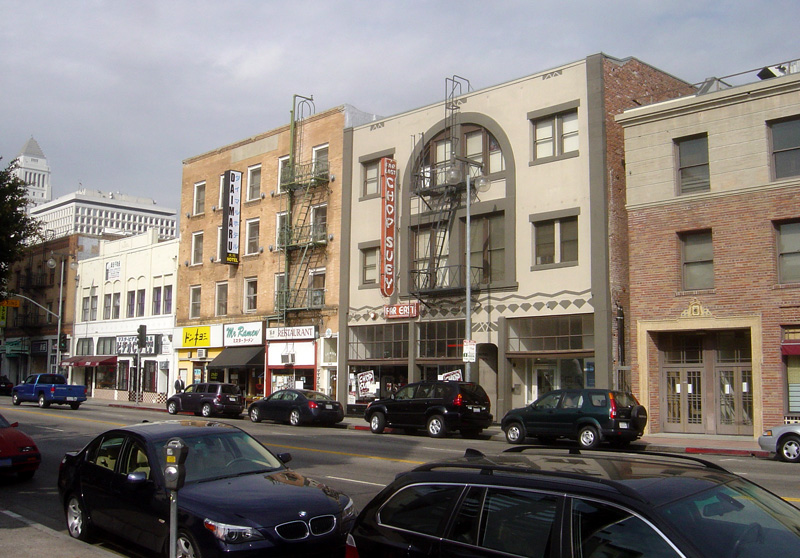
Little Tokyo, Los Angeles
34.0506° N · 118.2394° W · Historic District
Photo: The original uploader was Bobak at English Wikipedia. · CC BY-SA 2.5 · Wikimedia Commons
Little Tokyo, Los Angeles is a neighborhood of Los Angeles, California, USA. Settled by Japanese immigrants around the turn of the twentieth century. The free Lokali audio guide runs 7 minutes.
✓ Published October 2026 · how we write these guides
Visitor facts
| Lokali audio guide | 7 min · free |
|---|---|
| Type | Historic District |
| Location | Los Angeles, United States |
| Coordinates | 34.0506, -118.2394 |
| Languages | 50+, in the Lokali app |
The story
Listen for a moment. Under the hum of downtown traffic there is the soft clack of wooden paddles on a tray, the hiss of a griddle, and somewhere a shop bell. Paper lanterns sway above the sidewalk. The air carries soy, toasted sesame, and sweet rice. You are standing in Little Tokyo, a few short blocks east of the Los Angeles skyscrapers, and yet the rhythm here feels slower and closer to the ground.
This neighbourhood began in the late nineteenth and early twentieth centuries. Japanese immigrants came to California to work on farms, railroads, and fishing boats. Many settled around First Street, close to the old heart of the city. They opened boarding houses, grocers, bathhouses, and temples. Over a few decades, this became the largest Japanese American community in the United States. Today it is one of only three officially recognised Japantowns left in California, alongside those in San Francisco and San Jose.
To understand what you see, it helps to know two words. Issei means the first generation, the people who crossed the Pacific from Japan. Nisei means their children, born here as American citizens. The Issei built the shops. The Nisei grew up between two cultures, speaking English at school and Japanese at the dinner table. Much of Little Tokyo's story is the story of those two generations, and the hard choices history forced on them.
Look along First Street, on the north side. Many of these low brick buildings date from the early twentieth century. Together they form a historic district that was named a National Historic Landmark in 1995. Notice the plain facades, the upper-floor windows, and the small storefronts at street level. Families often lived above their businesses. The architecture is modest, but it holds an important record of how an immigrant community made a home.
Now look down at the sidewalk itself. Here is a detail most visitors walk straight over. Set into the pavement along this block is a public art piece called Remembering Old Little Tokyo. Bronze lines of text record the names of businesses that once stood here, along with the families who ran them. Some of the entries mark the year 1942. That year is the turning point of this whole neighbourhood.
In early 1942, a few months after the attack on Pearl Harbor, President Franklin Roosevelt signed Executive Order 9066. It led to the forced removal of more than one hundred thousand people of Japanese ancestry from the West Coast. Most of them were American citizens. Families had days, sometimes less, to sell or abandon their homes and shops. They were sent to remote incarceration camps. Little Tokyo emptied almost overnight.
And then something unexpected happened. The empty buildings did not stay empty. African American workers were arriving in Los Angeles from the South for wartime factory jobs. Housing was scarce, and many moved into these vacant rooms. For a few years, the area became known as Bronzeville. Jazz clubs opened in the old storefronts. According to many accounts, the saxophonist Charlie Parker played here just after the war. When Japanese American families returned, the two communities briefly shared these same streets.
Walk a little further and you reach the Japanese American National Museum. Its older wing occupies a former Buddhist temple, the Nishi Hongwanji, and you can still see its temple-like front. The newer glass and stone pavilion stands across the plaza. Inside, the collections tell the story of Japanese Americans from the first arrivals to the present day. The incarceration years are presented through letters, photographs, and objects people carried into the camps.
Just beside the museum stands the Go For Broke Monument. It is a curved wall of dark stone, carved with thousands of names. They belong to Japanese American soldiers who served in the Second World War, many in the 442nd Regimental Combat Team. The phrase go for broke was their motto, meaning risk everything. Some of these men enlisted while their own parents were held behind barbed wire. Run your eyes along the names, and the scale of that sacrifice becomes clear.
Now for something sweeter. On First Street you will find Fugetsu-Do, a family confectionery that has been making Japanese sweets since 1903. It is among the oldest businesses in Little Tokyo. Its specialty is mochi, soft cakes of pounded rice, often filled with sweet red bean paste. Watch the colours in the case: pale pink, leaf green, snowy white. The same family has kept this shop going for more than a century, through war, removal, and return.
A short walk south brings you to the Japanese American Cultural and Community Center. Its wide plaza holds a sculpture by Isamu Noguchi, a Japanese American artist known for gardens and stone. The work, two rough stone forms, honours the Issei generation. Below the plaza, partly hidden, is a sunken Japanese garden with a stream and waterfall. Many people pass by without knowing it is there. If it is open, the sudden quiet down there is worth the detour.
Little Tokyo is not a museum piece. Every August since the 1930s, the Nisei Week festival fills these streets with parades, dancers, and taiko drummers, who play large Japanese drums. On ordinary days, you will see older residents shopping for groceries beside students queuing for ramen. Temples still hold services nearby. Developers and preservation groups have argued for years about the neighbourhood's future, and residents work hard to keep it a living community rather than only a theme for visitors.
Before you leave, stand still for a moment. Look up at the lanterns, then down at the bronze names in the pavement beneath your feet. Notice how the old brick sits beside the glass towers just to the west. This small grid of streets has been emptied once and rebuilt by the people who came back. As you walk on, listen again for the shop bells and the griddles. They are the sound of a community that chose to return.
Key facts
What to look for
Practical tips
Common questions
Is there a free audio guide to Little Tokyo, Los Angeles?
Yes — the Lokali app narrates Little Tokyo, Los Angeles free of charge in 50+ languages. The guide runs about 7 minutes, covers the history, what to look for on site and practical tips, and works offline once downloaded.
Where is Little Tokyo, Los Angeles?
Little Tokyo, Los Angeles is in Los Angeles, United States, at 34.0506, -118.2394. Tap the map link on this page for directions from where you are.
What is Little Tokyo, Los Angeles known for?
Settled by Japanese immigrants around the turn of the twentieth century. One of three remaining official Japantowns in California.
What should you look for at Little Tokyo, Los Angeles?
Bronze text in the First Street sidewalk naming old businesses. Thousands of soldiers' names carved into the Go For Broke wall. Former Buddhist temple facade on the museum's older wing.
What should you know before visiting Little Tokyo, Los Angeles?
Arrive by Metro at the Little Tokyo Arts District station. Visit in August to catch the Nisei Week festival.
On the map
Opens directions to Little Tokyo, Los Angeles from your location.
More to see in Los Angeles


Hear Little Tokyo, Los Angeles in your language
The full story, narrated, in 50+ languages. Download it before you go and it plays offline, at your own pace, with no ticket and no tour group.