Photo: Roland Unger · CC BY-SA 3.0 · Wikimedia Commons
Malkata is an archaeological site of Egypt. Built for Pharaoh Amenhotep the Third, fourteenth century BCE. The free Lokali audio guide runs 6 minutes.
✓ Published October 2026 · how we write these guides
Visitor facts
| Lokali audio guide | 6 min · free |
|---|---|
| Type | Archaeological Site |
| Location | Luxor, Egypt |
| Coordinates | 25.7153, 32.5911 |
| Languages | 50+, in the Lokali app |
The story
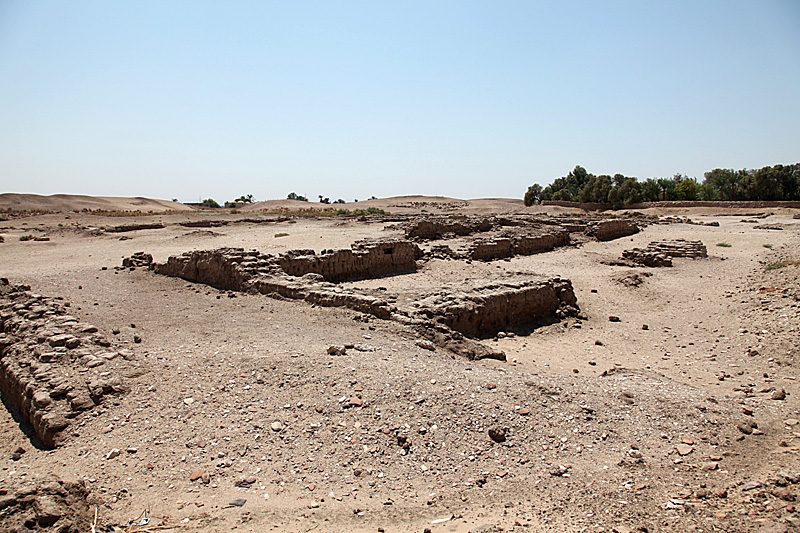
The ground here crunches softly underfoot. It is not quite sand and not quite soil. It is the powdered remains of mud brick, dried by thousands of summers. Low brown mounds run across the desert edge, and the cliffs of the Theban hills stand pale behind them. Wind moves the dust in small spirals. At first glance there is very little to see. And yet you are standing inside what was once one of the largest royal residences in ancient Egypt.
This is Malkata, on the west bank of the Nile, opposite modern Luxor. It lies a short distance from Deir el-Medina, the village of the craftsmen who cut and painted the royal tombs. Those workers lived in stone houses on a narrow valley floor. The king who built this place lived very differently. Malkata was the palace city of Amenhotep the Third, a pharaoh of the Eighteenth Dynasty, who ruled in the fourteenth century before Christ.
The name Malkata is not ancient. It comes from Arabic, and it is usually translated as the place where things are picked up. Local people gave it that name because the ground was full of small objects. Broken pottery, fragments of glass, pieces of faience, which is a glazed ceramic with a bright blue or green surface. For generations, anyone walking here could bend down and find something. Keep that in mind as you look at the ground near your feet.
Amenhotep the Third ruled at a moment of great wealth. Egypt controlled trade routes, received gifts from foreign kings, and had gold to spare. His reign is known for enormous building projects. On this side of the river he built a vast memorial temple, now mostly gone. Its two great seated statues still survive, and today people call them the Colossi of Memnon. Malkata belongs to the same ambitious programme.
Why build a palace here, on the side of the river usually reserved for the dead? The main reason was a festival. Egyptian kings could celebrate a jubilee called the heb-sed. In this ritual, the king renewed his strength and his right to rule, usually after about thirty years on the throne. Amenhotep the Third celebrated more than one jubilee late in his reign. Malkata was designed as the stage for these huge celebrations.
The palace was not a single building. It was a whole settlement. Archaeologists have identified royal apartments, halls with columns, kitchens, storerooms, houses for officials, and a temple dedicated to the god Amun. There were also residences connected to members of the royal family, including, scholars believe, Queen Tiye, the king's powerful wife. Picture courtyards, corridors, and painted rooms stretching across the area in front of you.
Almost all of it was built in mud brick. That surprises many visitors. Egyptian temples and tombs used stone because they were meant to last forever. Houses, even royal houses, were built for the living, and the living used mud. Mud brick kept rooms cool in summer and was quick to build with. The walls were then plastered and painted. What looks plain and brown today was once covered with colour.
Here is something most visitors never learn. The floors and ceilings of the palace were painted with scenes from nature. Excavators found fragments of plaster showing marsh plants, water, fish, birds, and calves leaping through reeds. Some ceilings carried images of vultures with spread wings. A person walking through these halls would have felt as if they were walking through a Nile marsh. Pieces of these paintings are now held in museum collections, including in New York and Cairo.
The largest excavation work here began in the early twentieth century. A team from the Metropolitan Museum of Art in New York dug across the site for several seasons. Later, a Japanese expedition from Waseda University worked here, and in more recent decades new teams returned with modern methods. Each generation of excavators has added pieces to the puzzle. But much of Malkata remains unexcavated, and mud brick is fragile once exposed.
Another surprise comes from the rubbish. Thousands of broken jar fragments were found here, many with short ink inscriptions. These labels recorded what each jar held and where it came from. Wine, meat, fat, honey, and other supplies arrived for the jubilee festivals. The labels name estates, officials, and dates in the king's reign. For historians, these humble shards are among the most useful finds on the whole site. They show the scale of the feasting.
To the east of the palace lay something even larger. A huge artificial basin was dug out of the ground, often connected with the palace and its festivals. Today the area is known as Birket Habu. The excavated earth was piled into long mounds, and some of these are still visible in the landscape. Many scholars think the basin served as a harbour, linked to the Nile, so that royal boats could arrive in style.
After Amenhotep the Third died, the palace did not keep its importance for long. His son, who later took the name Akhenaten, moved the royal court to a new capital far to the north. Later kings had their own palaces. Malkata slowly fell out of use. Rain was rare, but wind, time, and the search for fertile soil wore the mud walls down to the low ridges you see now.
Access to the site can be limited, and the remains are delicate, so it is wise to follow local guidance and stay on clear paths. Before you leave, stand still for a moment. Look at the brown ridges, and then lift your eyes to the cliffs behind them, where Deir el-Medina and the royal tombs are hidden. Here kings once feasted among painted birds and reeds. Now the wind moves the dust... and the place is quiet.
Key facts
What to look for
Practical tips
Common questions
Is there a free audio guide to Malkata?
Yes — the Lokali app narrates Malkata free of charge in 50+ languages. The guide runs about 6 minutes, covers the history, what to look for on site and practical tips, and works offline once downloaded.
Where is Malkata?
Malkata is near Luxor, Egypt, at 25.7153, 32.5911. Tap the map link on this page for directions from where you are.
What is Malkata known for?
Built for Pharaoh Amenhotep the Third, fourteenth century BCE. Designed as the setting for royal heb-sed jubilee festivals.
What should you look for at Malkata?
Low brown ridges marking the outlines of collapsed walls. Scattered pottery shards on the ground, but leave them. Long earth mounds left from digging the Birket Habu basin.
What should you know before visiting Malkata?
Check locally whether the site is accessible before travelling. Stay on clear paths to protect fragile mud-brick remains.
When is the best time to visit Malkata?
Visit early morning to avoid the strongest desert heat.
On the map
Opens directions to Malkata from your location.
More to see in Luxor


Hear Malkata in your language
The full story, narrated, in 50+ languages. Download it before you go and it plays offline, at your own pace, with no ticket and no tour group.