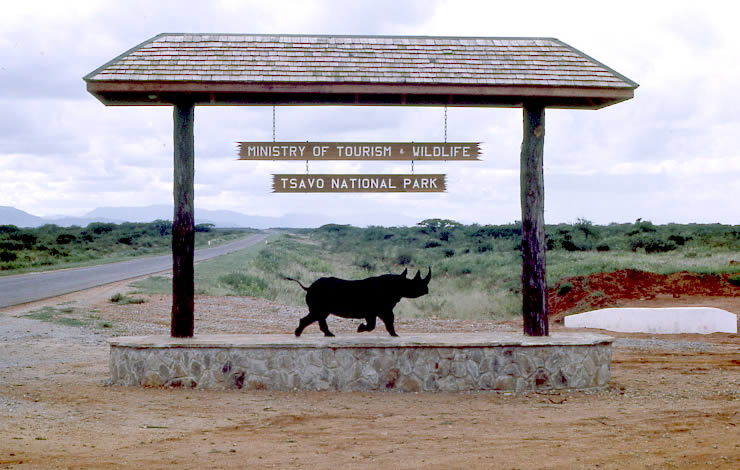
Tsavo East National Park
2.7786° S · 38.7717° E · National Park
Photo: Wikimedia Commons contributor · CC BY-SA 3.0 · Wikimedia Commons
Tsavo East National Park is a national park in Kenya. Tsavo East was established in 1948. The free Lokali audio guide runs 8 minutes.
✓ Published October 2026 · how we write these guides
Visitor facts
| Lokali audio guide | 8 min · free |
|---|---|
| Type | National Park |
| Location | Malindi, Kenya |
| Coordinates | -2.7786, 38.7717 |
| Languages | 50+, in the Lokali app |
The story
Listen first. Wind moves through dry thornbush with a thin, papery rustle. Somewhere a hornbill calls. Under your tyres or your boots, the ground is a deep rust red, fine as powder. It gets everywhere: into your shoelaces, onto your sleeves, into the creases of your hands. This red earth is the first thing almost every visitor to Tsavo East remembers. And it explains one of the strangest sights you may see today, an elephant that looks as if it has been painted the colour of brick.
Welcome to Tsavo East National Park. Most people who come here from Malindi drive inland on the road towards the Sala Gate, on the park's eastern edge. The coast falls away behind you. The air gets drier, the sky gets wider, and the green of the palm belt slowly gives way to grey-green scrub. It feels like crossing from one country into another without a border. For a coastal holiday, this is the great inland detour, from the ocean to the open bush in a single morning.
The scale here is hard to take in. Tsavo East was established in 1948, which makes it one of the oldest national parks in Kenya. Together with its twin, Tsavo West, it forms one of the largest protected areas on the African continent. The main Nairobi to Mombasa road and railway run between the two halves. Much of the eastern half is semi-arid bush and open plain, and large parts of it have been kept away from tourist traffic. So when you look towards the horizon, you are often looking at land that very few people ever cross.
Now, those red elephants. They are ordinary African elephants. They are not a separate kind. What makes them red is behaviour. Elephants spray dust and mud over their backs to protect their skin from the sun and from biting insects. Here, the soil is rich in iron, and it stains them. After a dust bath, a whole family can turn a soft orange. If they wade into the river and wash, you may see the grey skin come back. Then they roll again, and the colour returns.
The name Tsavo carries a darker story, and it is one of the best documented in East Africa. In 1898, British colonial engineers were building the Uganda Railway, a line meant to link the coast at Mombasa to Lake Victoria. At the crossing of the Tsavo River, two lions began attacking the camps of the railway workers. Many of those workers had been brought from British India. For months, the attacks spread fear, and work on the bridge slowed and at times stopped.
The engineer in charge of the bridge, John Henry Patterson, eventually shot both lions. He later wrote a book about the events, called The Man-Eaters of Tsavo, and the story became famous far beyond Kenya. The number of victims has long been argued over. Patterson's own figure was high, and later scientific studies suggested a lower total. The lions themselves did not stay here. Their skins and skulls are now kept at the Field Museum in Chicago, in the United States, thousands of kilometres from this dust.
Here is a detail many visitors miss. Male lions in Tsavo often have very little mane, or almost none at all. The man-eaters were maneless too. Scientists are still discussing why. One idea is the heat. A heavy mane in this hot, dry country could be a real burden. So if your guide points out a big lion that looks a little bare around the neck, do not assume it is a young male. In Tsavo, a full-grown male can look like that.
Water shapes everything in this park. The Galana River runs across the northern part of Tsavo East, flowing towards the coast and reaching the Indian Ocean north of Malindi. So the river you see here and the shoreline you left this morning are joined. Along its banks, doum palms rise above the bush. Doum palms are a type of palm with forked, branching trunks, unusual among palm trees. Crocodiles rest on the sandbanks. Hippos stay in the deeper pools, and elephants come down in the afternoon heat to drink.
On the Galana you will find Lugard Falls, named after Frederick Lugard, a British colonial officer of the late nineteenth century. Do not expect a tall curtain of water. This is something different. The river squeezes through a channel of hard, banded rock, worn smooth into grooves and hollows. The water rushes and twists between the stones. In the dry season, you can see the patterns cut into the rock very clearly. Stay behind the edges and take care, because the rock can be slippery and the current is strong.
Along the northern side of the park runs the Yatta Plateau. It is a long, flat-topped ridge, and it is often described as one of the longest lava flows on Earth. Long ago, molten rock flowed along an old river valley and then hardened. Over time, the softer land around it wore away, and the hard lava stayed high. From the plains, it looks like a low wall laid across the horizon. Its straight line helps you understand the land and find your direction.
Further south, a large granite outcrop called Mudanda Rock rises from the plain. Rainwater collects in a natural pool at its base. In the dry months, this pool can draw elephants, buffalo and other animals from far away. Visitors can sometimes climb onto the rock, with the guidance of rangers or their driver, and look down at the water. Watching an elephant herd come in to drink from above is quiet, slow and very moving. Be patient here. Many animals arrive only after a long wait.
Tsavo has also known hard times. In the late twentieth century, ivory poaching took a heavy toll on elephants across Kenya, and Tsavo was badly hit. Rangers, conservation groups and the Kenya Wildlife Service have worked for decades to protect the herds that remain. Keep an eye out for the smaller, drier-country animals too. These include the gerenuk, a slender antelope that stands on its back legs to reach leaves, and the lesser kudu, with pale stripes on its sides.
Before you leave, stop the engine for a minute if you can. Let the silence come back. Notice the red dust on your arms and the heat coming up from the ground. Notice how the thornbush runs on and on in every direction. When you drive back towards Malindi, watch the colour of the earth change at the roadside. Little by little, the red becomes pale sand again, and the smell of the sea returns. You may find some of that dust on your clothes for days.
Key facts
What to look for
Practical tips
Common questions
Is there a free audio guide to Tsavo East National Park?
Yes — the Lokali app narrates Tsavo East National Park free of charge in 50+ languages. The guide runs about 8 minutes, covers the history, what to look for on site and practical tips, and works offline once downloaded.
Where is Tsavo East National Park?
Tsavo East National Park is near Malindi, Kenya, at -2.7786, 38.7717. Tap the map link on this page for directions from where you are.
What is Tsavo East National Park known for?
Tsavo East was established in 1948. Tsavo East and West form a vast protected area.
What should you look for at Tsavo East National Park?
Elephants stained orange-red after a dust bath. Forked trunks of doum palms along the Galana. Smooth grooves cut into the rock at Lugard Falls.
What should you know before visiting Tsavo East National Park?
Leave Malindi early to reach the Sala Gate cool. Bring a scarf to cover your face from red dust.
When is the best time to visit Tsavo East National Park?
Leave Malindi early to reach the Sala Gate cool.
On the map
Opens directions to Tsavo East National Park from your location.
Hear Tsavo East National Park in your language
The full story, narrated, in 50+ languages. Download it before you go and it plays offline, at your own pace, with no ticket and no tour group.