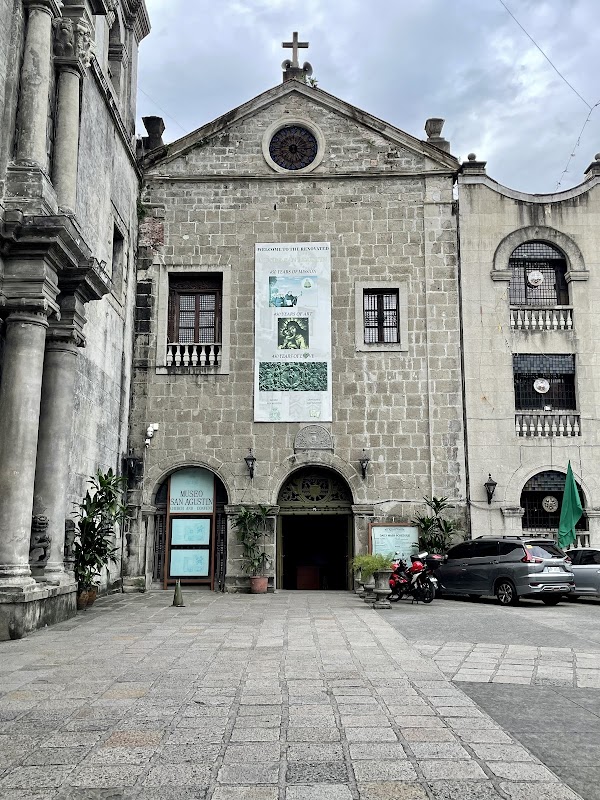
San Agustin Church is the oldest stone church in the Philippines, completed in 1607, with baroque architecture and thick walls that have survived earthquakes and wars. It is in Manila, Philippines. Most visitors spend 30–40 min here. The free Lokali audio guide runs 5 minutes.
✓ Verified August 2026 · how we write these guides
Visitor facts
| Time needed | 30–40 min |
|---|---|
| Lokali audio guide | 5 min · free |
| Type | Church |
| Best for | History |
| Location | Manila, Philippines |
| Coordinates | 14.5932, 120.9783 |
| Languages | 45, in the Lokali app |
The story
Pause at the great wooden doors before you step inside. Let your eyes follow the carvings worked deep into the old hardwood. As you cross the threshold, the air turns cool and still. Your footsteps echo across the stone floor. Light falls softly through the high windows above. Somewhere ahead, soft organ notes may drift through the nave. You have just entered the oldest stone church in the whole country.
San Agustin Church stands inside Intramuros, the old walled heart of Manila. Spanish friars of the Order of Saint Augustine built it long ago. They wanted a house of worship strong enough to last for ages. The church they raised has outlived nearly everything around it. Empires have come and gone while it stayed.
Work on this building began in 1586. A designer named Juan Macías drew the plans. The builders used adobe stone, cut and hauled from quarries beyond the city. Tradition holds that this is the third church on the site, after two earlier ones of wood and bamboo were lost. The church was finally completed in 1607. It has rested on this same ground ever since that day.
Think about what these walls have survived. Powerful earthquakes have shaken Manila many times across the centuries. Whole streets of buildings have fallen in moments. This church cracked, but it held its ground. The thick stone and the careful design carried it safely through shock after shock.
The hardest test came in 1945. In the last days of the Second World War, the battle for Manila destroyed almost all of Intramuros. Seven churches once stood within these walls. Six of them were reduced to rubble. Only San Agustin was left standing. The damage was so complete that the walled city had to be slowly rebuilt over many years. That is why so much of what you see here is truly original.
Step further in and lift your eyes to the ceiling. It looks carved and molded, full of deep panels, beams, and curves. But study it with your eyes alone. The whole surface is flat. Two Italian artists painted it in 1875 to trick the eye. Look for the painted moldings near the corners, where the trick is easiest to catch. The depth and the shadow are all a careful illusion.
Walk slowly down the long nave toward the altar. Notice how sound moves through this space. A whisper seems to travel far. A single footstep returns to your ears. The tall stone vault gathers every small noise and holds it. For more than four hundred years, prayers have risen into this same quiet air.
Along the walls you will find the tombs of important figures from the Spanish age. One of them holds Miguel López de Legazpi, the commander who founded Spanish Manila. The very man who began the city now rests inside the church that has outlived his empire by centuries.
In 1993, this church earned a great honor. UNESCO named it a World Heritage Site. It was listed together with three other old churches under the title Baroque Churches of the Philippines. The group was chosen for a style all its own, a blend of European plans with local hands and stone. Few buildings in the country carry such a title.
Beside the church stands a former monastery, now turned into a museum. Inside you will find religious paintings, old robes, carved holy images, and calm garden courtyards. The rooms hold centuries of objects gathered by the Augustinian friars. Give yourself the time to wander through them without rushing.
Look once more at the doors as you pass. The main wooden doors are carved with patterns and scenes from long ago. Hands that vanished centuries past shaped every line you see. The wood has grown dark with age and touch. Countless people have walked through them to pray, to wed, and to grieve.
Outside, find the courtyard and the old stone walls of the surrounding city. From here you can sense how the church sat at the center of daily life. Bells once marked the hours for the whole community. People measured their days by the sound that came from this tower. The sound of the bells still rings out on feast days.
Before you leave, find a quiet pew and sit for a while. The stone around you was set in place before many nations on earth even existed. It has held firm through quakes, through fire, and through war. Let the cool silence settle into you. Then rise gently, and step back out into the light.
Key facts
What to look for
Practical tips
Common questions
How long do you need at San Agustin Church?
Plan 30–40 min. That is the time most visitors spend at San Agustin Church. The free Lokali audio guide adds about 5 minutes of narration you can listen to as you walk, so it fits inside your visit rather than adding to it.
Is there a free audio guide to San Agustin Church?
Yes — the Lokali app narrates San Agustin Church free of charge in 50+ languages. It covers the history, what to look for on site and practical tips, and it works offline once downloaded.
Where is San Agustin Church?
San Agustin Church is in Manila, Philippines, at 14.5932, 120.9783. Tap the map link on this page for directions from where you are.
What should you know before visiting San Agustin Church?
Speak softly inside; services and prayer happen here.
What is San Agustin Church known for?
Construction began in 1586, designed by Juan Macías.
What is the best time to visit San Agustin Church?
The church is quieter than the cathedral and cooler inside—its thick stone walls keep it remarkably calm.
On the map
Opens directions to San Agustin Church from your location.
More to see in Manila


Hear San Agustin Church in your language
The full story, narrated, in 50+ languages. Download it before you go and it plays offline, at your own pace, with no ticket and no tour group.