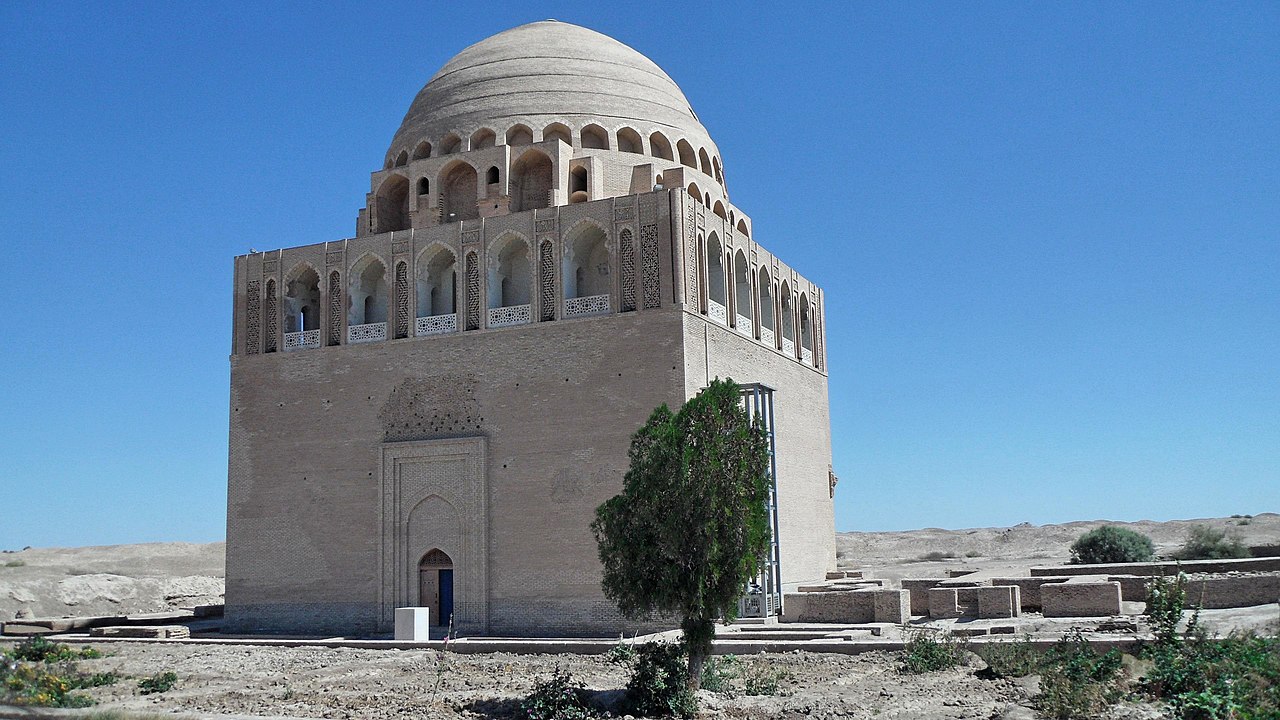
Mausoleum of Sultan Sanjar
37.6090° N · 61.8390° E · Mausoleum
Mausoleum of Sultan Sanjar is a mausoleum in Mary City, TM. Built in 1157, this turquoise-domed mausoleum honours Sultan Sanjar, a Seljuk ruler. Most visitors spend 30–45 min here. The free Lokali audio guide runs 5 minutes.
✓ Verified August 2026 · how we write these guides
Visitor facts
| Time needed | 30–45 min |
|---|---|
| Lokali audio guide | 5 min · free |
| Type | Mausoleum |
| Best for | History |
| Location | Mary City, TM |
| Coordinates | 37.6090, 61.8390 |
| Languages | 45, in the Lokali app |
The story
A great square mass of brick rises before you. The sun warms its walls to a soft gold. Above it sits a single broad dome. The desert is quiet all around. This is the resting place of Sultan Sanjar, a ruler of the Seljuk Turks, who died in 1157.
The tomb stands within Sultan Kala. That was the grandest of the walled cities of old Merv, near the modern town of Mary. In its day this whole quarter was full of life. Houses, markets, and mosques pressed close together. Now most of that is low ruin. The mausoleum remains, tall and almost whole. A few low walls and broken arches mark where the streets once ran. The tomb stands almost alone now, a single tall shape on the flat ground.
Sultan Sanjar ruled a wide realm in the twelfth century. His power stretched across much of the eastern Islamic world. Merv was one of his chief cities. The building was raised as a tomb fit for such a ruler. It was meant to last, and it has. He was one of the last strong rulers of his line. After him, the Seljuk hold on this land began to fade.
Step closer and look at the brick. The whole structure is built from it, baked and laid with great care. The walls are thick and plain near the ground. Higher up they break into arches, galleries, and patterns. Brick alone, set in many ways, becomes the decoration. Patterns of light and shadow play across the surface through the day.
The shape is simple and strong. The base is a square, about as wide as the building is tall. On this cube sits the dome. The form is calm and balanced. It does not lean on color or gold. Its power comes from sheer mass and clean line. Seen from a distance, it reads as one clear, solid block. Up close, the details slowly appear.
The dome is the great achievement here. It is built as two shells, one inside the other. The inner dome closes the chamber below. The outer dome rises above it, taller and broader. This double-shell method was advanced for its time. Builders far away would later use the same idea.
Once the outer dome carried a skin of blue and turquoise tiles. Old travelers said it shone in the sun. Some wrote that it could be seen a full day's journey away, as a caravan still crossed the desert toward the city. The tiles are long gone now. The bare brick remains.
Records name the builder as a master called Muhammad ibn Atsiz, from the nearby town of Serakhs. To raise such a dome by hand, without modern tools, took deep skill. Every arch had to carry its load down to the ground. The fact that it still stands is its own proof. Their names are mostly lost, but their work still holds up the sky here.
In 1221 the Mongols came to Merv. They broke the city and burned much of it. The tomb was looted and scorched, but the walls held. While the cities around it fell to dust, this one building kept its shape. It became almost the last witness of the Seljuk age here. For many travelers it is the first part of Merv they see.
Step inside, and the air turns cool and dim. Light falls from openings high in the walls. Look up into the curve of the inner dome. The space is large and bare. Your footsteps echo. The noise of the desert outside drops away to nothing. Pause here and let your eyes adjust. The shape of the room opens up above you.
In recent years the building was repaired. Workers strengthened the walls and the dome and cleared away later damage. The aim was to hold the structure steady for the future. Such old brickwork needs constant care, or wind and rain slowly pull it apart.
Walk a slow circle around the outside. Watch how the light changes on each face as you move. See the deep shadows under the high arches. Notice how the great dome seems to shift its shape against the sky. The building rewards a quiet, patient look. Morning and evening light suit it best.
Sultan Sanjar lost his last battles late in life. His empire broke apart soon after he died. Yet here his tomb still stands, long after the power it honored has gone. In the silence of the plain, the brick keeps its watch, and holds the memory of a vanished age.
Key facts
What to look for
Practical tips
Common questions
How long do you need at Mausoleum of Sultan Sanjar?
Plan 30–45 min. That is the time most visitors spend at Mausoleum of Sultan Sanjar. The free Lokali audio guide adds about 5 minutes of narration you can listen to as you walk, so it fits inside your visit rather than adding to it.
Is there a free audio guide to Mausoleum of Sultan Sanjar?
Yes — the Lokali app narrates Mausoleum of Sultan Sanjar free of charge in 50+ languages. It covers the history, what to look for on site and practical tips, and it works offline once downloaded.
Where is Mausoleum of Sultan Sanjar?
Mausoleum of Sultan Sanjar is in Mary City, TM, at 37.6090, 61.8390. Tap the map link on this page for directions from where you are.
What should you know before visiting Mausoleum of Sultan Sanjar?
Step inside to feel the cool, dim chamber.
What is Mausoleum of Sultan Sanjar known for?
Tomb of Seljuk ruler Sultan Sanjar, died 1157.
What is the best time to visit Mausoleum of Sultan Sanjar?
The interior dome creates a striking acoustic effect.
On the map
Opens directions to Mausoleum of Sultan Sanjar from your location.
More to see in Mary City

Hear Mausoleum of Sultan Sanjar in your language
The full story, narrated, in 50+ languages. Download it before you go and it plays offline, at your own pace, with no ticket and no tour group.