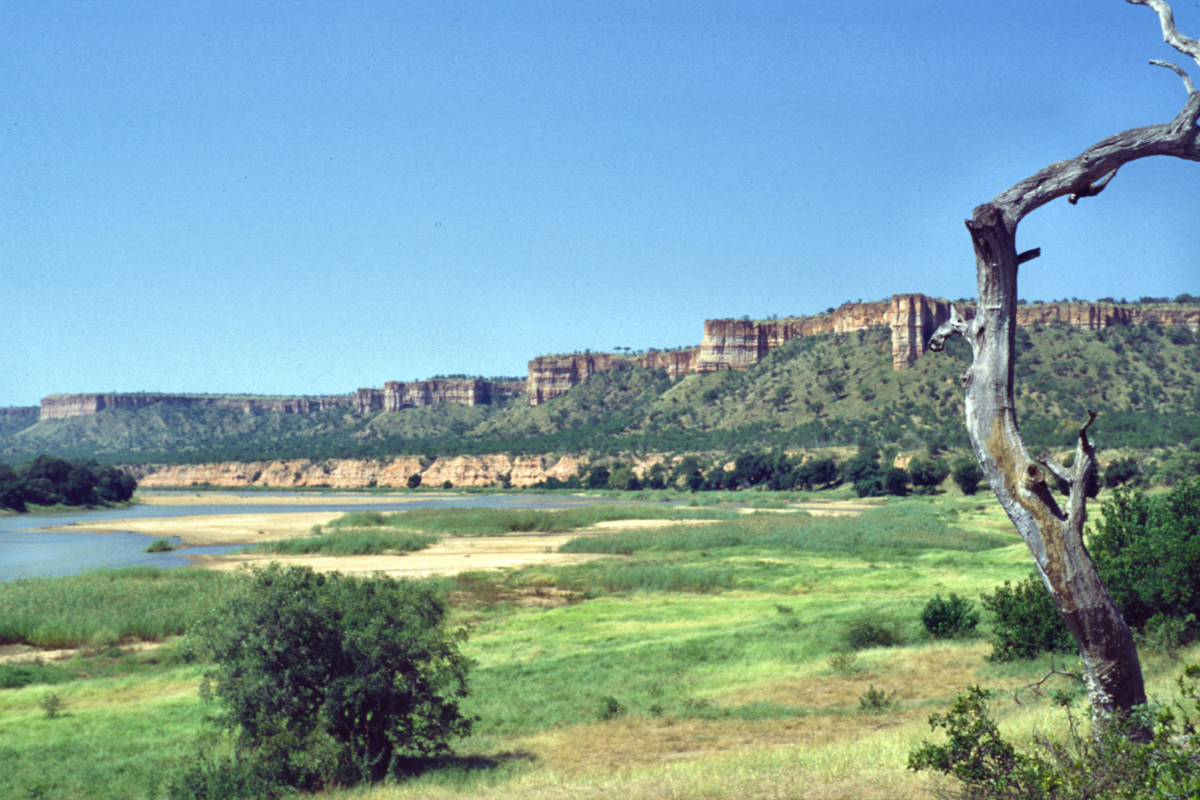
Gonarezhou National Park
21.6667° S · 31.6667° E · National Park
Photo: Ralf Ellerich · CC BY-SA 3.0 · Wikimedia Commons
Gonarezhou National Park is a national park in Zimbabwe. Gonarezhou roughly means place of many elephants in Shona. The free Lokali audio guide runs 7 minutes.
✓ Published October 2026 · how we write these guides
Visitor facts
| Lokali audio guide | 7 min · free |
|---|---|
| Type | National Park |
| Location | Masvingo, Zimbabwe |
| Coordinates | -21.6667, 31.6667 |
| Official website | zimparks.org |
| Languages | 50+, in the Lokali app |
The story
Listen first. A dry wind moves through the mopane leaves with a papery rustle. Somewhere a hornbill calls, a hollow, rising note. Underfoot, the sand is pale and soft, pressed into the round prints of something very large that passed here not long ago. The air smells of dust, warm bark, and, after rain, wet earth. Welcome to Gonarezhou, in the far southeast corner of Zimbabwe, a short drive from the sugar town of Chiredzi.
The name gives away the park's main character. In the Shona language, Gonarezhou is usually translated as the place of many elephants. That is not poetic exaggeration. Elephants are the backbone of this landscape. They shape the woodland, open paths to water, and push over trees that other animals then feed on. As you travel through the park, watch for broken branches and stripped bark. These are the daily signatures of the herds.
Gonarezhou is Zimbabwe's second largest national park, after Hwange in the west. It covers roughly five thousand square kilometres of dry woodland, river valleys, and sandstone ridges. That size matters. Distances here are long, roads are rough, and settlements are few. You can drive for an hour and see no other vehicle. For many visitors, that silence is the real reason to come. This is a park that has not been smoothed out for crowds.
Three rivers give the park its structure. The Save runs along the northeast, the Runde cuts through the middle, and the Mwenezi crosses the south. In the dry season they shrink into wide channels of sand, with a few deep pools that hold water all year. Those pools become the centre of life. Elephants, buffalo, and antelope walk long distances to reach them. Crocodiles wait in the deeper water. If you want to understand the park, follow the water.
Now for the image most people carry home. Along the Runde River rise the Chilojo Cliffs — a long wall of sandstone in shades of red, orange, and cream. The rock is layered in bands, laid down over an immense span of geological time and then carved by the river. Late in the afternoon the sun hits the cliff face directly, and the colours deepen almost by the minute. Many travellers say this is the most memorable view in Zimbabwe. It is hard to argue with them.
Here is something many visitors miss. The cliffs look most dramatic from below, from the riverbed, where they fill the whole horizon. But the view from the top is completely different. From the plateau, you look down across the wide sandy bed of the Runde and out over a sea of trees. Elephants on the riverbank look like small grey stones. If you can, see the cliffs from both levels. It feels like visiting two separate places.
The elephants of Gonarezhou have a reputation, and it is worth knowing before you meet them. For decades, this region suffered from poaching and from conflict, including the war that came before Zimbabwe's independence. The herds learned to be wary of people and vehicles. Some still react with mock charges, loud trumpeting, and raised ears. Guides here often say these elephants remember. Whether that is memory or simply caution, the lesson is the same — give them space, and they will usually give you space too.
Gonarezhou does not stand alone. It forms part of the Great Limpopo Transfrontier Park, a cross-border conservation area that links it with Kruger National Park in South Africa and Limpopo National Park in Mozambique. The idea is simple. Animals do not follow national borders, so the parks try to manage the land as one connected system. In practice, the linking corridors are still a work in progress. But the vision is large: one of the biggest protected wildlife areas on the continent.
In recent years the park has also changed how it is run. Zimbabwe's national parks authority works with the Frankfurt Zoological Society through a partnership known as the Gonarezhou Conservation Trust. Their work has focused on anti-poaching patrols, road repairs, research, and support for the communities around the park's edges. Reports from the trust point to recovering wildlife numbers, especially elephants. It is a quieter success story than most, and you are driving through the result.
The human story here did not begin with the park. The southeast lowveld has long been home to Shangaan communities, also known as Tsonga, along with other groups. People lived along these rivers, farmed the floodplains, and hunted in the woodland. The creation of the park changed that relationship, and not always easily. Today, several community projects near the boundary try to make sure that local families share in the benefits of conservation and tourism. Ask your guide about the villages you pass on the way in.
Keep your eyes on the trees as well as the animals. Baobabs stand out across the park, with thick grey trunks and bare branches that look like roots turned toward the sky. Some are wide enough that several people could link arms around them and still not close the circle. Elephants sometimes gouge the soft wood for moisture in the dry months. You may see trunks scarred with deep grooves. Nearby, lala palms and fever trees mark places where water lies close to the surface.
Beyond elephants, the wildlife list is long. Nyala, a shy antelope with striped flanks, move through the thickets near the rivers. Lions, leopards, and hyenas hunt here, though they are harder to find than in busier parks. African wild dogs, among the most endangered large predators in Africa, also roam these lands. And the birdlife is rich. Look for fish eagles over the pools and their white heads against the red rock.
What strikes most people, in the end, is the sense of scale and stillness. There are no paved roads through the heart of the park and few buildings. At night, if you stay at a campsite, the darkness is total. The stars are dense and bright. You may hear lions calling far away, a deep rhythmic sound that carries for kilometres. Hyenas answer with their rising whoops. It is a reminder that you are a guest here.
So before you move on, pause for a moment. Look at the ground near your feet and notice the tracks — the circles of elephant prints, the small split hearts of antelope hooves. Listen to the wind in the mopane. If the Chilojo Cliffs are in view, watch how the light changes on the rock. And as you leave, remember the name. This is the place of many elephants. With care, it will stay that way.
Key facts
What to look for
Practical tips
Common questions
Is there a free audio guide to Gonarezhou National Park?
Yes — the Lokali app narrates Gonarezhou National Park free of charge in 50+ languages. The guide runs about 7 minutes, covers the history, what to look for on site and practical tips, and works offline once downloaded.
Where is Gonarezhou National Park?
Gonarezhou National Park is near Masvingo, Zimbabwe, at -21.6667, 31.6667. Tap the map link on this page for directions from where you are.
What is Gonarezhou National Park known for?
Gonarezhou roughly means place of many elephants in Shona. Zimbabwe's second largest national park after Hwange.
What should you look for at Gonarezhou National Park?
Red and cream sandstone bands on the Chilojo Cliffs. Deep grooves gouged into baobab trunks by elephants. Round elephant tracks pressed into the sandy riverbeds.
What should you know before visiting Gonarezhou National Park?
Use a high-clearance four-wheel-drive vehicle for park roads. Visit Chilojo Cliffs in late afternoon for the warmest light.
When is the best time to visit Gonarezhou National Park?
Book campsites or lodges in advance for the dry season.
On the map
Opens directions to Gonarezhou National Park from your location.
Hear Gonarezhou National Park in your language
The full story, narrated, in 50+ languages. Download it before you go and it plays offline, at your own pace, with no ticket and no tour group.