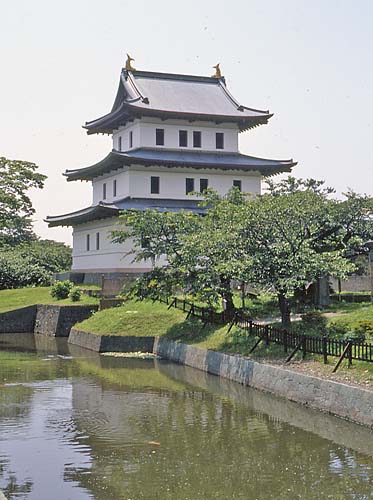
Photo: en:User:Fg2 · Public domain · Wikimedia Commons
Matsumae Castle is a Japanese castle in Matsumae, Hokkaido. Formal name is Fukuyama Castle. The free Lokali audio guide runs 6 minutes.
✓ Published October 2026 · how we write these guides
Visitor facts
| Lokali audio guide | 6 min · free |
|---|---|
| Type | Castle |
| Location | Matsumae, Japan |
| Coordinates | 41.4298, 140.1084 |
| Official website | town.matsumae.hokkaido.jp |
| Languages | 50+, in the Lokali app |
The story
Listen first. Gulls cry over the water, and wind comes up from the strait and moves through the pines on the castle hill. The air smells of salt and cold stone. In front of you, a white keep with three roofs stands on its stone base, grey tiles stacked one above the other. This is Matsumae Castle, at the southern tip of Hokkaido, Japan's northern island. For more than two centuries, this small coastal town was the edge of the Japanese world.
Its formal name is Fukuyama Castle, but almost everyone calls it after the town and the clan that ruled here. The Matsumae family held this corner of land through the Edo period, the long era of shogun rule that lasted until the 1860s. Their domain was unusual. The cold climate did not favour rice, so the clan could not count its wealth in rice harvests like other lords. Instead, its power came from trade.
That trade was with the Ainu, the Indigenous people of Hokkaido, which the Japanese then called Ezo. The Matsumae clan held the official right to control this exchange. Rice, sake, and iron goods went north. Salmon, herring, kelp, animal furs, and other northern products came south to Honshu. This trade made the clan rich. It also brought conflict and great hardship to Ainu communities, and that part of the story deserves a quiet moment here too.
Now here is the first surprise. Most Japanese castles were built in the late sixteenth and early seventeenth centuries, during the age of civil war. This one is much younger. Construction began in 1849, and the castle was completed in 1854. That makes it the last traditional Japanese castle completed during the Edo period. When it rose above the harbour, the era of samurai castles was almost over.
Why build a castle so late? The answer is out on the water. In the first half of the nineteenth century, foreign ships appeared more and more often in northern seas, including Russian vessels. The shogunate worried about this northern coast. So the Matsumae clan received permission to build a proper fortress. Gun batteries faced the strait. The new castle was designed to watch the sea and to defend it.
The second surprise follows from the first. In 1868, during the Boshin War — the civil war that ended shogun rule — the castle was attacked. The attack did not come from the sea. Former shogunate forces had sailed north to Hokkaido. Under commanders including Hijikata Toshizo, once vice-commander of the Shinsengumi police force of Kyoto, they marched overland. They struck from the land side. The castle fell in a matter of hours. A fortress built for one danger was taken by another.
After the war, the new Meiji government dismantled many castles across Japan. Here, most of the buildings were removed, but the keep survived. It stood for decades, and in 1941 it was named a National Treasure. Then, in 1949, disaster came. A fire started in the town hall nearby and spread to the old keep. The original tower burned down. Only a few years earlier, it had been one of Japan's protected treasures.
The keep you see today is a reconstruction in reinforced concrete, completed in 1961. From a distance, it follows the old silhouette closely: three storeys, white walls, curved roofs. Up close, you may notice the clean, even surfaces of modern building. Inside, the tower serves as a museum. Displays include objects connected to the Matsumae clan, such as armour and documents, and objects from Ainu culture. Take your time with the Ainu material.
But one structure here is truly old. Look for the main gate of the inner enclosure, the Honmaru Gomon. This gate survived the Meiji demolitions, and it survived the fire of 1949. It is an original Edo-period structure, protected today as an Important Cultural Property. Put your hand near the old wood and look at the dark beams and heavy iron fittings. When you walk through it, you walk through the same opening that samurai used.
Around the castle, the grounds form Matsumae Park. And in spring, this hill changes completely. The park is famous across Japan for cherry blossoms. Thousands of cherry trees grow here, from a very large number of varieties. Because different varieties bloom at different times, the season here lasts longer than in most places. Early trees open first, and later double-petalled varieties follow weeks after. In the right weeks, petals drift across the stone walls.
Some of these trees carry stories. Near the castle, the temple district holds old trees with local names and local legends. Locals tell tales of trees that were saved, transplanted, or given to the town by visitors. Treat these as folklore, but listen for them if a local guide or temple sign tells one. Many of the newer varieties were also bred here, so Matsumae has given its own names to the cherry world.
Behind the castle, a short walk takes you into a quiet area of temples and cemeteries. Here, the graves of the Matsumae lords stand among tall trees. The stone monuments are moss-covered and grey, and the ground is soft with needles and leaves. Few visitors come this far. The sound of the town fades, and you hear crows and wind. It is a good place to think about the family that built this castle.
Before you leave, turn toward the sea again. From the castle hill, you look out over the Tsugaru Strait, the water that separates Hokkaido from Honshu. On clear days, the far coast is visible as a low shape on the horizon. This was the view that worried the castle's builders. Now it is just the sea, the gulls, and the light on the water... and the white keep behind you, standing where an older keep once stood.
Key facts
What to look for
Practical tips
Common questions
Is there a free audio guide to Matsumae Castle?
Yes — the Lokali app narrates Matsumae Castle free of charge in 50+ languages. The guide runs about 6 minutes, covers the history, what to look for on site and practical tips, and works offline once downloaded.
Where is Matsumae Castle?
Matsumae Castle is in Matsumae, Japan, at 41.4298, 140.1084. Tap the map link on this page for directions from where you are.
What is Matsumae Castle known for?
Formal name is Fukuyama Castle. Completed in 1854, the last Edo-period castle.
What should you look for at Matsumae Castle?
The original Honmaru Gomon gate with iron fittings. Three tiers of grey tiled roofs on the keep. Massive fitted stones of the castle base.
What should you know before visiting Matsumae Castle?
Visit in spring for the long cherry blossom season. Walk behind the castle to the Matsumae clan graves.
When is the best time to visit Matsumae Castle?
Visit in spring for the long cherry blossom season.
On the map
Opens directions to Matsumae Castle from your location.
Hear Matsumae Castle in your language
The full story, narrated, in 50+ languages. Download it before you go and it plays offline, at your own pace, with no ticket and no tour group.