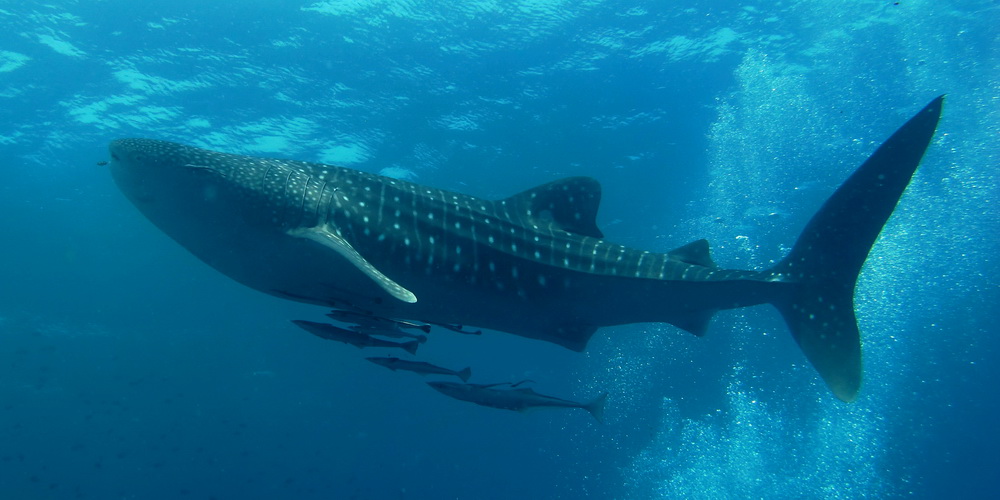
Whale Shark Encounters
23.8633° S · 35.2833° E · Marine Activity
Whale Shark Encounters is a marine activity in Maxixe, Mozambique. Tofo is a world-class hotspot for swimming alongside whale sharks, the world's largest fish. Most visitors spend 4–6 hours here. The free Lokali audio guide runs 5 minutes.
✓ Verified August 2026 · how we write these guides
Visitor facts
| Time needed | 4–6 hours |
|---|---|
| Lokali audio guide | 5 min · free |
| Type | Marine Activity |
| Best for | Photography |
| Location | Maxixe, Mozambique |
| Coordinates | -23.8633, 35.2833 |
| Languages | 45, in the Lokali app |
The story
The boat waits at the edge of the surf. You sit on its side, already wet, gripping the rope. The engine roars and the bow lifts. You punch out through the breaking waves and into the open sea. Spray stings your face. The search has begun. This is an ocean safari off Tofo, in Mozambique, hunting for the largest fish in the world.
Whale sharks are not whales at all. They are sharks, and yet there is nothing to fear in them. They have no interest in people. They feed only on plankton, the tiny drifting life of the sea, straining it from the water through their wide mouths. A single animal can grow longer than a bus and weigh more than several cars together.
The boat slows and begins to move along the coast. Everyone watches the water in silence. The guide stands at the bow and scans the surface for a dark shadow, or the tip of a fin. The sun is bright and the swell lifts and drops the boat. Minutes pass, and then more. Then someone points and shouts.
There. A great grey shape glides just beneath the surface. Pale spots cover its broad back, each one set in place like a star on a private map. The guide gives the order quickly. You pull down your mask, take a breath, and slip over the side as quietly as you can, trying not to splash.
Underwater, the world goes still and quiet. You look ahead, and the animal is simply there, huge and calm. It moves with slow, sweeping beats of its tail. You swim alongside it, never touching, keeping a respectful distance. It does not flee from you, and it does not threaten you. It just continues on, and lets you keep pace for a while.
For a few minutes you share the water with it. The shark is longer than the boat that brought you. Its mouth is wide enough to swim into, and yet it takes only plankton. Its eye, small in that vast body, seems to turn and take you in. Then it tips downward, slips into the deeper blue, and is gone.
People come from all over the world for this single moment. Tofo is one of the most reliable places on Earth to meet whale sharks. The warm Agulhas current pushes food close to the shore, and the animals follow it in. They can be found through much of the year here, with the best months running from October to March.
The same waters hold other giants. Manta rays pass overhead with their wings spread wide, moving like great slow birds. Dolphins, sea turtles, and humpback whales appear in their own seasons. Every trip out is different from the last. The ocean makes no promises to anyone. That uncertainty is part of what draws people back again.
Science lives in these waters too. In 2009, researchers founded the Marine Megafauna Foundation in Tofo to study these animals up close. They photograph each whale shark they meet, because the pattern of spots is unique, like a set of fingerprints. From the photographs they learn which sharks return, and how far they travel. Visitors are asked to share their own pictures to help.
These giants face real danger in the wider world. In some places they are hunted, and in others they are struck and killed by passing ships. Their numbers have fallen over the years. Places like Tofo, where the animals are watched and protected, matter for their future. Careful tourism gives a living shark more value than a dead one.
Back on the boat, no one speaks much at first. People are grinning, wiping salt and seawater from their eyes. The boat turns and points its bow toward the shore. The wind feels cold now against wet skin, but no one seems to mind. Something very large has just passed through the middle of an ordinary day.
There are rules to follow in the water. You keep a set distance from the animal. You do not touch it, and you do not block its path. You stay calm and move slowly. These rules protect the shark, and they protect you as well. The guides watch closely and call you back if you drift too near. Respect is the price of being allowed this close.
You ride the surf back onto the sand and climb out. Your legs are unsteady beneath you. The solid land feels strange after the long, moving sea. Out there, the shark is still swimming, just as it was before you came, and just as it will be after you leave. For a few minutes, your path and its path crossed. You will carry it with you.
Key facts
What to look for
Practical tips
Common questions
How long do you need at Whale Shark Encounters?
Plan 4–6 hours. That is the time most visitors spend at Whale Shark Encounters. The free Lokali audio guide adds about 5 minutes of narration you can listen to as you walk, so it fits inside your visit rather than adding to it.
Is there a free audio guide to Whale Shark Encounters?
Yes — the Lokali app narrates Whale Shark Encounters free of charge in 50+ languages. It covers the history, what to look for on site and practical tips, and it works offline once downloaded.
Where is Whale Shark Encounters?
Whale Shark Encounters is in Maxixe, Mozambique, at -23.8633, 35.2833. Tap the map link on this page for directions from where you are.
What should you know before visiting Whale Shark Encounters?
Choose operators who keep a respectful distance.
What is Whale Shark Encounters known for?
Whale sharks are the largest fish on Earth.
What is the best time to visit Whale Shark Encounters?
Book with a licensed operator early in your stay to secure good weather windows.
On the map
Opens directions to Whale Shark Encounters from your location.
More to see in Maxixe

Hear Whale Shark Encounters in your language
The full story, narrated, in 50+ languages. Download it before you go and it plays offline, at your own pace, with no ticket and no tour group.