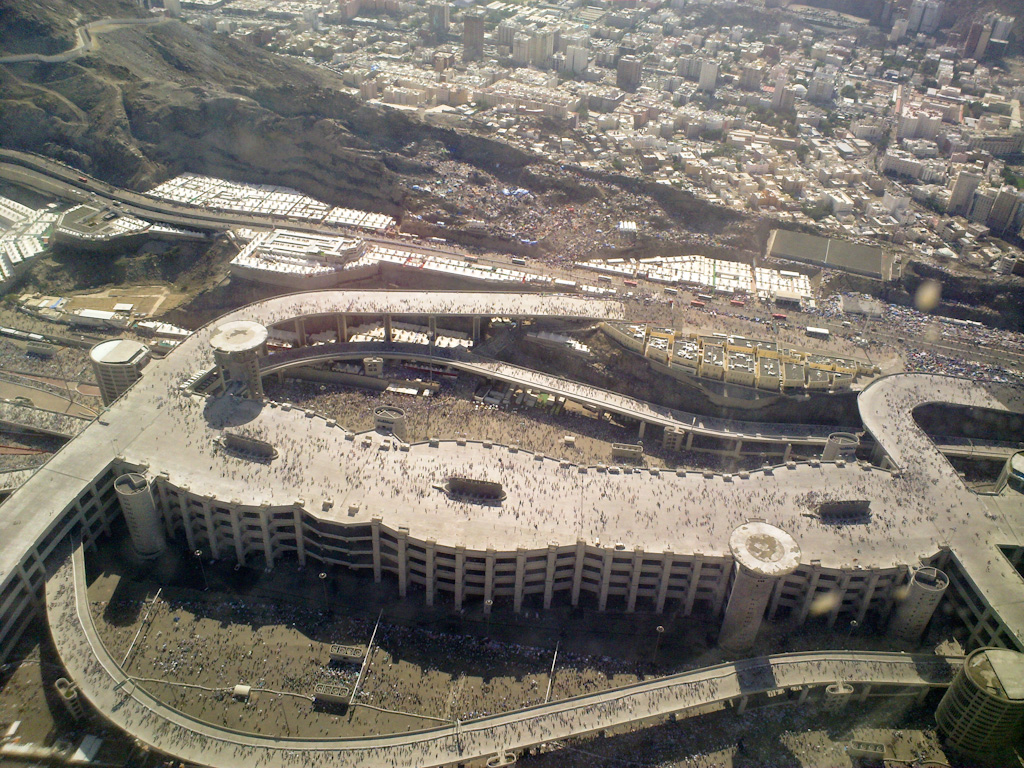
Photo: Al Jazeera English · CC BY-SA 2.0 · Wikimedia Commons
Jamaraat Bridge is an architectural structure. It is near Mecca, Saudi Arabia. The bridge stands in Mina, within the sacred area of Mecca. The free Lokali audio guide runs 7 minutes.
✓ Published October 2026 · how we write these guides
Visitor facts
| Lokali audio guide | 7 min · free |
|---|---|
| Type | Bridge |
| Location | Mecca, Saudi Arabia |
| Coordinates | 21.4214, 39.8728 |
| Languages | 50+, in the Lokali app |
The story
Listen first. Thousands of footsteps move in one direction, a soft roar of sandals on concrete. Above it rises a murmur of prayer in dozens of languages. Then comes a sharp, scattered sound, like hail on stone. These are small pebbles striking a wall. You are standing at the Jamaraat Bridge in Mina, a few kilometres east of the Grand Mosque in Mecca. Here, during the days of Hajj, pilgrims perform one of the oldest and most physical rites of the pilgrimage.
The rite is called Ramy al-Jamarat, the stoning of the jamarat. The word jamarat refers to small pebbles, and also to the three places where they are thrown. Each pilgrim throws seven pebbles at a time, one after another. With each throw, many pilgrims say God is Great. The act is simple. Its meaning, for those who perform it, is not. It is a rejection of temptation, made with the hand and the whole body, not only with words.
Muslim tradition traces this ritual to the Prophet Abraham, known in Arabic as Ibrahim. According to the tradition, Satan appeared to Abraham in this valley three times. Each time, he tried to turn Abraham away from obeying God. Each time, Abraham drove him off by throwing stones. The three walls in front of you mark those three places. Muslims also hold that the Prophet Muhammad performed this rite during his final pilgrimage, and pilgrims follow his example today.
The three sites have names. The first and smallest is Jamrat al-Ula. The middle one is Jamrat al-Wusta. The largest, often called the big jamrah, is Jamrat al-Aqabah. On the tenth day of the month of Dhul Hijjah, the day of Eid al-Adha, pilgrims stone only the largest. On the days that follow, they stone all three, in order, from the smallest to the largest. Many pilgrims pause after the first two to make a personal prayer.
Here is a detail many visitors miss. For centuries, the jamarat were narrow stone pillars. Pilgrims crowded around a small target, and many pebbles missed and struck other people. In 2004, the authorities replaced the pillars with long, wide walls. A wall gives far more people space to throw at once. The basins around each wall also catch the falling stones. It looks like a small change. In practice, it changed the safety of the whole rite.
The structure you see today has a sobering history. An earlier bridge stood here for decades, but the number of pilgrims grew far beyond what it could carry. In January 2006, a crush near the bridge killed several hundred people. Soon after, the old bridge was demolished. A new, much larger structure was built in its place over the following years. It was designed around one idea: keep huge crowds moving, and never let them stop.
Look at the building itself. It is less a bridge than a long, layered platform, several storeys high. Each level gives pilgrims another way to reach the three walls. The walls rise through every floor, so a pilgrim on the top level and a pilgrim at ground level throw at the same jamrah. Wide ramps lead up from the surrounding streets. The concrete is plain and functional. Nothing here is decorative. Every surface exists to move people safely.
The second surprise is in how you walk. The bridge works on a one-way system. Pilgrims enter from one side, throw their pebbles, and leave from the other. Nobody is meant to turn back against the flow. Exits are wide and frequent. Pilgrim groups are also given scheduled times to come, so that the whole valley does not arrive at once. The calm you feel in the crowd is partly faith, and partly very careful planning.
Where do the pebbles come from? Most pilgrims gather them the night before, at Muzdalifah, an open plain between Arafat and Mina. People sit on the ground under the night sky and search the earth for small stones, about the size of a chickpea. Some wash them. Some count them carefully into small bags. It is one of the quietest moments of the Hajj. The stones that sound like hail here began the night in the dark, in someone's patient hand.
Now consider the valley around you. Mina is a narrow valley, ringed by low, rocky hills. For most of the year, it stands almost empty. During Hajj, it becomes a city of white tents, stretching in long, even rows. Pilgrims sleep here, pray here, and walk from here to the bridge. The tents are fire-resistant, a lesson learned from earlier disasters. When you look out from an upper level, you see the scale of this temporary city.
The human texture of this place is extraordinary. Look at the clothing. Men wear the ihram, two plain, unstitched white cloths. Women wear simple, modest dress in many styles. Pilgrims come from Indonesia, Nigeria, Turkey, Pakistan, Bosnia, and almost every country in between. Many groups carry flags or wear matching scarves, so that members do not get lost. Older pilgrims are sometimes pushed in wheelchairs. Families hold hands in long chains through the crowd.
Notice also the emotions on people's faces. Some pilgrims throw with force, almost with anger. Others throw gently, eyes half-closed. Some laugh with relief after the final pebble. Some cry. Scholars teach that the stones do not strike Satan himself. The act is a symbol of a person's own struggle against the worst parts of themselves. Each pilgrim brings a private story to the wall. You see only the throw.
When the rite on the tenth day is complete, pilgrims move on to the next steps of Hajj. Many shave or cut their hair. They offer or arrange the sacrifice of an animal, in memory of Abraham. Many then return to the Grand Mosque. The bridge is one stop in a long, carefully ordered journey. For a few days each year, though, it is where millions of people choose, with their own hands, to begin again.
As you leave, listen once more. The footsteps keep moving. The prayers continue in many languages. Behind you, the small stones keep falling into the basins, one after another. Look at the person walking beside you. You may not share a language, but you have just done the same thing, in the same place. Walk slowly with the crowd. There is no need to rush now.
Key facts
What to look for
Practical tips
Common questions
Is there a free audio guide to Jamaraat Bridge?
Yes — the Lokali app narrates Jamaraat Bridge free of charge in 50+ languages. The guide runs about 7 minutes, covers the history, what to look for on site and practical tips, and works offline once downloaded.
Where is Jamaraat Bridge?
Jamaraat Bridge is near Mecca, Saudi Arabia, at 21.4214, 39.8728. Tap the map link on this page for directions from where you are.
What is Jamaraat Bridge known for?
The bridge stands in Mina, within the sacred area of Mecca. Three walls mark where Abraham rejected Satan, by tradition.
What should you look for at Jamaraat Bridge?
Long walls rising through every level of the structure. Basins around each wall catching the falling pebbles. Group flags and matching scarves held above the crowd.
What should you know before visiting Jamaraat Bridge?
Gather chickpea-sized pebbles at Muzdalifah the night before. Arrive at the time your Hajj group is assigned.
When is the best time to visit Jamaraat Bridge?
Leave large bags behind to move freely in crowds.
On the map
Opens directions to Jamaraat Bridge from your location.
More to see in Mecca


Hear Jamaraat Bridge in your language
The full story, narrated, in 50+ languages. Download it before you go and it plays offline, at your own pace, with no ticket and no tour group.