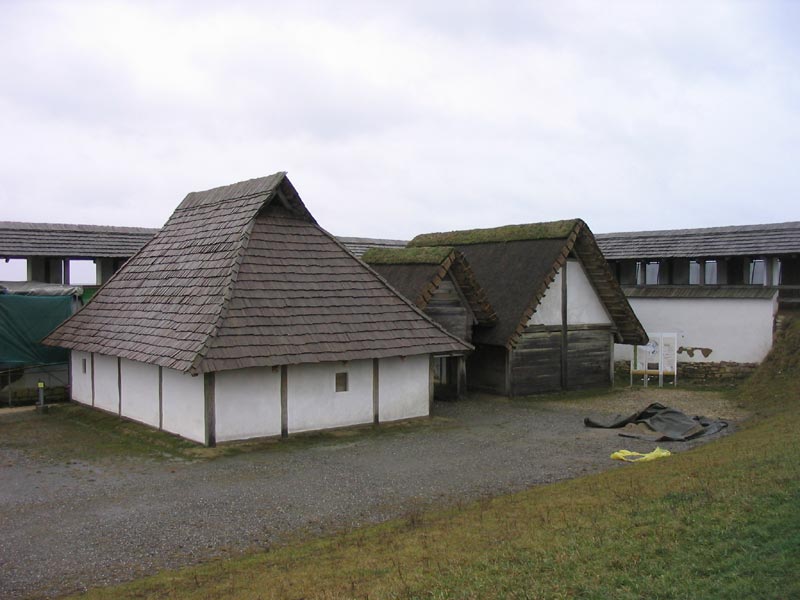
Photo: Ulf at German Wikipedia · CC BY-SA 3.0 · Wikimedia Commons
Heuneburg is an iron age hillfort in Germany. Early Celtic Hallstatt hillfort on the upper Danube. The free Lokali audio guide runs 7 minutes.
✓ Published October 2026 · how we write these guides
Visitor facts
| Lokali audio guide | 7 min · free |
|---|---|
| Type | Archaeological Site |
| Location | Meßkirch, Germany |
| Coordinates | 48.0947, 9.4119 |
| Official website | heuneburg-pyrene.de |
| Languages | 50+, in the Lokali app |
The story
Feel the ground under your feet first. The grass on this plateau is soft and springy, and the wind comes up from the valley below, carrying the cool smell of river water. Down there, the young Danube runs green and quiet between fields and willows. Up here, on this raised spur of land, it is very still. Only the birds, the grass, and a pale wall that looks strangely out of place in the German countryside. That wall is the first clue that something unusual happened on this hill.
You are standing at the Heuneburg, an early Celtic hillfort on the upper Danube. It is not inside Meßkirch itself, but a short drive away, in the rolling country of Upper Swabia. This is one of the most important prehistoric sites in Central Europe. Around two and a half thousand years ago, this hilltop was a centre of power, trade, and craft. Archaeologists have dug here for many decades, and they are still finding new pieces of the story.
The people who lived here belonged to what archaeologists call the Hallstatt culture. That name comes from a salt-mining village in Austria, where the culture was first identified. It describes the early Iron Age in this part of Europe, roughly the eighth to the fifth centuries before Christ. These people did not leave written records of their own. Everything we know comes from the soil — postholes, burnt timber, broken pots, bones, jewellery, and graves.
Now look again at that pale wall. Here is the first surprise. In the sixth century before Christ, the builders of the Heuneburg made part of their defensive wall from sun-dried mudbricks, set on a foundation of limestone. This was a Mediterranean building method, used in Greece and around the warm southern seas. North of the Alps, it is almost unknown. In a land of rain and frost, someone chose a southern style... and that choice tells us a great deal.
Why would a Celtic ruler build a Greek-style wall in a rainy German valley? Nobody knows for certain. One idea is that a builder had travelled south, or that a southern craftsman came north. Another idea is simple prestige. A white, towered wall looked modern and impressive, a sign of contact with the wider world. Whatever the reason, the mudbrick needed constant care. Water is its enemy. The wall section you see today is a modern reconstruction, built to show how it may have looked.
Those contacts with the south were real, not imagined. Excavations here have found fragments of Greek pottery, including fine painted drinking vessels, and pieces of amphorae. Amphorae are tall clay jars that carried wine and oil across the Mediterranean. So wine from the south reached this hilltop, probably along river routes like the Rhône and the Rhine. Imagine the scene: a feast in a timber hall, with imported wine poured into Greek cups, far from the sea.
And the settlement was much larger than this hilltop. Below and around the fortified plateau, archaeologists traced a lower town and a wide outer settlement, protected by ditches and earth ramparts. At its peak, the Heuneburg may have been home to several thousand people. That estimate is still debated, but even the cautious figures make it one of the earliest town-like places north of the Alps. Farmers, potters, metalworkers, and traders all lived in its shadow.
Here is the second surprise. The Greek historian Herodotus, writing in the fifth century before Christ, mentioned a Celtic city called Pyrene, near the source of the Danube. Some researchers think Pyrene could have been the Heuneburg. It is an attractive idea, and the open-air museum uses the name Pyrene for its Celtic town. But please hold it lightly. It is a hypothesis, not a proven fact. Herodotus also had strange ideas about where the Danube began.
The name Heuneburg is much younger than the fort. It comes from the German language of later centuries. The word is often linked with old ideas of giants or Huns. Locals say that people in the Middle Ages looked at these huge earthworks and believed that giants must have built them. It is a folk explanation, not documented history, but it is easy to understand. Even today, the scale of the ramparts makes people stop and stare.
Now turn your attention to the landscape beyond the plateau. Scattered across the countryside are large burial mounds, built for the elite of this society. The most famous is the Hohmichele, in the forest not far away. It is one of the largest burial mounds in Central Europe. Inside, excavators found graves with rich goods, including a wagon. These mounds were meant to be seen, a lasting mark of power on the horizon.
In 2010, archaeologists made another remarkable find nearby, at a place called Bettelbühl. They discovered the grave of a high-status woman, rich with gold and amber jewellery. Rather than dig it out in the field, they lifted the whole grave in one huge block of earth and moved it to a laboratory. There, specialists could study every detail slowly and carefully. Finds like this show that powerful women held an important place in this society.
The glory of the hilltop did not last forever. Around the middle of the sixth century before Christ, a great fire swept through the settlement, and the mudbrick wall was destroyed. Afterwards, the people rebuilt, but in their traditional style, with timber and earth. The southern experiment was over. Later, by the fifth century before Christ, the site lost its importance. Why it declined is still a question for researchers.
As you walk through the open-air museum, take your time with the reconstructed houses. They show the timber frames, the steep roofs, and the simple interiors of early Iron Age life. Step inside one and notice the low light, and the smell of wood and earth. Then walk to the edge of the plateau. From there, you can see why people chose this spot: a natural lookout above a river, with the valley spread out below.
Before you leave, stand for a moment beside the pale wall again. Feel the wind from the Danube, and listen to how quiet it is now. Two and a half thousand years ago, this hill was full of voices, smoke, hammering, and the clink of foreign cups. Today there is grass, sky, and the slow river. As you walk back down the slope, look at the gentle ridges in the fields... some of them are old ramparts, still holding their shape.
Key facts
What to look for
Practical tips
Common questions
Is there a free audio guide to Heuneburg?
Yes — the Lokali app narrates Heuneburg free of charge in 50+ languages. The guide runs about 7 minutes, covers the history, what to look for on site and practical tips, and works offline once downloaded.
Where is Heuneburg?
Heuneburg is near Meßkirch, Germany, at 48.0947, 9.4119. Tap the map link on this page for directions from where you are.
What is Heuneburg known for?
Early Celtic Hallstatt hillfort on the upper Danube. Mudbrick wall on stone base, sixth century before Christ.
What should you look for at Heuneburg?
The pale reconstructed mudbrick wall on its stone footing. Steep roofs and timber frames of reconstructed Iron Age houses. The green Danube winding through the valley below.
What should you know before visiting Heuneburg?
Plan a short drive from Meßkirch to reach the site. Wear sturdy shoes for grassy, uneven ground on the plateau.
On the map
Opens directions to Heuneburg from your location.
More to see near Heuneburg


Hear Heuneburg in your language
The full story, narrated, in 50+ languages. Download it before you go and it plays offline, at your own pace, with no ticket and no tour group.