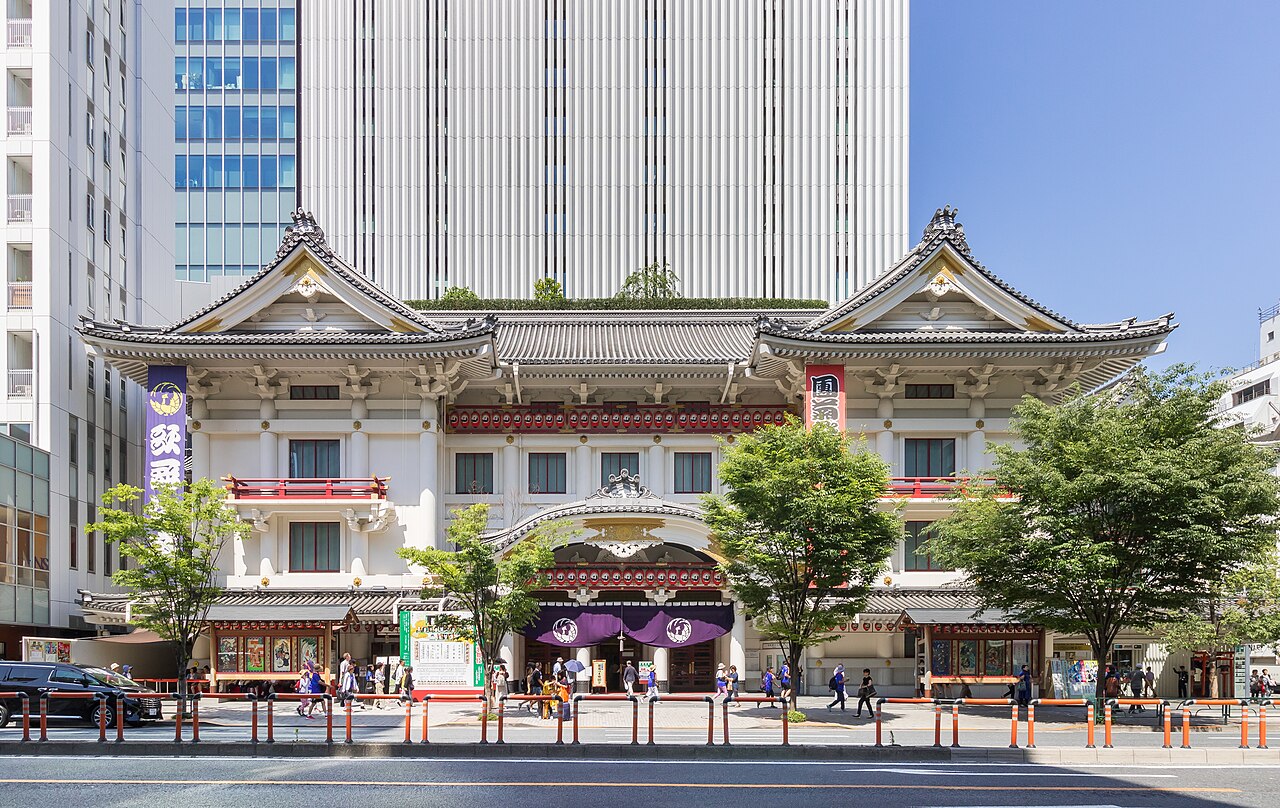
Kabuki-za Theatre is a theatre in Minato, Japan. Japan's principal kabuki playhouse, rebuilt in 2013 with a modern glass and steel tower above the historic facade. Most visitors spend 1–4 hours here. The free Lokali audio guide runs 5 minutes.
✓ Verified August 2026 · how we write these guides
Visitor facts
| Time needed | 1–4 hours |
|---|---|
| Lokali audio guide | 5 min · free |
| Type | Theatre |
| Best for | Editors' pick |
| Location | Minato, Japan |
| Coordinates | 35.6653, 139.7630 |
| Languages | 45, in the Lokali app |
The story
You come around the corner in Ginza, and the building stops you. Among the glass and the brand-name shops stands a great tiled roof, curving up at the ends, with red lanterns hung across the front. It looks like a castle or a palace from another age, set down in the middle of a modern shopping street. This is the Kabuki-za, the home of kabuki theater in Tokyo.
Kabuki is one of the old performing arts of Japan. It began about four hundred years ago and grew into a theater of spectacle: bold painted faces, heavy silk costumes, sliding stages, and stories of love, revenge, and sacrifice. Every role, even the women, is played by a man, and some actors train from childhood, inheriting their craft and their stage names from their fathers. The result is theater that fills the eye as much as the ear.
The theater in front of you opened first in 1889, when performers and writers wanted a grand home for the art in the modern capital. But the building you see is not that first one. The Kabuki-za has been destroyed and rebuilt again and again, by fire, by earthquake, and by the bombing of the city during the war.
The hall that stands here now is the fifth on this site. It opened in 2013. The architect, Kengo Kuma, kept the look of the older theaters, with the sweeping tiled roof, the gables, and the deep eaves, so that the front still carries the style of centuries past. Then, behind it, he placed a tall glass office tower. Step back and look up, and you can see the two together: the old roofline below, the sleek tower rising straight up behind it. The two styles meet without quarreling.
Look at the front more closely. The lanterns. The painted signboards. When a run of plays is on, banners hang out front with the actors' names and family crests. The whole face of the building is meant to announce that something special is happening inside. At night the lanterns glow, and the front seems to come alive.
Now, you might think you need to commit to a long evening to see kabuki. A full program can run for hours, with several plays, intermissions, and meals eaten in your seat. But there is another way. The Kabuki-za sells single-act tickets.
These are sold for one act only, often from an upper level of the theater. You buy one on the day, climb to your seat, and watch a single scene of the performance, perhaps thirty minutes, perhaps an hour. It costs far less than a full ticket, and you do not need to know the whole story to feel the power of what happens on the stage. Many first-time visitors choose exactly this.
For the language, the theater offers earphone guides. A small device explains the action in English as it unfolds: who the characters are, what the gestures mean, why the audience suddenly calls out. Because they do call out. At dramatic moments, voices ring from the crowd, shouting the actor's house name in praise. It is allowed, even expected, and it is one of the great pleasures of being in the room.
Watch for the walkway that runs from the stage out through the audience. It is called the hanamichi, the flower path. Actors make their entrances and exits along it, passing right through the seats. When a character pauses there, the whole hall seems to hold its breath.
The makeup is worth the visit on its own. In certain plays the actors wear bold painted lines on white faces: red for heroes and passion, blue for villains and the supernatural. The costumes can weigh a great deal, layered silk that turns each movement into something larger than life. Up close, the faces look almost like carved masks.
If you do not have time for a performance, you can still come close. Below the theater there is a basement arcade reachable from the subway, with shops selling sweets, crafts, and kabuki souvenirs. The tower behind has a rooftop garden, open to anyone, with a small exhibition about the theater's long history.
Before you move on, stand across the street one more time and take in the whole front. Four hundred years of an art form, burned down and built again five times over, still drawing crowds on a Ginza corner. The roof says old; the tower says new; and inside, the painted faces and the calling voices carry on much as they have for generations. Listen for the shouts as you pass.
Key facts
What to look for
Practical tips
Common questions
How long do you need at Kabuki-za Theatre?
Plan 1–4 hours. That is the time most visitors spend at Kabuki-za Theatre. The free Lokali audio guide adds about 5 minutes of narration you can listen to as you walk, so it fits inside your visit rather than adding to it.
Is there a free audio guide to Kabuki-za Theatre?
Yes — the Lokali app narrates Kabuki-za Theatre free of charge in 50+ languages. It covers the history, what to look for on site and practical tips, and it works offline once downloaded.
Where is Kabuki-za Theatre?
Kabuki-za Theatre is in Minato, Japan, at 35.6653, 139.7630. Tap the map link on this page for directions from where you are.
What should you know before visiting Kabuki-za Theatre?
Buy a single-act ticket for a short, affordable visit.
What is Kabuki-za Theatre known for?
First opened in 1889 as Tokyo's grand kabuki theater.
What is the best time to visit Kabuki-za Theatre?
Single-act tickets are sold for ground-floor standing room, letting you dip into a show without committing to a full evening.
On the map
Opens directions to Kabuki-za Theatre from your location.
More to see in Minato

Hear Kabuki-za Theatre in your language
The full story, narrated, in 50+ languages. Download it before you go and it plays offline, at your own pace, with no ticket and no tour group.