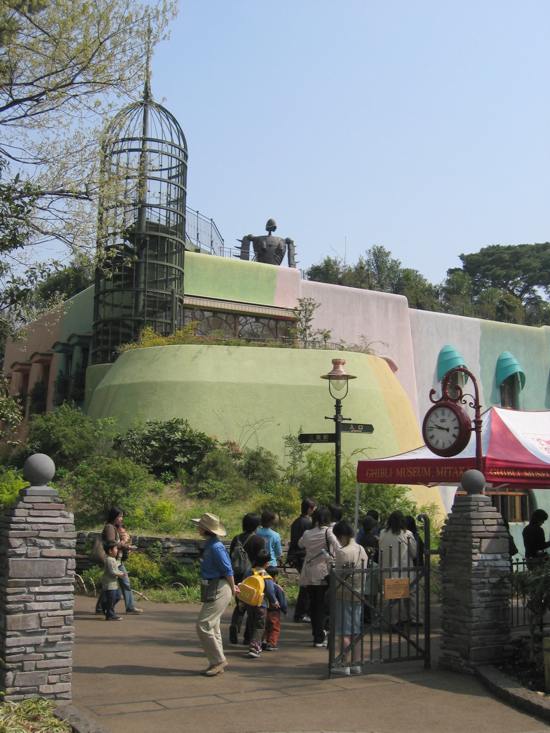
Photo: Wikimedia Commons contributor · CC BY-SA 3.0 · Wikimedia Commons
Ghibli Museum is an art museum in Mitaka, Tokyo, Japan. The museum opened to the public in 2001. The free Lokali audio guide runs 7 minutes.
✓ Published October 2026 · how we write these guides
Visitor facts
| Lokali audio guide | 7 min · free |
|---|---|
| Type | Museum |
| Location | Mitaka, Japan |
| Coordinates | 35.6962, 139.5704 |
| Official website | ghibli-museum.jp |
| Languages | 50+, in the Lokali app |
The story
Listen for a moment. Under the trees at the western edge of Inokashira Park, the city noise falls away. Leaves move overhead, a crow calls somewhere, and gravel crunches under your shoes. Then, through the green, a building appears that does not look like a museum at all. Its walls are soft pastel colours, ivy climbs the corners, and the windows are all different shapes. It looks more like a house from a storybook than a public institution.
This is the Ghibli Museum, in the quiet Tokyo suburb of Mitaka. It opened in 2001. It is dedicated to the work of Studio Ghibli, the Japanese animation studio behind films such as My Neighbor Totoro, Spirited Away, and Princess Mononoke. The building itself came from the imagination of Hayao Miyazaki, the studio's co-founder and its best-known director. He drew sketches for the museum long before construction began, in the same way he plans a film.
That detail explains a lot about what you will feel inside. This is not a gallery of glass cases and polite silence. It is closer to walking into one of the films. The museum's own motto is often translated as "Let's get lost together." There is no fixed route and no map that tells you where to go first. You are invited to wander and wonder, and to open small doors just to see what lies behind them.
Before you even reach the entrance, look for the first surprise. Beside the path there is a small ticket booth, and sitting inside it is a large Totoro, the round, grey forest spirit. But this booth sells nothing. It is a joke, and a gentle test. The real entrance is a little further on, and it is easy to walk past it if you are busy looking at Totoro.
Tickets here work differently from most museums. They must be reserved in advance, and they are not sold at the door. When you enter, you receive a ticket made from a short strip of real film. Hold it up to the light. You will see a few frames from one of the studio's animated films. Every strip is different, so visitors often compare them to guess which film and which scene they hold.
Once inside, the building opens upward. There is a central hall with a high, light-filled space. A spiral staircase and narrow walkways connect the floors, and a small iron bridge crosses overhead. Children run up and down, and adults soon follow. Look at the ceilings, the railings, and the lamps. Almost every surface has been designed with care, and many small details are easy to miss on a first visit.
One of the permanent rooms looks at how movement is created on film. Here you can see devices that come from the early days of animation, before cinema as we know it. The most memorable is a spinning zoetrope with three-dimensional figures of Totoro and other characters. When the strobe light flashes as it turns, the still figures appear to jump, run, and bounce. It is a simple trick of the eye, but it often stops visitors in their tracks.
Another set of rooms recreates the workspace where a film begins. Imagine an animator's studio, crowded and personal. Desks are covered in pencils, paints, and paper. Shelves are full of books, and sketches cover the walls, layered on top of one another. These rooms show that every animated film starts with hand drawings, one at a time. Take a slow look. Some of the books and objects reflect the artists' real inspirations, from European towns to old flying machines.
On the ground floor is the Saturn Theater, a small cinema. It shows short animated films made by the studio especially for the museum. These shorts are generally not released anywhere else, so for many fans this little screen is the only place to see them. The film changes over time, and your film-strip ticket also serves as your entry to the screening. The room is small, so the experience feels close and shared.
One important note about the interior. Photography is not permitted inside the building. At first this can feel strange in a world where everyone films everything. But many visitors find that it changes how they move through the rooms. Without a phone in hand, you look more carefully, and the memory stays with you in a different way. Outside, on the grounds and on the roof, you are free to take pictures.
That roof is where most visitors end up. Climb the outdoor spiral staircase, and you reach a rooftop garden of grasses and trees. Standing quietly among the plants is a tall robot soldier from the film Castle in the Sky. In the film, these robots are gentle guardians of a floating island, covered in moss. Here, too, it looks calm and patient. Nearby there is also a stone block with a symbol from the same film, and fans like to look for it.
For families with small children, there is a special room with a large, soft Catbus, the many-legged cat that works as a bus in My Neighbor Totoro. Young children are allowed to climb on it and roll around inside. Parents often stand at the edge and watch, sometimes wishing they were small enough to join. There is also a café called the Straw Hat Café, and a gift shop called Mamma Aiuto, named after a band of sky pirates in the film Porco Rosso.
The walk to the museum is part of the visit. From Mitaka Station, a path follows a narrow canal lined with trees, and the walk takes roughly a quarter of an hour. From the other direction, you can stroll through Inokashira Park from Kichijoji, past a pond where people row small boats. Either way, you arrive slowly, through greenery and quiet streets, which suits the spirit of the place well.
As you leave, turn around once more and look at the building. Notice the uneven windows, the ivy, and the colours that seem to change with the light. Listen to the children still laughing inside, and to the leaves moving in the park around you. Then check the film strip in your pocket. A few frames of a story are now yours to keep, and the walk home under the trees is waiting for you.
Key facts
What to look for
Practical tips
Common questions
Is there a free audio guide to Ghibli Museum?
Yes — the Lokali app narrates Ghibli Museum free of charge in 50+ languages. The guide runs about 7 minutes, covers the history, what to look for on site and practical tips, and works offline once downloaded.
Where is Ghibli Museum?
Ghibli Museum is in Mitaka, Japan, at 35.6962, 139.5704. Tap the map link on this page for directions from where you are.
What is Ghibli Museum known for?
The museum opened to the public in 2001. Hayao Miyazaki sketched the museum's design himself.
What should you look for at Ghibli Museum?
The fake ticket booth with Totoro sitting inside. The robot soldier standing in the rooftop garden. The flashing zoetrope with bouncing Totoro figures.
What should you know before visiting Ghibli Museum?
Reserve your ticket in advance; none are sold at the door. Walk the canal path from Mitaka Station for a calmer arrival.
On the map
Opens directions to Ghibli Museum from your location.
More to see near Ghibli Museum


Hear Ghibli Museum in your language
The full story, narrated, in 50+ languages. Download it before you go and it plays offline, at your own pace, with no ticket and no tour group.