Trowulan
7.5500° S · 112.3667° E · Archaeological Site
Photo: Gunawan Kartapranata · CC BY-SA 3.0 · Wikimedia Commons
Trowulan is an archaeological site in Indonesia. Widely believed to be the Majapahit kingdom's royal capital. The free Lokali audio guide runs 7 minutes.
✓ Published October 2026 · how we write these guides
Visitor facts
| Lokali audio guide | 7 min · free |
|---|---|
| Type | Archaeological Site |
| Location | Mojokerto, Indonesia |
| Coordinates | -7.5500, 112.3667 |
| Languages | 50+, in the Lokali app |
The story
Start with the colour. Almost everything here is red: old bricks the shade of dried earth, worn smooth at the edges, warm under your palm by late morning. Between the ruins you will hear roosters, a motorbike passing on a village lane, and maybe the dull knock of someone working clay. Trowulan does not rise from the ground in one great monument. It lies spread across fields and villages, piece by piece. Somewhere under these rice paddies and kitchen gardens are the remains of a royal city.
That city most likely belonged to Majapahit, the Hindu-Buddhist kingdom that grew from East Java into one of the largest powers in Southeast Asian history. Majapahit was founded at the end of the thirteenth century, and tradition credits its founding to a prince named Raden Wijaya. Over the next two centuries its influence reached across much of the Indonesian archipelago and beyond. Most historians and archaeologists believe that Trowulan was its capital. The case comes from texts, from the ruins, and from an enormous scatter of everyday objects found in the soil.
The most famous text is a long court poem called the Nagarakertagama. It was written in 1365 by a Buddhist court poet known as Mpu Prapanca. In it, he praised his king, Hayam Wuruk, and described the royal capital: its walls, gates, courtyards, and religious buildings. For modern researchers, the poem works like an old travel guide. They compare its descriptions with what lies in the ground here. The match is not perfect, but it is close enough to keep scholars coming back.
Now look again at the brick. This is one of the first surprises of Trowulan. The famous temples of Central Java, such as Borobudur and Prambanan, are built mostly of grey volcanic stone. Majapahit builders here worked mainly in fired red brick. They often laid the bricks with very fine joints, and sometimes they carved decoration directly into the brick after it was set. Brick is softer than stone, so it weathers differently. Watch how the corners have rounded and how the surfaces have turned rough and pale in places.
One of the best-known structures is Candi Wringin Lawang, a tall split gateway. In Javanese and Balinese design, this type is called a candi bentar: imagine a single tower cut cleanly down the middle, with the two halves pulled apart to make a passage. You can still see this gate form today at temples and homes on the island of Bali. The name Wringin Lawang is usually explained as banyan gate. Standing between the two halves, you are walking through a shape that Majapahit helped to pass on.
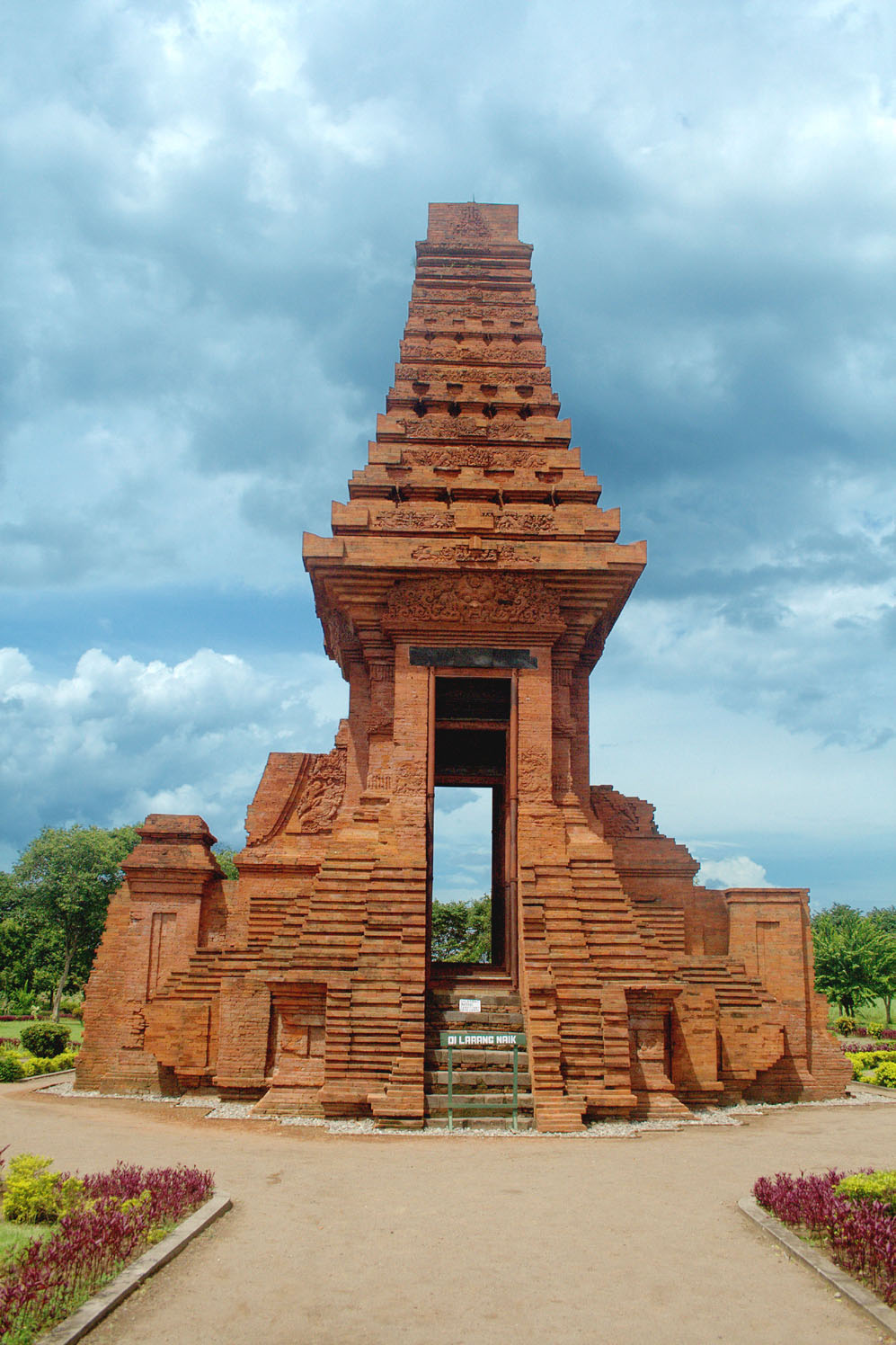
A second gateway, Candi Bajang Ratu, has a different form. It is a roofed gate called a paduraksa, where the two sides join overhead. Its tall, slim profile climbs in stepped layers toward the sky, and carved reliefs decorate parts of the surface. Local tradition links this gate with Jayanegara, an early Majapahit king, and with rituals held after his death. That connection is a popular explanation rather than a settled fact. Even so, the gate carries real weight in local memory.
Then there is water. Kolam Segaran is a very large rectangular pool with walls of brick. Its scale surprises many visitors; it looks less like a garden pond and more like a reservoir. People still debate its main purpose. Some suggest water storage for the city, while others point to ceremony or recreation. Locals tell a story that royal guests once threw their golden dishes into the pool after a feast to show the kingdom's wealth. Treat that as legend, but it is a good one.
Not far away is Candi Tikus, a sunken bathing structure. You look down into it from the edge, and you see steps, terraces, and small spouts where water once ran. The name means rat temple. One local explanation says the site was full of rats when people first uncovered it. Many scholars connect this structure with ideas of sacred water and the mythical mountain at the centre of the world. Water was not only practical in Majapahit. It also carried spiritual meaning.
Here is the second surprise. Some of the most moving finds from Trowulan are not grand buildings at all. They are small terracotta objects: little heads with distinct faces and hairstyles, tiny houses, animals, and roof ornaments. Some of the heads seem to show foreigners, which suggests a capital where many different peoples met and traded. Many piggy banks shaped like round pigs have also been found. Some people believe the Indonesian word for piggy bank, celengan, comes from celeng, a word for wild boar.
Several of these objects, along with statues, pottery, and fragments of foreign ceramics, are displayed in the site museum in Trowulan. Collecting here began in earnest in the 1920s. A Dutch architect named Henry Maclaine Pont helped to set up an archaeological society and studied the layout of the old city. Earlier still, in the early nineteenth century, British visitors described ruins in this area. Each generation has added pieces to the puzzle, and the puzzle is still not finished.
The living village around you is part of the story too. Trowulan is still a place of brick and clay. Many households make bricks or terracotta goods, and you may pass stacks of drying bricks beside the road. This creates a real tension. Digging for clay can damage buried remains, and it has worried archaeologists for many years. At the same time, these makers continue a craft that is centuries old. Here the past and the working present share the same soil.
As you move between the sites, notice how they appear without warning. A gateway suddenly stands above a field. A brick wall shows at the edge of a lane. It can be hard to imagine one city across this whole landscape, but that is the point. A capital is not one building. It is canals, markets, homes, workshops, shrines, and gates. Most of it has returned to the earth. Only the strongest brick and the deepest pools remain to mark the outline.
So pause for a moment before you leave. Look at the red brick in front of you, the green of the rice, and the fine dust on the path. Listen to the village going about its day. Somewhere beneath your feet, there may still be a floor where someone once swept, cooked, or counted coins into a little clay pig. Trowulan does not ask you to see a whole empire. It asks you to notice small pieces of one, and to carry them with you.
Key facts
What to look for
Practical tips
Common questions
Is there a free audio guide to Trowulan?
Yes — the Lokali app narrates Trowulan free of charge in 50+ languages. The guide runs about 7 minutes, covers the history, what to look for on site and practical tips, and works offline once downloaded.
Where is Trowulan?
Trowulan is near Mojokerto, Indonesia, at -7.5500, 112.3667. Tap the map link on this page for directions from where you are.
What is Trowulan known for?
Widely believed to be the Majapahit kingdom's royal capital. Majapahit was founded at the end of the thirteenth century.
What should you look for at Trowulan?
The split halves of the Wringin Lawang gateway. Stepped roof layers rising on the Bajang Ratu gate. Fine, tight joints between the old red bricks.
What should you know before visiting Trowulan?
Start at the site museum to understand the layout. Use a car or scooter because sites are spread out.
When is the best time to visit Trowulan?
Visit in the early morning before the heat builds.
On the map
Opens directions to Trowulan from your location.
Hear Trowulan in your language
The full story, narrated, in 50+ languages. Download it before you go and it plays offline, at your own pace, with no ticket and no tour group.