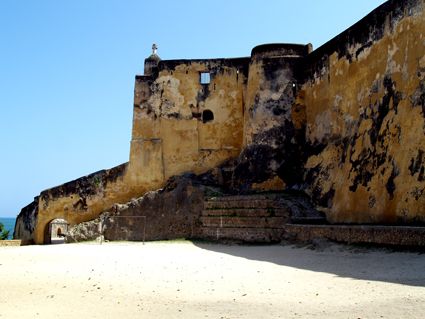
Photo: The original uploader was Zeljko at Croatian Wikipedia. · CC BY-SA 3.0 · Wikimedia Commons
Fort Jesus is a fort in Mombasa, Kenya. Built by the Portuguese in the 1590s. The free Lokali audio guide runs 7 minutes.
✓ Published October 2026 · how we write these guides
Visitor facts
| Lokali audio guide | 7 min · free |
|---|---|
| Type | National Park |
| Location | Mombasa, Kenya |
| Coordinates | -4.0712, 39.6821 |
| Official website | museums.or.ke |
| Languages | 50+, in the Lokali app |
The story
Put your hand flat against the outer wall. The stone is rough, pitted, and slightly warm. It is coral, cut from the reef and the ridge beneath your feet. Look closely and you can sometimes see the tiny tubes and patterns of creatures that lived in the sea long before anyone thought of building here. Behind you, the Indian Ocean moves against the rocks. Above you, the walls rise in pale ochre, streaked with darker stains from centuries of monsoon rain.
This is Fort Jesus. The Portuguese built it in the 1590s, at the edge of Mombasa Island, facing the narrow channel into the old harbour. Their goal was simple. Whoever held this point could watch every ship that came and went. In those years the Indian Ocean was one of the busiest trading worlds on Earth. Gold, ivory, cloth, spices, and enslaved people all moved along this coast.
The design came from an Italian architect, Giovanni Battista Cairato, who worked for the Portuguese crown across its Asian territories. He followed the newest military thinking of Renaissance Europe. Instead of tall, round towers, he used low, angled bastions — pointed corners that let defenders fire along the face of the walls. This left no blind spot where an attacker could hide. It was a European idea, built with African stone and African labour, on an island with Swahili traditions far older than the fort.
Here is something many visitors miss. Seen from the air, the fort's outline is often said to look like a human figure lying on its back. The head points toward the sea, and the arms and legs stretch out as bastions. Whether this was deliberate is debated. The name, Fort Jesus, makes the idea tempting. Either way, the shape is real, and you can trace it on the site plans inside.
Now look at the ditch around the walls. It is a dry moat, cut down into the coral rock. Digging it gave the builders much of their stone, so the moat and the walls are, in a sense, one piece of work. The sea protected one side. The ditch protected the land side. For a fort this far from Lisbon, with help months away by sail, every advantage mattered.
It did not stay peaceful. In 1631 the local ruler, Sultan Yusuf bin Hasan, who had been raised and baptised by the Portuguese, turned against them. He killed the Portuguese inside the fort and held it for a time. The Portuguese returned, but their grip on the coast grew weaker as rivals rose. The strongest rival came from across the sea, from Oman, on the Arabian Peninsula.
That rivalry led to the most famous event in the fort's life. In 1696 Omani forces surrounded Fort Jesus and began a siege. It lasted close to three years. Inside, disease spread, food ran short, and the garrison shrank to a tiny number of defenders. Relief ships came and went. Finally, in December 1698, the Omanis broke in. The fall of this fort marked the end of Portuguese power on most of the East African coast north of Mozambique.
One piece of that siege lies under the water just outside. During the fighting, a Portuguese frigate, the Santo António de Tanná, sank in the harbour below these walls. Divers and archaeologists excavated the wreck in the late twentieth century. They brought up pottery, tools, and pieces of the ship itself. Some of those finds are in the museum here. So when you look out at the calm water, remember that a warship still rests beneath it.
After 1698 the fort changed hands several times. Omani governors held it, and in the eighteenth century the local Mazrui family ruled from here with growing independence. The Portuguese briefly took it back, then lost it again. Each group repaired the walls, added rooms, and left their own marks. That is why the fort feels layered. A Portuguese gate can stand beside an Arab doorway, under a later colonial roof.
Walk to the building known as the Omani House. Its plain white walls and carved wooden doorway feel very different from the military stone around it. Inside, look at the old plaster. People scratched drawings into it — ships with masts and sails, simple figures, and lines of writing. Nobody knows the names of most of these artists. They may have been soldiers, guards, or prisoners passing long hours. These small marks bring you closer to ordinary lives than any battle date can.
In the nineteenth and twentieth centuries the fort had a quieter, harder role. Under British colonial rule, it served as a prison. The thick walls that once kept attackers out now kept people in. Later, in the mid-twentieth century, Kenya declared it a national monument and opened a museum. In 2011 UNESCO added Fort Jesus to its World Heritage List. UNESCO described it as one of the finest surviving examples of sixteenth-century Portuguese military architecture.
The museum collection is modest in size but wide in reach. You will find Chinese porcelain, Persian and Islamic ceramics, and local Swahili pottery. Together they show how connected this coast was. Ships followed the monsoon winds, which blow one way for half the year and the other way for the rest. Traders arrived, waited, and left with the next season. Mombasa was one stop on a long ring of ports linking Africa, Arabia, India, and China.
Before you leave, climb up onto the ramparts if you can. Look along the line of old cannons pointing toward the channel. Then turn around. Just beyond the fort lies Mombasa's Old Town, with narrow lanes, carved doors, balconies, and the call to prayer drifting from its mosques. The fort and the town grew side by side. One was built for war. The other was built for living, and it is still lived in today.
Stand still for a moment and listen. You may hear gulls, the hum of traffic on the road outside, a guide's voice in another language, and the steady sound of the sea. The coral under your hand has outlasted the empires that cut it. As you walk out through the gate, notice how the heat lifts from the stone. Then follow the lanes into the Old Town, and carry this place with you.
Key facts
What to look for
Practical tips
Common questions
Is there a free audio guide to Fort Jesus?
Yes — the Lokali app narrates Fort Jesus free of charge in 50+ languages. The guide runs about 7 minutes, covers the history, what to look for on site and practical tips, and works offline once downloaded.
Where is Fort Jesus?
Fort Jesus is in Mombasa, Kenya, at -4.0712, 39.6821. Tap the map link on this page for directions from where you are.
What is Fort Jesus known for?
Built by the Portuguese in the 1590s. Designed by Italian architect Giovanni Battista Cairato.
What should you look for at Fort Jesus?
Fossil patterns visible in the coral stone walls. Dry moat cut directly into the coral rock. Ship drawings scratched into Omani House plaster.
What should you know before visiting Fort Jesus?
Visit early morning before the coastal heat builds. Bring water and a hat for the open ramparts.
When is the best time to visit Fort Jesus?
Visit early morning before the coastal heat builds.
On the map
Opens directions to Fort Jesus from your location.
Hear Fort Jesus in your language
The full story, narrated, in 50+ languages. Download it before you go and it plays offline, at your own pace, with no ticket and no tour group.