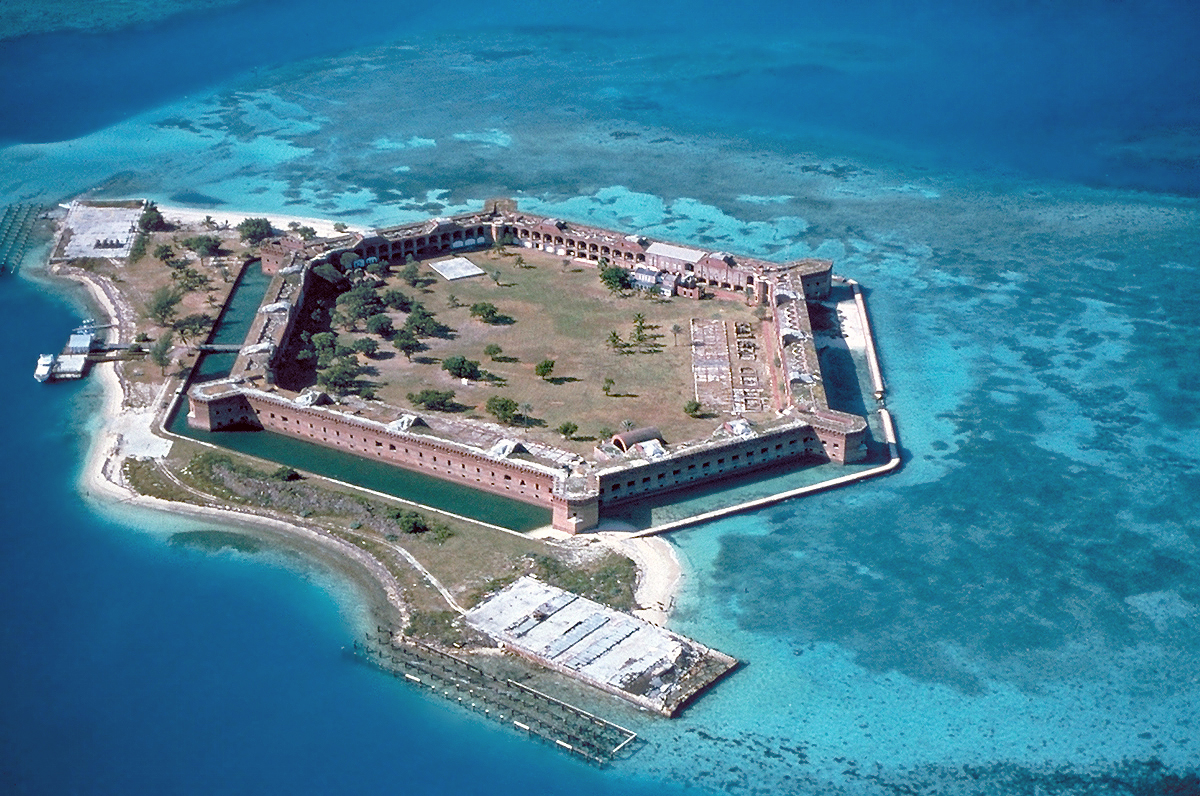
Dry Tortugas National Park
24.6286° N · 82.8733° W · National Park
Photo: U.S. National Park Service · Public domain · Wikimedia Commons
Dry Tortugas National Park is a 64,657 acres in Florida (US) managed by the National Park Service. Ponce de León named the islands Las Tortugas in 1513. The free Lokali audio guide runs 7 minutes.
✓ Published October 2026 · how we write these guides
Visitor facts
| Lokali audio guide | 7 min · free |
|---|---|
| Type | National Park |
| Location | Monroe County, United States |
| Coordinates | 24.6286, -82.8733 |
| Official website | nps.gov |
| Languages | 50+, in the Lokali app |
The story
Listen first. Wind moves across open water, and waves slap softly against an old brick wall. Above you, seabirds call without pause. The light out here is very bright. It bounces off white sand, off pale green shallows, off water so clear you can see the sandy bottom. You are standing on one of the most remote corners of the United States, a small group of islands far out in the Gulf of Mexico, west of the Florida Keys.
Dry Tortugas National Park lies about seventy miles, or roughly 110 kilometres, west of Key West. The park is almost entirely water. Only a tiny part of it is land, spread across seven low islands of sand and coral. There are no roads here and no bridges. Everyone arrives by boat or by seaplane. That distance shapes everything you will see and feel today, from the silence at night to the wildlife that still nests here.
The name has two halves, and each one tells a story. In 1513, the Spanish explorer Juan Ponce de León sailed through these waters. His crew found the beaches full of sea turtles, so he called the islands Las Tortugas, which means the turtles. Later, sailors added the word dry as a warning. These islands have no natural fresh water. A ship that came here hoping to refill its barrels would leave with nothing.
Now turn toward the great brick fortress. This is Fort Jefferson, and it covers almost all of Garden Key. The United States began building it in 1846. The goal was to guard one of the busiest shipping lanes in North America, the passage between the Gulf and the Atlantic. Whoever controlled these islands could watch every ship moving in and out of the Gulf. For a young nation with a long coastline, that was worth an enormous effort.
And it was enormous. The fort contains more than sixteen million bricks. It is often described as the largest brick masonry structure in the Americas. Every one of those bricks came by ship, along with the sand, the iron, the tools, and the people. Workers included soldiers, hired labourers, and enslaved men. Construction went on for about three decades, through heat, storms, and outbreaks of disease. Then, quietly, the work stopped. The fort was never finished.
Here is a detail many visitors miss. Walk along the outer walls and look closely at the brick. The colour is not even. Some sections are a warmer red, others look paler or browner. The bricks came from different places over those long years of building, and the changes are still visible. You are reading the construction timeline in the wall itself, row by row, almost like the layers in a cliff.
The fort also had a serious problem below the surface. Garden Key is made of sand and coral, not solid rock. As the heavy walls went up, the foundation settled and shifted. Cracks opened in the masonry. The builders had designed large cisterns inside the walls to collect rainwater, because there was no other fresh water. But the settling let seawater leak in. So the fort on the dry islands struggled, in the end, with water.
During the Civil War, Union forces held Fort Jefferson, and it became a military prison. Its most famous prisoner was Doctor Samuel Mudd. He was the physician who set the broken leg of John Wilkes Booth after the assassination of President Lincoln in 1865. Mudd was convicted as a conspirator and sent here. Many people still debate how much he knew. His story at the fort, however, took an unexpected turn.
In 1867, yellow fever swept through Fort Jefferson. The fort's own doctor died. Mudd stepped in and cared for sick soldiers and prisoners through the worst of the outbreak. Many of the men he treated later signed a letter supporting his release. In 1869, President Andrew Johnson pardoned him. Inside the fort, you can still see the area associated with his imprisonment, a small and plain space behind thick walls.
As warships and weapons changed, the fort lost its purpose. The army eventually left. In 1935, President Franklin Roosevelt protected the area as a national monument. In 1992, it became a national park, with the protection extended to the surrounding reefs and seagrass. That second step mattered. Today, the real treasure here is not only the fort. It is the living ocean around it, which is healthier and calmer than in many busier parts of the Keys.
Look out toward Bush Key, the island next to the fort. In spring and early summer, it fills with nesting seabirds, especially sooty terns and brown noddies. The noise can be remarkable. Because the birds are easily disturbed, that island is usually closed during nesting season. Farther west lies Loggerhead Key, with its tall lighthouse. The beaches across the park still serve as nesting grounds for sea turtles, including loggerheads and green turtles. The old name still fits.
If you brought a mask and snorkel, the water beside the moat wall is worth exploring. The old seawall has become a kind of reef. Corals, sponges, and fish now live along the stone and brick. Parrotfish graze, small fish dart into cracks, and sometimes larger fish drift through the shade. The ocean around these islands has also claimed many ships over the centuries. Reefs, shallow banks, and sudden storms made this a dangerous place to sail.
Before you go, climb to the upper level of the fort if it is open. From the top, you see the full shape of the walls, the moat, the narrow strip of sand, and the open blue in every direction. The arches of the gun rooms repeat, one after another, and they frame the sea like windows. Stand still for a moment and notice the wind on your face. Notice the salt on your skin. Notice how small everything human looks against the water and the sky.
As you walk back toward the dock, listen once more. The birds over Bush Key. The waves at the wall. The quiet hum of people speaking softly, almost as if the place asks for it. A huge fort stands here, unfinished, built for a war that never reached it. Around it, the turtles, the terns, and the reef carry on. Take one last look at the brick in the afternoon light... and then at the water beyond it.
Key facts
What to look for
Practical tips
Common questions
Is there a free audio guide to Dry Tortugas National Park?
Yes — the Lokali app narrates Dry Tortugas National Park free of charge in 50+ languages. The guide runs about 7 minutes, covers the history, what to look for on site and practical tips, and works offline once downloaded.
Where is Dry Tortugas National Park?
Dry Tortugas National Park is near Monroe County, United States, at 24.6286, -82.8733. Tap the map link on this page for directions from where you are.
What is Dry Tortugas National Park known for?
Ponce de León named the islands Las Tortugas in 1513. Fort Jefferson construction began in 1846 and never finished.
What should you look for at Dry Tortugas National Park?
Changes in brick colour across the fort's outer walls. Corals and fish growing along the moat seawall. Repeating arches of the gun rooms framing the sea.
What should you know before visiting Dry Tortugas National Park?
Bring all food and water you need for the day. Pack a mask and snorkel for the moat wall.
On the map
Opens directions to Dry Tortugas National Park from your location.
Hear Dry Tortugas National Park in your language
The full story, narrated, in 50+ languages. Download it before you go and it plays offline, at your own pace, with no ticket and no tour group.