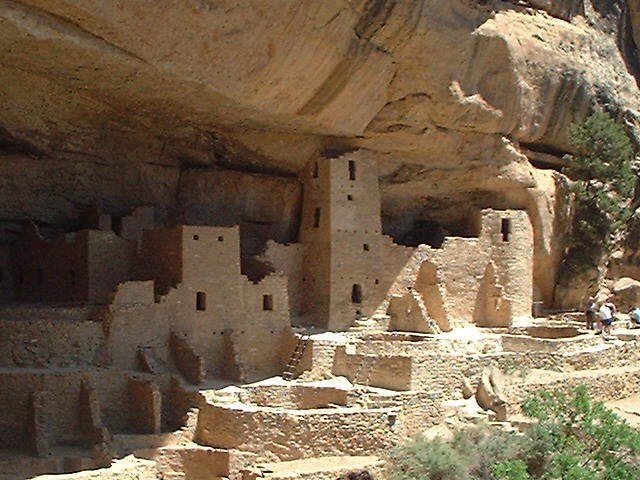
Mesa Verde National Park
37.2604° N · 108.4944° W · Archaeological Site
Photo: Elaine from Sheffield, England · CC BY 2.0 · Wikimedia Commons
Mesa Verde National Park is a national park in Montezuma County, Colorado, United States. Theodore Roosevelt established the park by law in 1906. The free Lokali audio guide runs 7 minutes.
✓ Published October 2026 · how we write these guides
Visitor facts
| Lokali audio guide | 7 min · free |
|---|---|
| Type | Archaeological Site |
| Location | Montezuma County, United States |
| Coordinates | 37.2604, -108.4944 |
| Official website | nps.gov |
| Languages | 50+, in the Lokali app |
The story
Listen for a moment. The wind moves through the piñon pines and the juniper. It carries a dry, resinous smell, like warm pencil shavings. Under your feet the ground is pale and sandy, and far below the mesa edge the canyons drop away in layers of tan and rust. This is Mesa Verde, in the southwest corner of Colorado. For roughly seven hundred years, people farmed this high tableland and raised their families here. Then, in a single generation, they left.
The name is Spanish for green table. It fits. From a distance, the mesa looks like a long, flat surface covered in dark green trees, tilted gently toward the south. Up close, that table is cut by deep canyons, like fingers spread across the land. In those canyon walls, tucked under overhangs of sandstone, are the cliff dwellings. They made this place famous. But they are only the last chapter of a much longer story.
The people who lived here are known today as the Ancestral Pueblo people. You may also hear the older term Anasazi, which many Pueblo descendants prefer not to use. Around the sixth century, families began to settle on the mesa top. They lived in pit houses. These were partly underground rooms, roofed with timber and earth, warm in winter and cool in summer. They grew corn, beans, and squash in the thin soil, and they caught rainwater wherever they could.
Over the centuries, the houses rose out of the ground. People began building with stone. Villages grew on the mesa top, with rooms joined wall to wall. Yet the old pit house never disappeared. It became the kiva — a round, sunken room used for ceremony, gathering, and daily work. As you explore, watch for these circles in the ground. Many still show the stone bench around the inner wall and the small hole in the floor.
Then, in the late twelfth and thirteenth centuries, something changed. Many families moved off the open mesa top and down into the alcoves of the cliffs. Nobody knows exactly why. Archaeologists discuss several possibilities: defence, shelter from weather, social pressure, or a closer link to springs that seeped from the rock. Probably more than one reason mattered. What is clear is the scale. The park protects thousands of archaeological sites, including around six hundred cliff dwellings.
The largest of them is Cliff Palace. It is considered the largest cliff dwelling in North America. It has around one hundred and fifty rooms and more than twenty kivas, all packed under one curving roof of stone. Look at the towers, some round and some square. Look at the small doorways and the plastered walls. A few walls still carry traces of painted colour. Here is a detail many visitors miss: wooden beams in these walls carry tree rings. Scientists match those rings to known patterns, so they can date construction very precisely, sometimes to a single year.
Now think about daily life in these alcoves. The farm fields were up on the mesa top. The water was often below. So people climbed — every day. They used toeholds cut into the sandstone, and they carried loads of corn, water jars, and firewood. Children played on narrow ledges high above the canyon floor. The rooms were small and often dark. Much of life happened outside, on the rooftops and in the open courtyards, in the sun.
And then, by around 1300, the people were gone. A long and severe drought struck the region in the late thirteenth century. Crops failed, and conflicts may have grown. Families walked south and east. They did not vanish. Their descendants live today in the Pueblo communities of Arizona and New Mexico, including the Hopi, the Zuni, and the pueblos along the Rio Grande. Many of these communities still regard Mesa Verde as an ancestral home, not as a ruin.
For almost six centuries, the alcoves stood quiet. Ute people knew this land and the old sites well. Then, in December 1888, two local ranchers, Richard Wetherill and Charlie Mason, rode out to look for stray cattle. Through falling snow, they saw a stone village across the canyon. Wetherill gave it the name Cliff Palace. Word spread quickly. Within a few years, collectors and diggers were carrying away pottery, tools, and even human remains.
Here is a second surprise. In 1891, a young Swedish visitor named Gustaf Nordenskiöld excavated here and shipped a large collection back to Europe. Those objects ended up in a museum in Finland. More than a century later, in 2020, some of the ancestral remains and funerary objects were returned and reburied by the associated tribes. Damage like his helped push Congress to act. In 1906, Theodore Roosevelt signed the law creating Mesa Verde National Park. It was one of the first parks set aside to protect the work of people, not only scenery.
In 1978, the park was also named one of the first World Heritage Sites by UNESCO, the cultural agency of the United Nations. Today it is a place of careful balance. Rangers lead visitors into the larger cliff dwellings in small groups. Crews stabilise crumbling walls with matching stone and mortar. Some sites close when rockfall threatens them. The aim is simple: keep these rooms standing for the next seven hundred years.
As you drive and walk across the mesa, notice the land itself. Large areas show the grey trunks of burned trees. Wildfires have swept through the park many times, and after some fires, new sites appeared in the bare ground. Notice how the light changes too. In the morning, the cliff dwellings sit in cool shadow. By late afternoon, the sandstone turns gold and orange. Many alcoves face south, and that was no accident. The low winter sun warms them, while the overhang blocks the high summer sun.
So, before you move on, stand still at the canyon rim for one more minute. Look across at the alcoves and the small, dark doorways. Hear the wind again in the junipers, and perhaps a raven calling over the canyon. The people who built here are not a lost mystery. Their grandchildren's grandchildren are alive today, a few hundred kilometres away. As you walk back to the trail, think of those daily climbs between field and home — and watch your own footing on the stone.
Key facts
What to look for
Practical tips
Common questions
Is there a free audio guide to Mesa Verde National Park?
Yes — the Lokali app narrates Mesa Verde National Park free of charge in 50+ languages. The guide runs about 7 minutes, covers the history, what to look for on site and practical tips, and works offline once downloaded.
Where is Mesa Verde National Park?
Mesa Verde National Park is in Montezuma County, United States, at 37.2604, -108.4944. Tap the map link on this page for directions from where you are.
What is Mesa Verde National Park known for?
Theodore Roosevelt established the park by law in 1906. Ancestral Pueblo people lived here for about seven centuries.
What should you look for at Mesa Verde National Park?
Round sunken kivas with stone benches along the walls. Toeholds cut into the sandstone near cliff dwellings. Square and round towers rising inside Cliff Palace.
What should you know before visiting Mesa Verde National Park?
Reserve ranger-led cliff dwelling tours well before your visit. Allow a full day; the mesa roads are long.
When is the best time to visit Mesa Verde National Park?
Visit cliff overlooks in late afternoon for warm light.
On the map
Opens directions to Mesa Verde National Park from your location.
Hear Mesa Verde National Park in your language
The full story, narrated, in 50+ languages. Download it before you go and it plays offline, at your own pace, with no ticket and no tour group.