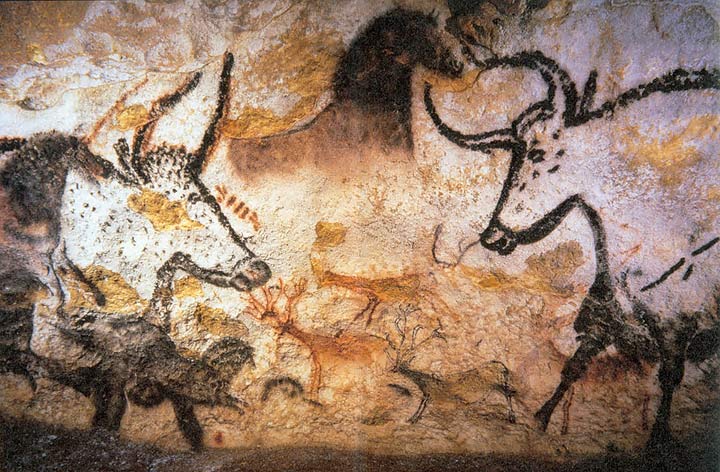
Photo: EU · Public domain · Wikimedia Commons
Lascaux is a cave in southwestern France famous for its Paleolithic cave paintings. It is near Montignac-Lascaux, France. Teenagers discovered the cave in September 1940. The free Lokali audio guide runs 7 minutes.
✓ Published October 2026 · how we write these guides
Visitor facts
| Lokali audio guide | 7 min · free |
|---|---|
| Type | Archaeological Site |
| Location | Montignac-Lascaux, France |
| Coordinates | 45.0538, 1.1710 |
| Languages | 50+, in the Lokali app |
The story
Picture the air inside a limestone hill. It is cool and still, and it smells faintly of damp stone. There is no daylight here. There is only the dark, and the slow drip of water somewhere far below. Now imagine a small flame from an animal-fat lamp moving across the rock. As it moves, a herd of animals seems to stir on the walls above you. This is Lascaux, in the green Vézère Valley of southwest France, and this is how its first artists saw it.
The story of the modern discovery begins in September 1940. France was at war, and life in the small town of Montignac went on quietly under heavy news. Four teenagers climbed the wooded hill above the town. One of them was Marcel Ravidat, and he had heard about a hole in the ground near a fallen tree. According to a popular tale, a dog named Robot led the boys to the opening. Whether the dog really found it is uncertain, but the boys certainly crawled in.
They slid down a narrow passage into the darkness with a simple lamp. What they saw changed our picture of early humans. Huge red and black animals covered the ceiling and the walls. There were horses, deer, and wild cattle, painted with confidence and energy. The boys returned with friends, and soon they told their teacher. Within days, specialists arrived, including the French priest and prehistorian Henri Breuil, who spent years studying cave art across Europe.
So how old are these images? Scientists generally date the paintings to around 17,000 years ago. That places them in the Upper Paleolithic, the late part of the Old Stone Age, when Ice Age hunters lived across Europe. The climate was colder than today. Reindeer moved through this valley, and the people here were skilled hunters and gatherers. Think about that distance in time. The pyramids of Egypt are closer to us than they are to the painters of Lascaux.
The most famous space is often called the Hall of the Bulls. Here, enormous aurochs stretch across the white limestone. An aurochs was a wild ancestor of modern cattle, larger than any cow you know, and it is now extinct. One of these bulls measures around five metres from end to end. The artists used the natural curves of the rock. A bulge in the wall becomes a shoulder. A ridge becomes the line of a back. The animals seem to move with the stone itself.
Here is something many visitors miss. Lascaux is not only paintings. Researchers have counted roughly six hundred painted figures, but there are also around 1,500 engravings scratched into the rock. Many of them are fine lines, almost invisible unless light falls across them at a low angle. Some images were painted on high ceilings. To reach them, the artists likely built some kind of scaffolding, and researchers found holes in the walls that may have held wooden beams.
The colours came from the earth. Reds and yellows came from ochre, a natural iron-rich clay. Blacks came from charcoal and manganese oxide, a dark mineral. The artists ground these into powder. They applied it with pads, brushes, or by blowing it through hollow tubes onto the wall. Small stone lamps burned animal fat to light their work. Imagine the smoke, the flicker, and the patience it took to work in these conditions, deep under the hill.
One small scene in a deep part of the cave, known as the Shaft, holds a second surprise. It shows a wounded bison and a simple stick-like human figure with what looks like the head of a bird. Nearby there is a bird on a stick. It is one of the very few human figures in the whole cave. Nobody knows what it means. Some see a hunting accident, others a spiritual vision. The honest answer is that its meaning is lost.
After the war, the cave opened to the public in 1948. Crowds came from across the world. But each visitor brought warm breath, moisture, and carbon dioxide into a sealed space. Over the years, the delicate balance of the cave began to break down. Green algae spread across the walls, and white mineral deposits started to form. In 1963, the French authorities closed the cave to the public. It has stayed closed ever since, and only a few specialists enter it, and only for short periods.
The problems did not end with the closing. In the early 2000s, fungal growth and black stains appeared in parts of the cave. Scientists still monitor the temperature, humidity, and air with great care. In 1979, Lascaux and other prehistoric sites of the Vézère Valley joined the UNESCO World Heritage List. The protection of the cave is now a long scientific project, and its future depends on keeping people out.
So what are you seeing today? France chose to build copies, and each one is more precise than the last. Lascaux II opened in 1983, close to the original cave, and it reproduces the main halls. Then, in December 2016, a much larger centre opened at the foot of the hill. It is known as Lascaux IV, the International Centre for Cave Art. Here, artists and technicians recreated almost the entire cave, using detailed scans and traditional pigments.
It is natural to wonder whether a copy can move you. Many visitors are surprised to find that it does. The dim light, the cool air, and the hush of the group all help. The shapes of the walls follow the real rock closely. When the guide lowers the lights, the animals seem to come forward out of the dark. The copy also lets you see the paintings without harming them, and that is a kind of respect for the people who made them.
As you leave, look up at the wooded hill above the town. Somewhere inside it, behind locked doors, the real paintings sit in total darkness, as they did for thousands of years. Listen to the river and the birds in the trees. The people who painted Lascaux knew this valley too, in a colder age. You are standing in their landscape now... and their animals are still running across the rock, just out of sight.
Key facts
What to look for
Practical tips
Common questions
Is there a free audio guide to Lascaux?
Yes — the Lokali app narrates Lascaux free of charge in 50+ languages. The guide runs about 7 minutes, covers the history, what to look for on site and practical tips, and works offline once downloaded.
Where is Lascaux?
Lascaux is near Montignac-Lascaux, France, at 45.0538, 1.1710. Tap the map link on this page for directions from where you are.
What is Lascaux known for?
Teenagers discovered the cave in September 1940. Paintings date to roughly 17,000 years ago.
What should you look for at Lascaux?
The huge aurochs bulls in the Hall of the Bulls. Rock bulges painted to shape animal shoulders and backs. Fine engraved lines visible under low, angled light.
What should you know before visiting Lascaux?
Book a timed guided visit to Lascaux IV in advance. Bring a light jacket for the cool replica cave.
On the map
Opens directions to Lascaux from your location.
Hear Lascaux in your language
The full story, narrated, in 50+ languages. Download it before you go and it plays offline, at your own pace, with no ticket and no tour group.