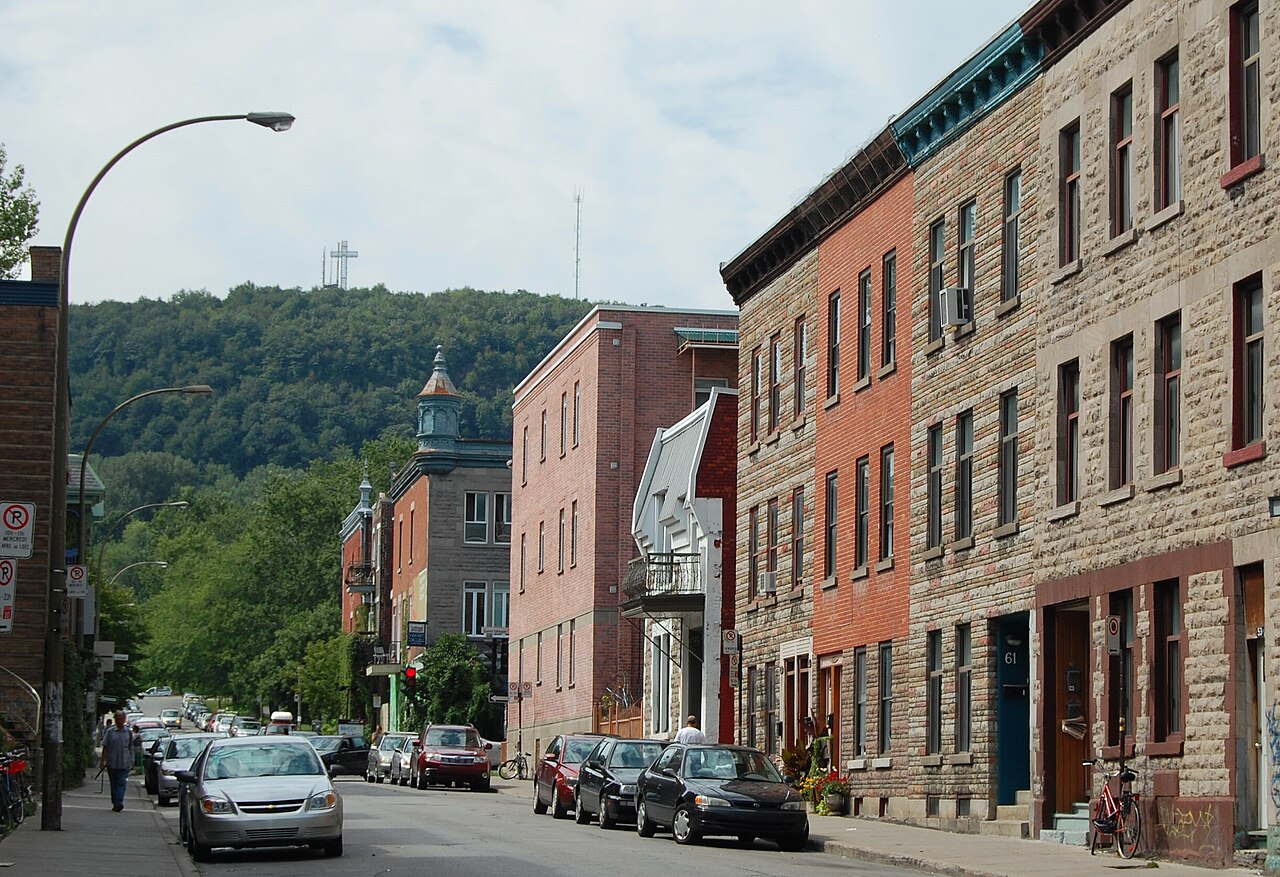
Plateau Mont-Royal
45.5211° N · 73.5803° W · Neighborhood
Plateau Mont-Royal is a neighborhood in Montreal, Canada. Outdoor spiral staircases saved indoor rental space in winter. Built for working families between eighteen-eighties and nineteen-twenties. Most visitors spend 1-2 hours here. The free Lokali audio guide runs 6 minutes.
✓ Verified October 2026 · how we write these guides
Visitor facts
| Time needed | 1-2 hours |
|---|---|
| Lokali audio guide | 6 min · free |
| Type | Neighborhood |
| Best for | Authentic finds |
| Location | Montreal, Canada |
| Coordinates | 45.5211, -73.5803 |
| Languages | 45, in the Lokali app |
The story
The staircases here are the first thing that catches your eye — wrought iron spirals climbing the fronts of three-storey walk-ups, painted in deep greens and reds and blacks, twisting upward like frozen helixes. They are everywhere, lining both sides of the street, a rhythm of curves against brick. Montreal winters made them necessary. Indoor staircases take up rentable square footage, so landlords in the late nineteenth century pushed them outside, saving space and lowering rents. What started as pragmatism became the neighbourhood's signature.
You are standing in the Plateau Mont-Royal, a district that sprawls east from Parc du Mont-Royal across a gentle slope toward the old port. The name is literal — this is the high plateau, a few dozen metres above the Saint Lawrence River, where French-speaking working families settled in waves between the eighteen-eighties and the nineteen-twenties. The housing stock they built still dominates: row after row of two- and three-storey duplexes and triplexes, their facades clad in brick or painted wood, their rooflines flat or gently pitched. The density is relentless but the scale is human. No towers, no wide boulevards. Just block after block of tight-knit streets where the buildings press close and the life of the neighbourhood spills onto the sidewalk.
The streetscape changes texture as you move through it. Avenue du Mont-Royal, the commercial spine, runs east-west through the heart of the district — cafés with chalkboard menus, second-hand bookshops, bagel bakeries open since the nineteen-fifties, vintage clothing stores in former hardware shops. Rue Saint-Denis angles southeast, younger and louder, lined with bars and late-night crêperies. Boulevard Saint-Laurent, the great north-south artery that splits Montreal into east and west, cuts through the western edge of the Plateau, its storefronts a mix of Portuguese fishmongers, Jewish delis, and new-wave taco joints. Each street carries a different layer of the city's immigration history.
The Plateau was never wealthy. It was built for labourers, factory workers, streetcar drivers — people who needed cheap rent close to work. The flats were small, the walls thin, the heating coal-fired. Families crowded in. By the nineteen-sixties, the district was fraying, its population aging, its youth leaving for the suburbs. Then the artists arrived. Cheap rent and central location drew writers, musicians, filmmakers, students. They painted murals on the brick, opened co-op galleries, turned basements into rehearsal spaces. The Plateau became Montreal's counterculture heart, a reputation it still trades on, though rents have climbed steeply since the two-thousands.
Look at the details as you walk. The balconies are not decorative — they are living space, extensions of tiny apartments, strung with laundry lines and potted tomatoes and Christmas lights that stay up year-round. The brick comes in every shade: burnt orange, deep red, pale yellow, charcoal grey, sometimes painted over in bold flat colours. The cornices are modest, the windows tall and narrow, the rooflines unadorned. This is vernacular architecture, built quickly and cheaply, but the repetition creates a kind of accidental beauty. The rhythm of the staircases, the setback of the facades, the way the light falls between the buildings at dusk — it all coheres.
The street life here operates on foot. Montrealers walk everywhere in the Plateau, even in January when the sidewalks are banked with plowed snow. The blocks are short, the intersections frequent, the grid legible. You pass the same faces daily — the woman who runs the Portuguese bakery on Rue Rachel, the man who sells flowers from a cart on Avenue Duluth, the teenagers smoking outside the dépanneur. The neighbourhood has a village texture despite sitting in the middle of a city of nearly two million people.
Food is a serious matter here. The bagels are boiled in honey water and baked in wood-fired ovens, a tradition brought by Jewish immigrants from Eastern Europe in the early twentieth century. The smoked meat — Montreal's answer to pastrami — is cured for weeks, steamed until it falls apart, served on rye with yellow mustard. The poutine, that Québécois invention of fries and gravy and cheese curds, was perfected in diners along these streets in the nineteen-fifties. You can eat your way through a century of immigration without leaving a ten-block radius.
Parc La Fontaine anchors the eastern edge of the Plateau, a broad green rectangle with two ponds, gravel paths, and mature maples that blaze orange in October. Locals come here to run, to read on benches, to let their dogs off-leash in the early mornings. In summer, the park hosts free outdoor theatre and open-air concerts. In winter, one of the ponds is flooded and frozen into a skating rink, lit at night, crowded with families and couples gliding slow circles under the trees. The park is the neighbourhood's communal backyard, the place where the density of the streets loosens and people spread out.
The Plateau is not a monument. It is not grand or carefully preserved. It is a lived-in neighbourhood, scuffed and layered and constantly changing, where the past is visible in the architecture and the present is loud in the cafés and the future is uncertain because rents keep rising and the old families keep leaving. But the staircases are still there, spiraling upward, and the light still slants through the narrow streets at the same angle it did a hundred years ago.
As you walk away, notice the small things. The way the brick changes colour in the rain. The sound of French and Portuguese and English mixing on the sidewalk. The smell of coffee and cigarette smoke drifting from a second-floor balcony. The Plateau is a neighbourhood that rewards attention. It does not announce itself. It just unfolds, block by block, staircase by staircase, one small detail at a time.
Key facts
What to look for
Practical tips
Common questions
How long do you need at Plateau Mont-Royal?
Plan 1-2 hours. That is the time most visitors spend at Plateau Mont-Royal. The free Lokali audio guide runs 6 minutes and is made to listen to while you walk.
Is there a free audio guide to Plateau Mont-Royal?
Yes — the Lokali app narrates Plateau Mont-Royal free of charge in 50+ languages. No ticket, tour group or subscription, and it works offline once downloaded.
Where is Plateau Mont-Royal?
Plateau Mont-Royal is in Montreal, Canada, at 45.5211, -73.5803. Tap the map link on this page for directions.
What should you know before visiting Plateau Mont-Royal?
Walk Avenue du Mont-Royal for cafés and vintage shops
What is Plateau Mont-Royal known for?
Outdoor spiral staircases saved indoor rental space in winter
What is the best time to visit Plateau Mont-Royal?
Visit Parc La Fontaine early morning for quiet paths
On the map
Opens directions to Plateau Mont-Royal from your location.
More to see in Montreal


Hear Plateau Mont-Royal in your language
The full story, narrated, in 50+ languages. Download it before you go and it plays offline, at your own pace, with no ticket and no tour group.