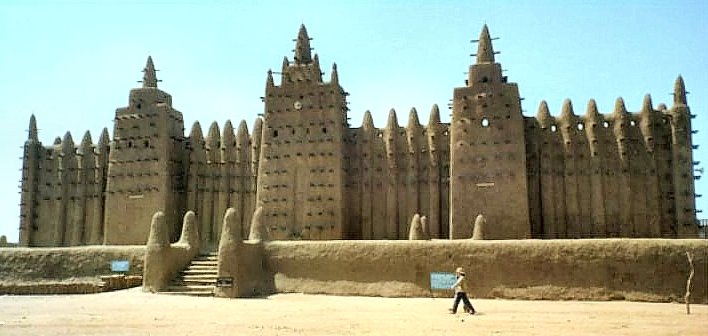
Photo: The original uploader was Euronaut at German Wikipedia. Later versions were uploaded by Z · CC BY-SA 3.0 · Wikimedia Commons
Djenné-Djenno is a historic site in Djené Cercle, Mali. Earliest settlement dates to around the third century BCE. The free Lokali audio guide runs 8 minutes.
✓ Published October 2026 · how we write these guides
Visitor facts
| Lokali audio guide | 8 min · free |
|---|---|
| Type | Archaeological Site |
| Location | Mopti Region, Mali |
| Coordinates | 13.8900, -4.5403 |
| Languages | 50+, in the Lokali app |
The story
Listen to the ground as you walk. It crunches. That sound is not gravel. It comes from thousands of broken pieces of pottery, red, brown and grey, scattered across the surface of this low mound. Some carry faint patterns pressed into the clay. Every step lands on the leftover dishes, cooking pots and storage jars of people who lived here more than a thousand years ago. Take a moment before you look up. The ground is the first thing this place shows you.
You are standing at Djenné-Djenno, which means something like ancient Djenné. The site lies a short distance from the modern town of Djenné, in the Inner Niger Delta of central Mali. The Inner Niger Delta is a huge inland floodplain. Here the Niger and Bani rivers spread out each year across flat country. Around you, the land is wide and open. There are no towering ruins here, no columns, no grand gate. The mound itself is the monument. It is quiet, and that quiet takes a little time to understand.
Archaeologists call a mound like this a tell. A tell grows slowly. People build houses of mud, and the houses wear down or collapse. New houses go up on top of the old ones. Rubbish, ash and broken pots pile up between them. Over many centuries, a living town lifts itself above the flat plain. That height mattered. When the annual floods came, a raised settlement stayed dry. So this hill under your feet is made of human life, layer on layer, generation on generation.
For a long time, many scholars outside Africa held a fixed idea about West African cities. They believed that towns here grew only after traders arrived across the Sahara, bringing Islam and long-distance commerce with them. In that story, cities were an import. They came from the north, from the Arab world. Djenné-Djenno helped to break that story apart. What lies inside this mound is much older than the trans-Saharan trade, and it grew from local roots.
In the late 1970s and early 1980s, the American archaeologists Susan and Roderick McIntosh led excavations here. Their trenches cut down through the layers of the tell. The dating results surprised the field. The earliest settlement goes back to around the third century before the common era. Over the following centuries it grew into a large town. Djenné-Djenno is now counted among the oldest known urban sites in Africa south of the Sahara. Remember that as you look around. This was a city before the caravans came.
Here is a second surprise, and it is a quiet one. The excavations found no clear palace. They found no great central temple and no obvious royal tomb. Instead, the town seems to have grown as a cluster of neighbourhoods and smaller mounds. Researchers have suggested that different groups may have specialised in different crafts, such as ironworking, pottery or fishing. Power may have been shared between these groups rather than held by one ruler. It is a city without a king at its centre, or at least without the buildings we usually expect a king to leave behind.
Think about what this landscape lacks. There is no stone here, and no iron ore close by. Yet the people of Djenné-Djenno worked iron from early on. Both iron and stone had to come from elsewhere, carried along rivers and overland routes. In return, the delta had much to offer. The rivers held fish. The floodplain grew African rice, a crop domesticated in West Africa itself, and its remains were found at the site. So trade networks connected this town to its region long before the trade across the desert.
At its height, the town was ringed by a wall built of mud brick. Little of it is easy to see today, because mud returns to earth when it is no longer repaired. But excavators traced its line. A wall like this needs many hands and shared effort. It also tells us that the people inside wanted to mark their town, protect it, or perhaps hold back floodwater. Look at the modern mud buildings of the region. They come from the same building tradition, and they still need care after every rainy season.
Djenné-Djenno and the wider Inner Niger Delta are known for fired clay figures. These terracotta sculptures show seated and kneeling people, riders, and figures wrapped in snakes. Some were found by archaeologists in their original setting. That matters, because context tells us how an object was used. Sadly, many other figures were dug up illegally and sold on the international art market. Each looted figure is a sentence torn out of a book. Its art survives, but its story is gone. This loss is one reason the site is now protected so closely.
The town did not last forever. By around the year 1400, the mound seems to have been largely abandoned, and life moved to the site of modern Djenné nearby. Why did people leave? Scholars still discuss this. Changes in climate, trade and religion may all have played a part. Local tradition links the move to the coming of Islam, and to a ruler of Djenné who is said to have converted. That account belongs to oral history. It is a tradition, not a documented record, but it shows how the two towns are tied together in memory.
Today Djenné-Djenno is part of a UNESCO World Heritage Site, the Old Towns of Djenné, inscribed in 1988. The listing joins this archaeological mound with the living mud-brick town nearby, including its Great Mosque. In 2016, the site was placed on the List of World Heritage in Danger. The reasons include insecurity in the region, erosion, and pressure on the old buildings and mounds. This place is fragile. Rain, wind and careless feet all wear it away a little more each year.
The seasons still shape this landscape, just as they shaped the ancient town. When the floods rise, water spreads across the plain, and higher ground stands out above it. When the waters fall back, the land opens again for grazing, farming and travel. Herders, fishers and farmers share this delta and move with its rhythm. The people who built Djenné-Djenno lived inside that same cycle. Standing here, you can picture the mound as an island in a sheet of shining water.
Before you go, look down once more at the broken pottery under your feet. Leave every piece exactly where it lies. Each one is part of the record, and its position is part of its meaning. Then lift your eyes to the open plain and the direction of the modern town. Feel the warm air and the wide sky. A city grew here from its own soil, and it lasted well over a thousand years. As you walk away, listen again to that soft crunch. It is the oldest sound in this place.
Key facts
What to look for
Practical tips
Common questions
Is there a free audio guide to Djenné-Djenno?
Yes — the Lokali app narrates Djenné-Djenno free of charge in 50+ languages. The guide runs about 8 minutes, covers the history, what to look for on site and practical tips, and works offline once downloaded.
Where is Djenné-Djenno?
Djenné-Djenno is near Mopti Region, Mali, at 13.8900, -4.5403. Tap the map link on this page for directions from where you are.
What is Djenné-Djenno known for?
Earliest settlement dates to around the third century BCE. Excavated by Susan and Roderick McIntosh, late 1970s onward.
What should you look for at Djenné-Djenno?
Broken pottery sherds scattered across the mound's surface. Faint pressed patterns decorating some of the clay fragments. The mound's gentle rise above the flat floodplain.
What should you know before visiting Djenné-Djenno?
Check current travel advisories for central Mali before planning a visit. Arrange your visit with a local guide based in Djenné.
When is the best time to visit Djenné-Djenno?
Come in the dry season when the plain is passable.
On the map
Opens directions to Djenné-Djenno from your location.
More to see near Djenné-Djenno

Hear Djenné-Djenno in your language
The full story, narrated, in 50+ languages. Download it before you go and it plays offline, at your own pace, with no ticket and no tour group.