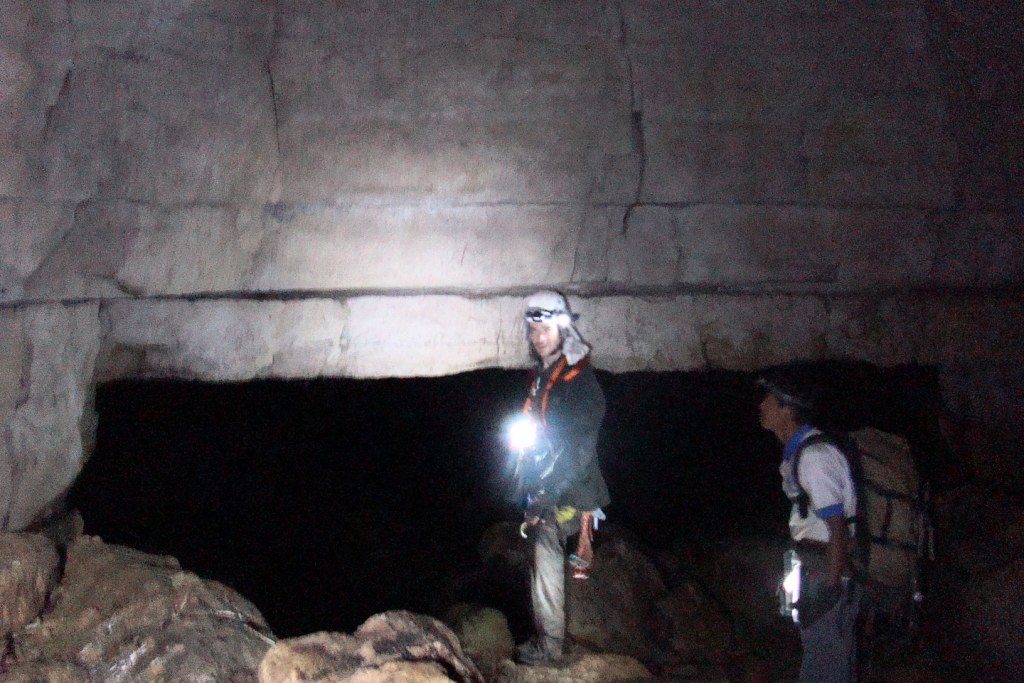
Photo: MezzoforteF · CC BY-SA 3.0 · Wikimedia Commons
Cueva de los Tayos is a cave in Ecuador. Named after tayos, the local word for oilbirds. The free Lokali audio guide runs 6 minutes.
✓ Published October 2026 · how we write these guides
Visitor facts
| Lokali audio guide | 6 min · free |
|---|---|
| Type | Cave |
| Location | Morona-Santiago, Ecuador |
| Coordinates | -3.0515, -78.2054 |
| Languages | 50+, in the Lokali app |
The story
Listen first. Somewhere below your feet, in total darkness, thousands of birds are calling. It is a harsh, clicking, screeching sound, like metal scraping on stone. The air at the mouth of the shaft feels cool and damp against your face. Around you, the forest drips. Moss and roots hang over the edge of the opening, and the light simply stops a short way down. This is Cueva de los Tayos, the Cave of the Oilbirds, in the green hills of southeastern Ecuador.
The cave sits in Morona-Santiago Province, on the eastern slopes of the Andes, where the mountains fall away toward the Amazon basin. This is the ancestral territory of the Shuar people, one of the best-known Indigenous nations of the Ecuadorian Amazon. For the Shuar, this place is not an attraction. It is a sacred site, a place of spirits and of power. Any visit here happens on their land and, in practice, with their permission and their guides.
Now, about that sound. The name of the cave comes from the tayo, the local word for the oilbird. It is a strange creature, and scientists still find it remarkable. The oilbird is nocturnal. It lives in caves by day and flies out at night to feed on fruit, especially the fruit of palms and laurels. It is the only fruit-eating bird in the world that flies at night. Most visitors do not expect that.
Here is a second surprise. Like a bat, the oilbird uses echolocation. It sends out sharp clicks and listens to the echoes to find its way through the dark. Those clicks are within the range of human hearing. So the noise you hear rising from the shaft is not only conversation between birds. It is also navigation. Every click is a bird reading the shape of the cave walls in the blackness.
The bird gave its name to the cave, and it also played a part in Shuar life. According to Shuar tradition, families descended into the cave at certain times of year to collect the young chicks. The chicks become very fat on their diet of oily fruit. That fat was valued as food and as a source of oil. The English name, oilbird, comes from the same fact. The animal and the human story are tied together here.
The cave itself is formed in limestone. Over a very long time, water dissolved the rock and carved a network of passages and chambers. The main way in is a deep vertical shaft. Explorers descend it on ropes. There are no stairs, no handrails, and no electric lights. Below, the passages open into large halls with high ceilings, wet floors, and a constant sound of dripping water.
The outside world began to pay close attention to this cave in the late 1960s. A Hungarian-Argentine explorer named Juan Moricz entered the cave and later made dramatic claims about it. He said he had found tunnels and objects made by an ancient, lost civilisation. These claims were never confirmed. No verified evidence of such objects has ever been shown to scientists.
The story became much bigger in the early 1970s. The Swiss writer Erich von Däniken described the cave in a popular book. He wrote about a so-called metal library, a collection of engraved metal plates hidden underground. This idea spread across the world. But it remains a legend, not documented history. Moricz himself later disputed parts of the account, and researchers found nothing to support it.
The legend led to one of the strangest expeditions of the twentieth century. In 1976, a large British and Ecuadorian team came to study the cave. The expedition was organised by Stan Hall, a Scottish engineer. Its members included scientists, soldiers, and cavers. And its honorary president was Neil Armstrong — the first human to walk on the Moon. Armstrong travelled here and went into the cave.
Think about that for a moment. A few years after he stood on the lunar surface, Armstrong stood in this wet, dark limestone hall in the Ecuadorian forest. The expedition did not find a metal library. Instead, it produced something more lasting: maps of the passages and records of the plants, insects, and animals that live inside. It treated the cave as a natural place worth studying for its own sake.
That is perhaps the most honest way to understand Cueva de los Tayos today. The tales of lost gold and ancient tunnels still bring curious travellers. But the real story is the living cave. It is a home for thousands of birds, a shelter for small creatures adapted to darkness, and a sacred place for the Shuar. The truth here is strange enough without any invention.
If you do go down, the experience is physical and demanding. You will feel the rope take your weight. You will smell wet earth and guano, the droppings of the birds, which cover parts of the floor. Your headlamp will catch the gleam of water on the walls. And the calls of the oilbirds will grow louder, until they fill the whole chamber around you.
Before you leave, stay still for a minute at the edge of the forest. Notice how quickly the green closes in around the opening. As evening comes, watch the sky above the trees. With luck, you may see the first dark shapes rise from the shaft and fly out over the valley to feed. The cave is breathing out its birds. And tomorrow, before dawn, it will take them back in.
Key facts
What to look for
Practical tips
Common questions
Is there a free audio guide to Cueva de los Tayos?
Yes — the Lokali app narrates Cueva de los Tayos free of charge in 50+ languages. The guide runs about 6 minutes, covers the history, what to look for on site and practical tips, and works offline once downloaded.
Where is Cueva de los Tayos?
Cueva de los Tayos is near Morona-Santiago, Ecuador, at -3.0515, -78.2054. Tap the map link on this page for directions from where you are.
What is Cueva de los Tayos known for?
Named after tayos, the local word for oilbirds. Oilbirds are the only nocturnal fruit-eating birds.
What should you look for at Cueva de los Tayos?
The deep vertical shaft forming the main entrance. Roots and moss hanging over the shaft's edge. Pale guano covering parts of the cave floor.
What should you know before visiting Cueva de los Tayos?
Visit only with authorised Shuar guides from local communities. Bring a reliable headlamp with spare batteries.
When is the best time to visit Cueva de los Tayos?
Arrive near dusk to watch the birds leave.
On the map
Opens directions to Cueva de los Tayos from your location.
Hear Cueva de los Tayos in your language
The full story, narrated, in 50+ languages. Download it before you go and it plays offline, at your own pace, with no ticket and no tour group.