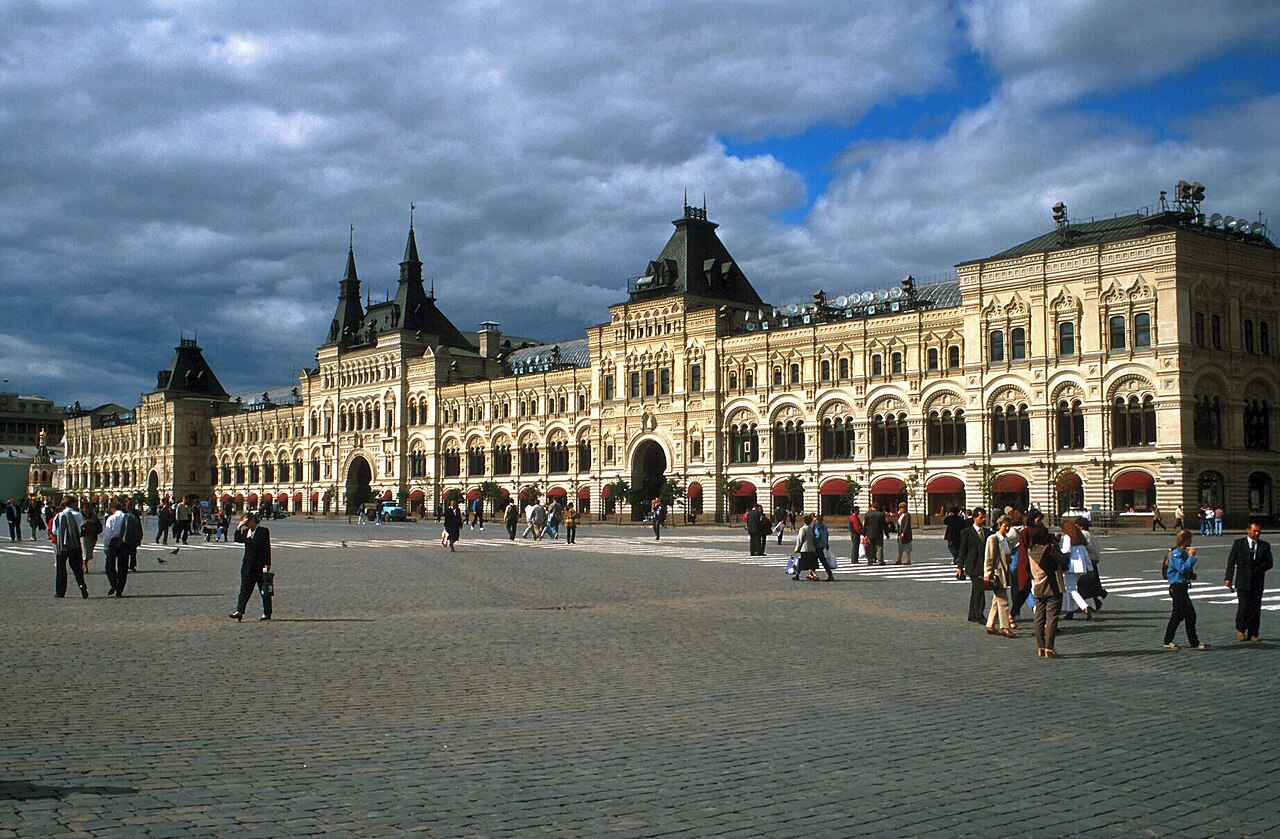
GUM Department Store is a three-story arcade of shops and restaurants built in 1893, facing Red Square. It is in Moscow, Russia. Most visitors spend 30–45 min here. The free Lokali audio guide runs 5 minutes.
✓ Verified August 2026 · how we write these guides
Visitor facts
| Time needed | 30–45 min |
|---|---|
| Lokali audio guide | 5 min · free |
| Type | Market |
| Best for | Photography |
| Location | Moscow, Russia |
| Coordinates | 55.7543, 37.6258 |
| Languages | 45, in the Lokali app |
The story
Step in from Red Square and look straight up. A long glass roof curves high above your head. Daylight pours down through it onto stone bridges and iron railings. Three levels of shopfronts face one another across the open halls. Somewhere below, water runs and splashes in a fountain at the center. This is GUM, the great trading hall of Moscow. It fills one entire side of the square.
The name is short for a longer Russian phrase. Spelled out, it means the Main Universal Store. Most people simply say the three letters, GUM. The building runs the whole length of one side of Red Square, and it stands directly across the open space from the red wall of the Kremlin. The two of them face each other like old neighbors.
There was a market on this exact spot long before the present hall was built. Rows of small wooden stalls once stood here, selling cloth, food, tools, and goods of every kind. They were known together as the Upper Trading Rows. By the late nineteenth century the old rows had grown crowded, dark, and worn, and the city decided to replace them with something new.
The building you see was raised between 1890 and 1893. The architect was Alexander Pomerantsev, who gave it a long front of stone carved in the old Russian style. The remarkable roof was the work of the engineer Vladimir Shukhov, a man known across the country for his bold designs in iron and glass. Together the two men created a market that felt light, airy, and open to the sky.
Look closely at that roof. It is a frame of gently curved iron, filled with many thousands of panes of glass. When it was new, a roof on this scale was a true feat of engineering. It let daylight flood into the halls while keeping out the cold, the rain, and the heavy winter snow. On a bright day, the whole interior seems to glow with soft light.
The inside is laid out like three covered streets. They run the full length of the building, side by side and parallel. Slim bridges cross high between the upper floors, joining one side to the other. Stand on one of these bridges, and you can watch the shoppers move along the floor far below, small figures against the great arched space around them.
In Soviet times, GUM became a state-run store. For many years it stood as a kind of window onto what the planned economy was able to offer its people. At some moments the counters were full of goods. At others, shoppers stood in long, patient lines, waiting for items that had become hard to find. The store quietly mirrored the country's fortunes.
GUM has lived through difficult chapters of its own. For one long stretch under Soviet rule, the store was closed entirely, and its halls were turned over to government offices. Years later it opened its doors again as a store. Like the city around it, the building rose, fell, and rose once more with the changing times.
After the Soviet Union came to an end, GUM changed yet again. Today its halls hold the shops of well-known brands from around the world, and the prices on the tags can be very high. Yet many visitors come without any plan to buy. They come simply to walk the floors, to look up at the roof, and to take in the sheer scale of the place.
Whatever you do, do not miss the ice cream. GUM has sold plain, simple ice cream from small carts here for generations. It comes in a humble paper cup with a flat wooden spoon. For a great many Russians, that exact taste brings back clear memories of childhood visits to this very hall.
In the evening, the front of the building comes alive with light. Thousands of small bulbs trace every arch and line of the long front. Seen from out on Red Square, GUM shines warmly against the dark sky, a glowing wall standing beside the much older and heavier stones of the Kremlin and the cathedral.
GUM is far more than a place to shop. It is a covered hall where the whole city has come to meet itself for well over a hundred years. So walk its bridges slowly. Listen to the murmur of voices rise up into the glass above. And then, when you are ready, step back out into the wide light of the square.
Key facts
What to look for
Practical tips
Common questions
How long do you need at GUM Department Store?
Plan 30–45 min. That is the time most visitors spend at GUM Department Store. The free Lokali audio guide adds about 5 minutes of narration you can listen to as you walk, so it fits inside your visit rather than adding to it.
Is there a free audio guide to GUM Department Store?
Yes — the Lokali app narrates GUM Department Store free of charge in 50+ languages. It covers the history, what to look for on site and practical tips, and it works offline once downloaded.
Where is GUM Department Store?
GUM Department Store is in Moscow, Russia, at 55.7543, 37.6258. Tap the map link on this page for directions from where you are.
What should you know before visiting GUM Department Store?
Walk the upper bridges for the best long views.
What is GUM Department Store known for?
Built between 1890 and 1893 as covered trading rows.
What is the best time to visit GUM Department Store?
Ride the escalators to the top floor for a quieter vantage of Red Square.
On the map
Opens directions to GUM Department Store from your location.
More to see in Moscow


Hear GUM Department Store in your language
The full story, narrated, in 50+ languages. Download it before you go and it plays offline, at your own pace, with no ticket and no tour group.