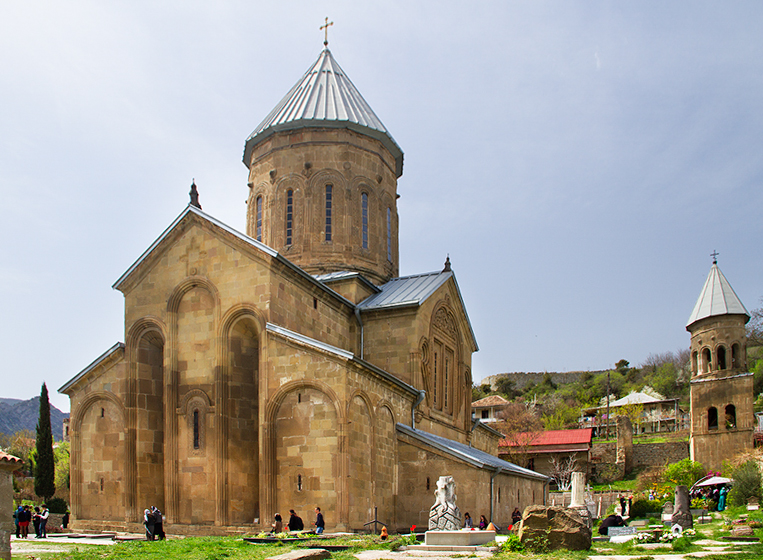
Photo: Levan Gokadze · CC BY-SA 2.0 · Wikimedia Commons
Nunnery of St. Nino is a convent dedicated to St. It is in Mtskheta, Georgia. Most visitors spend 30–45 min here. The free Lokali audio guide runs 5 minutes.
✓ Verified August 2026 · how we write these guides
Visitor facts
| Time needed | 30–45 min |
|---|---|
| Lokali audio guide | 5 min · free |
| Type | Monastery |
| Best for | Local life |
| Location | Mtskheta, Georgia |
| Coordinates | 41.5420, 44.8210 |
| Languages | 45, in the Lokali app |
The story
Push open the gate and the noise of the street falls away. Inside, the air is cooler. You smell beeswax and the smoke of thin candles. A nun in black moves quietly across the yard. Birds call from the old trees. You have entered the convent of Saint Nino, in the town of Mtskheta. Georgians know it as Samtavro. The women who live behind these walls have kept the same daily rhythm for a very long time.
To understand this place, you should know the woman it honors. Saint Nino came to this land in the fourth century. She is remembered as the one who brought the Christian faith to the kingdom. Stories say she was gentle but firm in her belief. Wherever she went, people listened. Georgians have loved her memory for more than sixteen hundred years.
It is said that Nino lived on this very ground, before the church was built. According to old accounts, she made her home in a bramble bush at the edge of the royal garden. She prayed here. From this humble corner, the new faith is said to have spread. Whether each detail is history or holy story, the place has been honored for it ever since.
Not far away lived the king and queen of the land, Mirian and Nana. In time, they too accepted the faith that Nino taught. Their choice changed the kingdom forever. A whole people followed where their rulers led. This small town became the center from which Christianity grew across Georgia.
The king and queen were laid to rest within this monastery. Their tombs lie inside the church, marked and honored. When you step into the cool, dim interior, you stand near the graves of the rulers who first turned this country to its faith. People come to bow their heads here. Candles burn beside the old stones.
The main church is built of pale, weathered stone. Its walls are thick and plain, shaped by hands long ago. A tall tower rises above the cross. Inside, the light is low. Dark images of saints look down from the walls, their gold faded and soft. Your voice drops to a whisper without your meaning it to.
Find the stand of candles near the entrance. People light a thin taper, set it in the sand, and stand in silence for a moment. The small flames lean and flicker. Painted icons hang in carved frames, some kissed smooth by many hands. This is a living place of worship, not only a monument to see.
Black-robed nuns live and work here. You may see them tending the garden, carrying baskets, or walking to prayer. The convent runs by its own quiet clock, marked by bells and services. Visitors are welcome, but you are a guest in their home. Move softly. Speak low. Let the calm of the place settle on you.
Through the day, visitors come and go. Some are pilgrims who have traveled far to pray. Some are local families marking a feast or a memory. They cross the yard, enter the church, and bow before the old icons. Children hold their parents' hands and learn to be still. Each leaves a small candle burning behind them.
Take time to walk the grounds. There are old trees and worn paths. A smaller church stands apart from the main one, simple and low. Flowers grow in tended beds. Stone walls hold the warmth of the sun. Benches wait in the shade for those who wish to sit and think.
This convent is one of several holy places in Mtskheta. The great cathedral stands only a short walk away. On the hill above the rivers sits another ancient church. Together they make this small town the spiritual heart of the country. Saint Nino's convent holds a special place among them, tied to the very beginning of the story.
Stand still in the yard for a moment. Listen. You may hear soft singing from inside the church, voices rising and falling in old chants. The sound has no hurry in it. It is the same kind of prayer that has been offered on this ground for many centuries.
Before you leave, look back at the worn stones and the leaning candle flames. A woman once prayed on this spot and changed the path of a nation. Kings lie buried within these walls. Yet the place feels gentle, almost ordinary, kept by quiet hands. Carry that quiet with you as you step back through the gate into the day.
Key facts
What to look for
Practical tips
Common questions
How long do you need at Nunnery of St. Nino?
Plan 30–45 min. That is the time most visitors spend at Nunnery of St. Nino. The free Lokali audio guide adds about 5 minutes of narration you can listen to as you walk, so it fits inside your visit rather than adding to it.
Is there a free audio guide to Nunnery of St. Nino?
Yes — the Lokali app narrates Nunnery of St. Nino free of charge in 50+ languages. It covers the history, what to look for on site and practical tips, and it works offline once downloaded.
Where is Nunnery of St. Nino?
Nunnery of St. Nino is in Mtskheta, Georgia, at 41.5420, 44.8210. Tap the map link on this page for directions from where you are.
What should you know before visiting Nunnery of St. Nino?
Enter quietly and speak in a low voice inside.
What is Nunnery of St. Nino known for?
Saint Nino brought Christianity to Georgia in the fourth century.
What is the best time to visit Nunnery of St. Nino?
The nunnery is quieter and less visited than the major monasteries.
On the map
Opens directions to Nunnery of St. Nino from your location.
Hear Nunnery of St. Nino in your language
The full story, narrated, in 50+ languages. Download it before you go and it plays offline, at your own pace, with no ticket and no tour group.