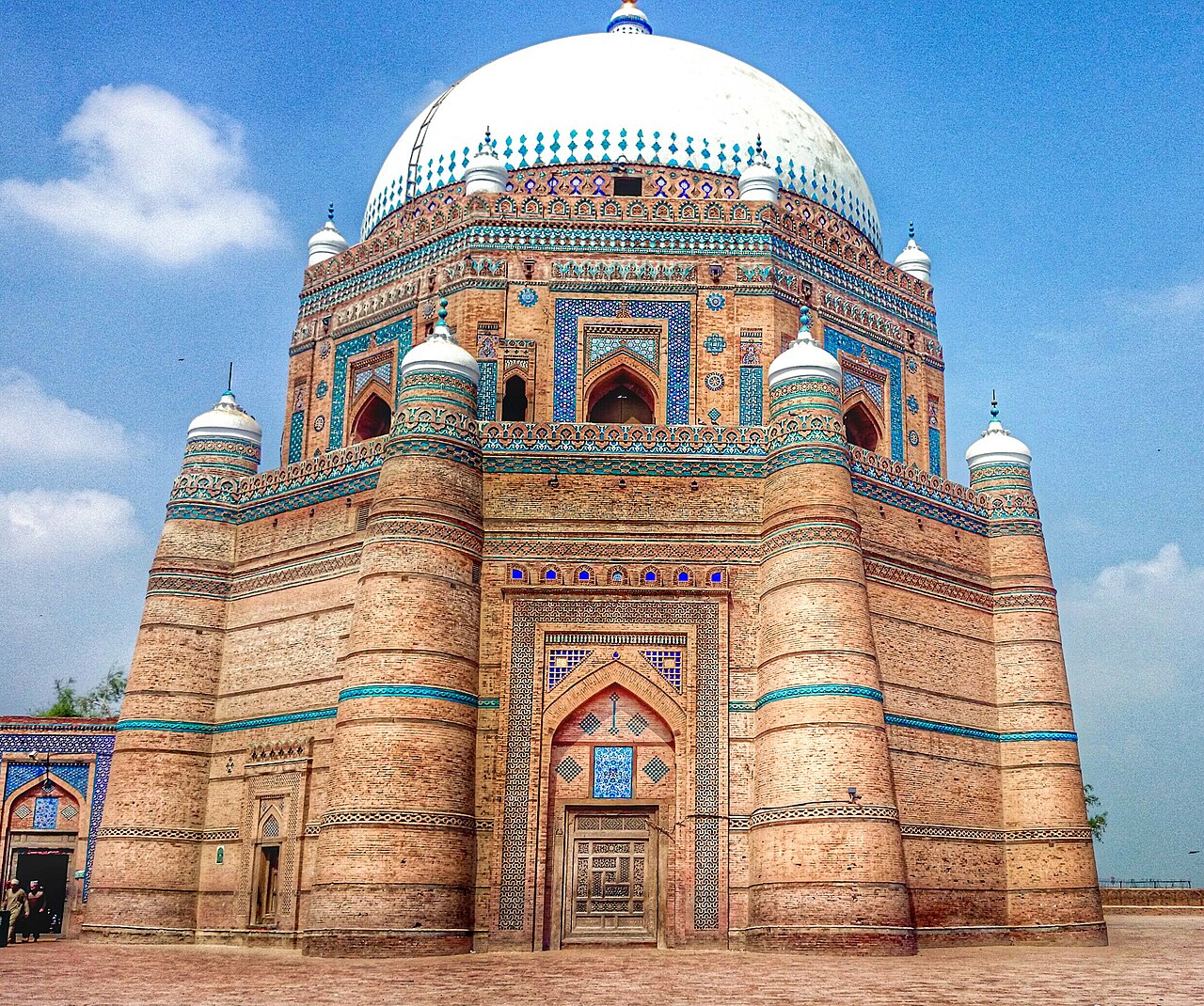
Mausoleum of Shah Rukn-e-Alam
30.1878° N · 71.4333° E · Mausoleum
Mausoleum of Shah Rukn-e-Alam is a 14th-century octagonal tomb of the Sufi saint Shah Rukn-e-Alam, built with distinctive blue and turquoise tilework. It is in Multan, Pakistan. Most visitors spend 45–60 min here. The free Lokali audio guide runs 5 minutes.
✓ Verified August 2026 · how we write these guides
Visitor facts
| Time needed | 45–60 min |
|---|---|
| Lokali audio guide | 5 min · free |
| Type | Mausoleum |
| Best for | History |
| Location | Multan, Pakistan |
| Coordinates | 30.1878, 71.4333 |
| Languages | 45, in the Lokali app |
The story
The dome appears before the city does. From far across the flat plain of southern Punjab, a white half-sphere floats above the heat haze. Beneath it stand bands of deep red brick, dark timber, and glazed blue tile. This is the tomb of Shah Rukn-e-Alam, the Pillar of the World. It has stood over Multan for seven centuries, and it is still the first thing many travelers see.
The man inside was born in Multan in 1251. His name was Rukn-ud-Din Abul Fath, but people called him Rukn-e-Alam. He was the grandson of Bahauddin Zakariya, the great Sufi teacher who made Multan a center of learning. Rukn-e-Alam led the Suhrawardiyya order of Sufis after his father. Sultans asked him for advice. The poor asked him for bread and blessings. He died in 1335, mourned across Punjab.
The building is older than the man's death, and that is a strange story. Most historians believe Ghiyas-ud-Din Tughluq built it between 1320 and 1324, while he governed this frontier before founding the Tughluq dynasty in Delhi. Many think he intended it as his own tomb. History changed his plans. He died near Delhi, and his successor gave this building to the saint's family. Rukn-e-Alam was buried here in 1335.
Walk around the outside first. The tomb is an octagon, a shape with eight sides, and it rises in three levels. The lowest level has walls that lean inward as they climb, like the base of a mountain. Round towers stand at each corner, and they slope too. The shape is not only beautiful. Sloped walls resist floods and tremors, and they carry the great weight of the dome above.
The whole structure rises about 35 meters above the mound. Because it stands on the highest ground in the city, the tip of the dome is the highest point in Multan. In the fourteenth century, this dome was among the largest in South Asia. Builders talked about it from Delhi to Central Asia. Travelers wrote that they could see it from a full day's ride away.
Come close to the walls and read the crafts of Multan. Red brick is laid in careful courses. Beams of dark shisham wood run through the brickwork, tying the walls together and absorbing shocks. Between brick and timber sit panels of glazed tile in white, sky blue, and deep cobalt. This is Multani kashi work, a craft the city still practices today. Look for stars, flowers, and flowing Arabic script.
The doors are low and made of carved wood, so every visitor bows a little on the way in. Inside, the light is soft and the air is cool. A single high room holds the cenotaph of the saint, covered with cloth and rose petals. Relatives and followers rest in graves around him. A mihrab marks the direction of prayer. Voices stay low under the great curve of the dome.
Watch the pilgrims for a moment. Some tie colored threads to the lattice screens and whisper a wish. Some bring sweets to share after a prayer was answered. The air smells of rosewater and incense. Nothing here is performed for tourists. These are the same quiet habits that visitors brought seven hundred years ago.
By the twentieth century, the great tomb was tired. Tiles had fallen and timber had cracked. Between 1971 and 1977, craftsmen carried out a complete restoration using traditional methods, firing new tiles in local workshops and cutting timber as the first builders did. In 1983, the project received an Aga Khan Award for Architecture, one of the highest honors for building in the Islamic world.
Multan is called the City of Saints, and this tomb is the heart of that name. Around 100,000 pilgrims come here every year. During the urs, the festival that marks the anniversary of the saint's death, the courtyard fills with prayer, song, and shared food. For many families of Punjab, no journey to Multan is complete without climbing this hill.
Before leaving, stand at the edge of the platform. The old fort mound spreads around you, and below lie the packed lanes of the walled city, the domes of other shrines, and the flat green plain. In the evening light, swallows circle the dome and the brick turns the color of embers.
Seven centuries of heat, floods, and wars have passed over this hill. Empires rose and dissolved. Even the river moved away. The tomb remains, doing the same patient work it has always done: holding one man's memory, and giving an entire city a shape to look up to.
Key facts
What to look for
Practical tips
Common questions
How long do you need at Mausoleum of Shah Rukn-e-Alam?
Plan 45–60 min. That is the time most visitors spend at Mausoleum of Shah Rukn-e-Alam. The free Lokali audio guide adds about 5 minutes of narration you can listen to as you walk, so it fits inside your visit rather than adding to it.
Is there a free audio guide to Mausoleum of Shah Rukn-e-Alam?
Yes — the Lokali app narrates Mausoleum of Shah Rukn-e-Alam free of charge in 50+ languages. It covers the history, what to look for on site and practical tips, and it works offline once downloaded.
Where is Mausoleum of Shah Rukn-e-Alam?
Mausoleum of Shah Rukn-e-Alam is in Multan, Pakistan, at 30.1878, 71.4333. Tap the map link on this page for directions from where you are.
What should you know before visiting Mausoleum of Shah Rukn-e-Alam?
Remove shoes and cover your head before entering.
What is Mausoleum of Shah Rukn-e-Alam known for?
Built between 1320 and 1324 by Ghiyas-ud-Din Tughluq.
What is the best time to visit Mausoleum of Shah Rukn-e-Alam?
Visit early morning to see the turquoise dome catch fresh light.
On the map
Opens directions to Mausoleum of Shah Rukn-e-Alam from your location.
More to see in Multan

Hear Mausoleum of Shah Rukn-e-Alam in your language
The full story, narrated, in 50+ languages. Download it before you go and it plays offline, at your own pace, with no ticket and no tour group.