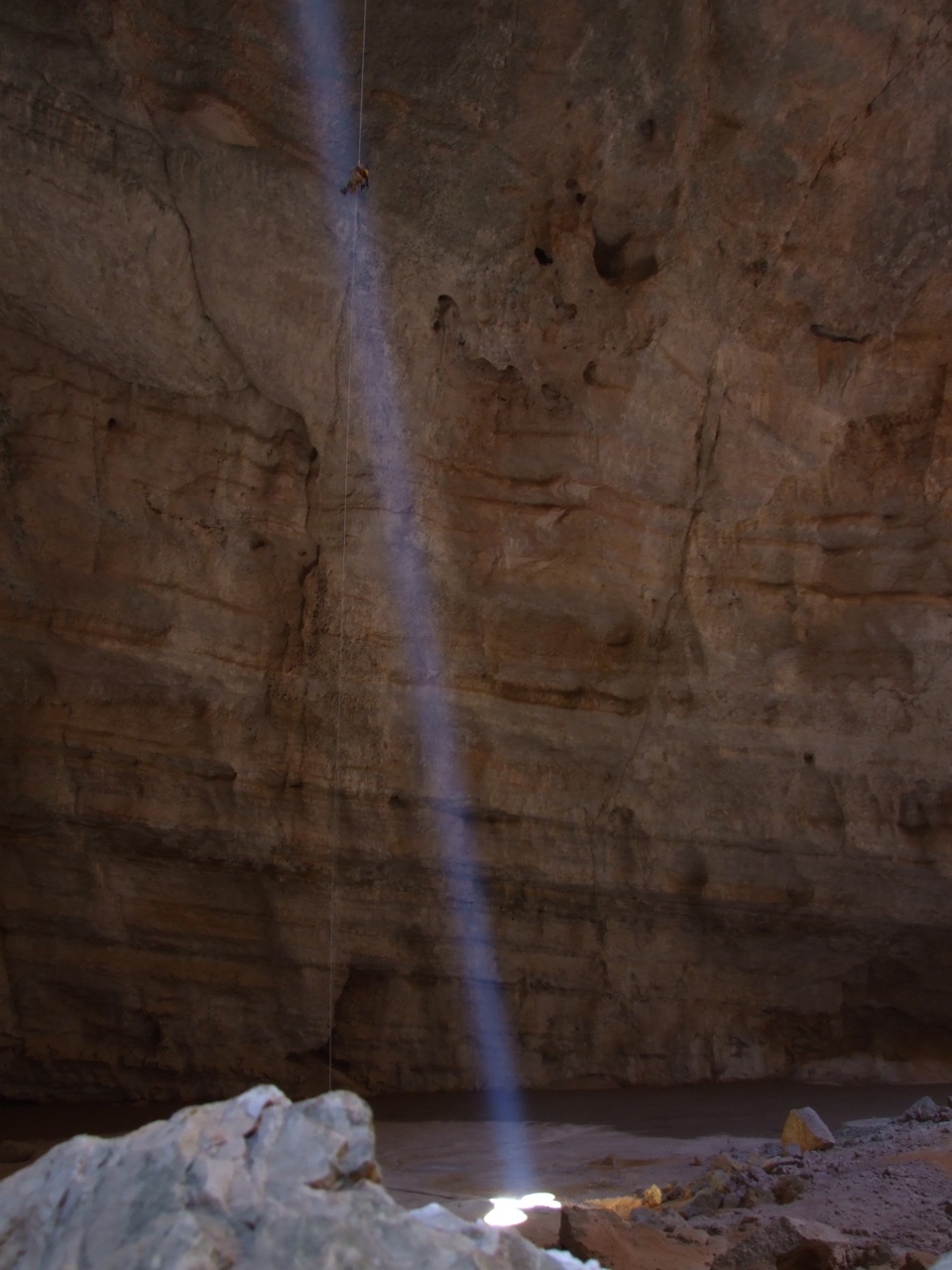
Photo: The original uploader was Michaelmcandrew at English Wikipedia. · CC BY-SA 3.0 · Wikimedia Commons
Majlis al Jinn is a cave. It is near Muscat, Oman. Name means roughly the Meeting Place of the Jinn. The free Lokali audio guide runs 6 minutes.
✓ Published October 2026 · how we write these guides
Visitor facts
| Lokali audio guide | 6 min · free |
|---|---|
| Type | Cave |
| Location | Muscat, Oman |
| Coordinates | 22.8806, 59.1052 |
| Languages | 50+, in the Lokali app |
The story
The first thing you notice up here is the silence. The wind moves across bare limestone, pale and sharp-edged, and the ground crunches under your boots. There are no trees to speak of, only low scrub and broken rock. Then you reach the edge of a hole in the earth, and the air changes. A cooler breath rises from below. Somewhere beneath your feet is one of the largest underground chambers ever found.
This is Majlis al Jinn, high on the Selma Plateau in the eastern hills of Oman. It sits inland, in the mountains between Muscat and Sur, a long drive up rough tracks from the coast. The name translates roughly as the Meeting Place of the Jinn. In Arabian and Islamic belief, jinn are unseen beings, made from smokeless fire, who live alongside humans. It is easy to understand why people would give a place like this such a name.
From the surface, the cave shows very little of itself. You see only a few dark openings in the plateau, almost like wells. They are holes in the roof of a single vast chamber. There is no grand entrance, no tunnel you can walk into. The only way down is on a rope, lowered through the ceiling into the darkness. For most visitors, the experience is this — standing on the surface and imagining the space below.
And that space is enormous. The chamber is often ranked among the largest known cave rooms in the world. It stretches for more than three hundred metres from one end to the other. The ceiling rises well over a hundred metres above the floor. Cavers who have been inside describe it as a dome of rock with no visible supports. Light falls through the roof openings in long, narrow beams and fades long before it reaches the walls.
How does a hole this size form? The answer is water and time. The Selma Plateau is made of limestone, a rock that slowly dissolves in slightly acidic water. Over an immense span of time, rain soaked into cracks and carried the stone away, grain by grain. This kind of landscape is called karst — ground riddled with sinkholes, shafts and caves. What you are standing on is, in a real sense, a hollowed shell.
Here is something most visitors do not expect. Local herders and villagers knew these openings for generations. Goats wandered near them, and people avoided the edges. But the scale of what lay below remained unknown to the wider world until 1983. That year, an American hydrogeologist named Don Davison, working on water surveys in Oman, explored the shafts. His work put the chamber on the map for cavers worldwide.
The openings have names of their own. One of the best known is called Cheryl's Drop, named after Davison's wife. From its lip, a rope hangs free through open air for well over a hundred metres before it touches the floor. There is no wall to rest against on the way down. Experienced cavers say the descent is long enough to lose all sense of distance, with only the rope and the shrinking circle of sky above.
That brings us to an important point. Majlis al Jinn is not a show cave. There are no stairs, no railings, no lighting. Entry into the chamber requires official permission from the Omani authorities, and only trained teams with specialist equipment go down. Even near the surface openings, the rock is loose and the edges are sheer. If you visit, keep well back from the holes, and treat the plateau with real respect.
Now look around you at the plateau itself. The surface is cut and pitted by rainwater into sharp ridges and small hollows. The colours shift through cream, grey and soft honey depending on the hour. In the early morning, the low sun throws long shadows across every groove. At midday, the light turns flat and white, and the heat rises fast from the stone. There is very little shade up here.
The journey matters as much as the destination. Reaching the plateau usually means a four-wheel-drive vehicle and a driver who knows the tracks. On the way up, you pass through high, quiet country with scattered settlements and grazing animals. On a clear day, the views run out toward the hills and, in places, toward the coast. Many people combine this trip with time in Sur, the old seafaring town below.
That connection to Sur is worth a thought. Down on the coast, Sur built its identity on the sea — on wooden boats, trade winds and long voyages. Up here, the story is the opposite. It is about stone, darkness and water moving underground. The same region holds both worlds. Standing on the plateau, you are looking at the slow, hidden side of the Omani landscape.
The name invites one more reflection. Locals say the jinn gathered here, and the dark openings would certainly feed such stories. Whether you hear them as folklore or poetry, they carry a simple truth. People have always felt that some places are not entirely ours. A cave you cannot easily enter, with a roof you stand on but cannot see beneath, fits that feeling well.
Before you leave, stand still for a moment, a safe distance from the nearest opening. Feel the faint, cool movement of air from below. Listen to the wind on the rock, and to how little else there is to hear. Beneath you, a room larger than most stadiums sits in total darkness, as it has for a very long time. As you walk back to the vehicle, notice the pale stone under your feet. It is the roof of that hidden world.
Key facts
What to look for
Practical tips
Common questions
Is there a free audio guide to Majlis al Jinn?
Yes — the Lokali app narrates Majlis al Jinn free of charge in 50+ languages. The guide runs about 6 minutes, covers the history, what to look for on site and practical tips, and works offline once downloaded.
Where is Majlis al Jinn?
Majlis al Jinn is near Muscat, Oman, at 22.8806, 59.1052. Tap the map link on this page for directions from where you are.
What is Majlis al Jinn known for?
Name means roughly the Meeting Place of the Jinn. Ranked among the largest known cave chambers worldwide.
What should you look for at Majlis al Jinn?
Dark roof openings scattered across the flat plateau. Rain-carved ridges and pits in the pale limestone. Cool air rising from the edges of the shafts.
What should you know before visiting Majlis al Jinn?
Arrange a four-wheel-drive vehicle with an experienced local driver. Stay well back from the roof openings at all times.
When is the best time to visit Majlis al Jinn?
Visit early morning to avoid heat and harsh light.
On the map
Opens directions to Majlis al Jinn from your location.
Hear Majlis al Jinn in your language
The full story, narrated, in 50+ languages. Download it before you go and it plays offline, at your own pace, with no ticket and no tour group.