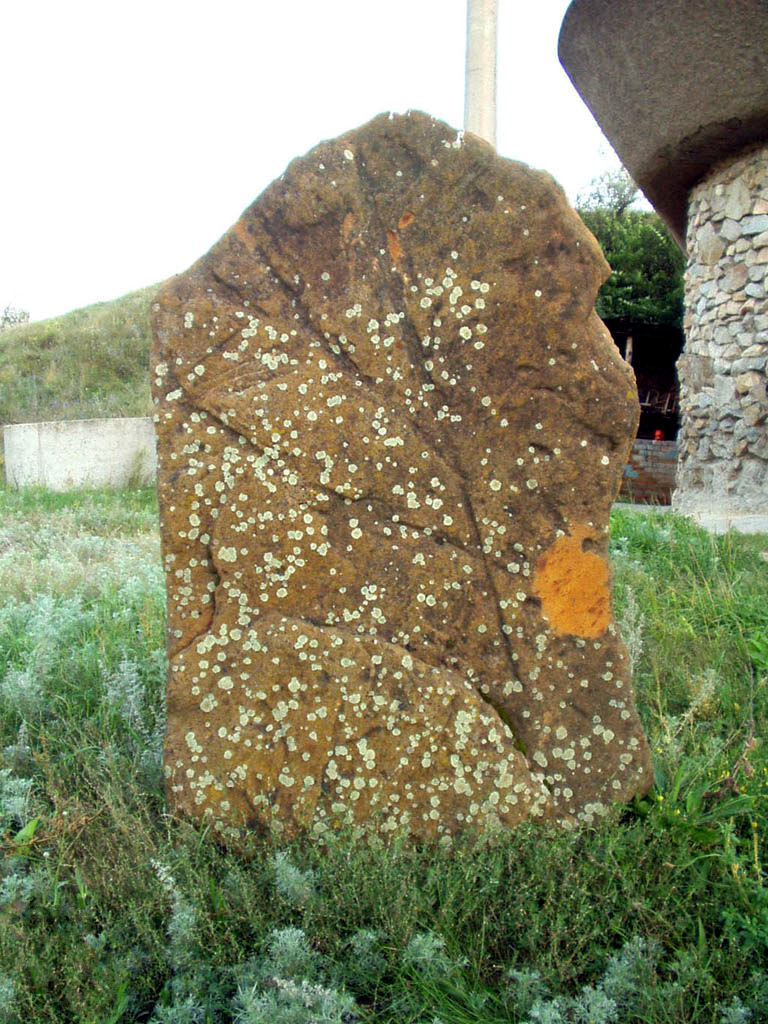
Kamyana Mohyla
46.9497° N · 35.4694° E · Archaeological Site
Photo: The original uploader was Ghirlandajo at English Wikipedia. · CC BY-SA 3.0 · Wikimedia Commons
Kamyana Mohyla is a blockfield and rock engravings site in Zaporizhia Oblast, Ukraine. Kamyana Mohyla means the Stone Grave in Ukrainian. The free Lokali audio guide runs 7 minutes.
✓ Published October 2026 · how we write these guides
Visitor facts
| Lokali audio guide | 7 min · free |
|---|---|
| Type | Archaeological Site |
| Location | Myrne, Ukraine |
| Coordinates | 46.9497, 35.4694 |
| Official website | stonegrave.org |
| Languages | 50+, in the Lokali app |
The story
Listen for a moment. Out here, the wind carries across the open steppe with almost nothing to stop it. Then, rising from the flat land, there is this. A low, rounded heap of pale sandstone blocks, cracked, tilted and piled together. Under your feet the stone feels gritty, like coarse sugar. In the afternoon sun it turns a warm, honey colour. This is Kamyana Mohyla. The name means the Stone Grave, and once you see it, the name makes sense.
Let us start with a surprise. This hill was not built by anyone. People often assume the blocks were dragged here and stacked. They were not. Kamyana Mohyla is a natural formation. Geologists describe it as a remnant of sand from an ancient sea that once covered this part of Ukraine. Over a very long time, that sand hardened into sandstone. Later, the softer ground around it wore away. What stays behind is this solitary outcrop, standing alone above the plain.
Look around at the horizon. In almost every direction the land is flat. Fields, grass and sky stretch out. Nearby, the Molochna River runs through its valley toward the Sea of Azov. In a landscape like this, any high point matters. A rocky hill visible from far away becomes a landmark. It becomes a meeting place, a shelter, and perhaps a sacred site. That idea is the key to understanding why people have come here for so many thousands of years.
The stone is soft enough to wear and crack, and so the hill is full of hollows. Over time, the blocks shifted and settled. They left behind grottoes, narrow passages and small caves between the slabs. Some are barely wide enough for a person to crouch inside. These sheltered spaces are where the most important treasure of Kamyana Mohyla was found. It is not gold or bones. It is lines scratched and carved into the rock.
Inside these grottoes, researchers recorded a large number of petroglyphs. Petroglyphs are images carved or scratched into rock, as opposed to paintings. Some show animals. Some show human figures, or shapes that look like signs, nets or patterns of lines. Archaeologists working here in the twentieth century documented many of these surfaces. Their work drew scholarly attention to the hill, and it was later protected as a national historical and archaeological reserve.
Now comes the honest part. Dating rock carvings is very difficult. Unlike a buried object, a scratch on stone does not come with a clear layer of soil around it. Different researchers have proposed very different ages for the images here. Many link them to the long stretch of prehistory, from the Stone Age into the Bronze Age. What most agree on is simple. People returned to this hill, again and again, across a very long span of time.
You may hear bolder claims as well. Some writers have argued that certain signs here are a form of very early writing. Some have even compared them to the script of ancient Mesopotamia. Treat these ideas with caution. Mainstream archaeologists have not accepted them. They remain popular stories, not established history. Still, it is easy to see why the carvings spark the imagination. Faced with marks this old, people want them to speak.
The name itself carries a quiet puzzle. A mohyla, in Ukrainian, usually means a burial mound, a kurgan. Kurgans are the earth mounds that ancient steppe peoples raised over their dead, and many still dot this region. From a distance, this rocky hill looks like one of them, only made of stone. Locals say the name came from that resemblance. Whether real burials were connected to the hill itself is a separate question for archaeologists.
Take a moment to notice the texture of the surfaces close to you. Some slabs are smooth and rounded by weather. Others are broken, with sharp, fresh-looking edges. Lichen spreads across them in patches of grey, rust and pale green. In the cracks, small steppe plants find a foothold. The contrast is striking. Soft grasses move in the wind while the stone stays still. Remember, too, that the hill is fragile. Sandstone crumbles, and every footstep counts.
This fragility is why the most precious grottoes are protected. Many of the carved surfaces are not open for visitors to touch or enter freely. Sweat, skin oils, and the simple friction of hands can erase marks that survived for thousands of years. Graffiti is an even greater danger. So, if you see barriers or closed passages, they are there for a reason. The reserve keeps a museum nearby, where copies and explanations show what lies inside.
Stand still and think about the people who came before you. Hunters may have watched herds move across this plain. Later, herders and farmers lived along the river valley. Each group saw the same pale hill rising from the grass. Each may have given it a different meaning. A shelter from storms. A place for rituals. A spot to mark with signs. We do not know their words. We only have what they left in the stone.
The light here changes the whole character of the hill. At midday, the sun flattens everything. The stone looks bleached and the shadows are short. In the early morning or late afternoon, the low light rakes across the surfaces. Cracks deepen. Textures sharpen. Shapes that seemed flat suddenly gain depth. Some researchers have noted that carved lines on rock become easier to see in angled light. Here, you can test that idea for yourself.
Before you leave, walk a little way out and turn around. See the hill as earlier travellers would have seen it — a lone, pale mound on a wide green plain. Listen again to the wind, the grass, perhaps a bird overhead. The stone under your feet is far older than any name people gave it. As you walk away, notice how quickly the hill shrinks against the sky... and how long it stays in view.
Key facts
What to look for
Practical tips
Common questions
Is there a free audio guide to Kamyana Mohyla?
Yes — the Lokali app narrates Kamyana Mohyla free of charge in 50+ languages. The guide runs about 7 minutes, covers the history, what to look for on site and practical tips, and works offline once downloaded.
Where is Kamyana Mohyla?
Kamyana Mohyla is near Myrne, Ukraine, at 46.9497, 35.4694. Tap the map link on this page for directions from where you are.
What is Kamyana Mohyla known for?
Kamyana Mohyla means the Stone Grave in Ukrainian. The hill is a natural sandstone outcrop, not man-made.
What should you look for at Kamyana Mohyla?
Patches of grey, rust and green lichen on slabs. Narrow gaps and grottoes between the tilted blocks. Smooth weathered edges beside sharp, freshly broken stone.
What should you know before visiting Kamyana Mohyla?
Visit the reserve museum to see what the grottoes hold. Come early or late for angled light on the stone.
When is the best time to visit Kamyana Mohyla?
Come early or late for angled light on the stone.
On the map
Opens directions to Kamyana Mohyla from your location.
Hear Kamyana Mohyla in your language
The full story, narrated, in 50+ languages. Download it before you go and it plays offline, at your own pace, with no ticket and no tour group.