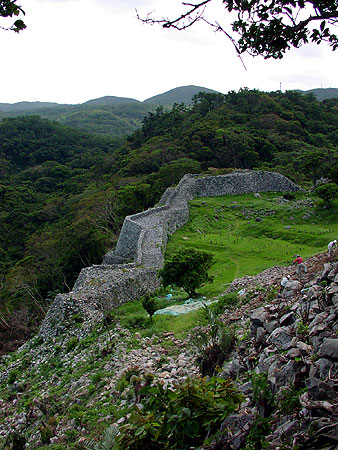
Photo: 沖縄発!役に立たない写真集 · Public domain · Wikimedia Commons
Nakijin Castle is a fortification. It is in Nakijin, Japan. Seat of the Hokuzan kingdom in fourteenth-century Okinawa. The free Lokali audio guide runs 7 minutes.
✓ Published October 2026 · how we write these guides
Visitor facts
| Lokali audio guide | 7 min · free |
|---|---|
| Type | Castle |
| Location | Nakijin, Japan |
| Coordinates | 26.6908, 127.9303 |
| Official website | nakijinjo.jp |
| Languages | 50+, in the Lokali app |
The story
Listen to the wind first. Up here on the Motobu Peninsula, it comes off the East China Sea and moves through the trees on the slope. Under your feet, the path is grey stone, uneven and worn smooth in places. Ahead of you, a long wall of pale limestone curves across the hillside. It does not run in straight lines. It bends and rises with the ground, like a ribbon laid over the land.
This is Nakijin Castle, known in Okinawa as Nakijin Gusuku. The word gusuku is special to the Ryukyu Islands, the island chain that stretches south from mainland Japan towards Taiwan. A gusuku can be a fortress, a royal residence, and a sacred place, all at once. Nakijin is all three. Keep that in mind as you walk, because the stones around you served soldiers, kings, and priestesses.
To understand why this hilltop mattered, picture Okinawa around the fourteenth century. The main island was not one kingdom. It was divided into three rival states. Historians call this the Sanzan period, which means the period of the Three Mountains. In the south was Nanzan. In the centre was Chuzan. And here in the north, across rugged and forested land, was Hokuzan, the Northern Mountain. This castle was the seat of the Hokuzan kings.
The northern kingdom was the largest in area, but the land was hard. There were steep hills, thin soil, and long distances between villages. Power here depended on control of the coast and the sea routes. The kings of Hokuzan sent missions to Ming China, which ruled China at that time. Archaeologists have found Chinese ceramics on this site, and these fragments show that the castle was connected to a wide trading world.
Now look closely at the walls. They are made of limestone blocks, fitted together without mortar. Notice how they curve. These curves were not decoration. A curved wall is stronger against pressure, and it gives defenders more angles to watch the slopes below. The walls follow the natural edges of the hill, so the builders used the cliffs as part of the defence. In total, the walls stretch for more than a kilometre.
Here is something many visitors miss. From a distance, the walls look almost soft, like a coastline drawn in stone. Some people compare their shape to the Great Wall of China in miniature. But the technique is local. Ryukyu builders shaped walls to match the land, rather than forcing the land to match the wall. Run your eyes along the top edge, and you will see how it rises and falls with every change in the ground.
The story of Hokuzan does not end in triumph. In the early fifteenth century, the ruler of Chuzan, a man named Sho Hashi, moved against the north. Hokuzan fell, and soon afterwards Sho Hashi united the three states into a single Kingdom of Ryukyu. The capital became Shuri, far to the south. Nakijin lost its king, but it did not lose its importance.
After the conquest, the new kingdom sent a warden to govern the northern region from this castle. For about two centuries, Nakijin remained the centre of royal authority in the north. Then, in 1609, samurai from the Satsuma domain in southern Japan invaded the Ryukyu Kingdom. Nakijin was burned during that invasion. After that, the castle was no longer an active seat of government. The stones stayed, but the buildings inside them did not.
Yet people never stopped coming here. As you explore the inner areas, you may notice small stone spaces, sometimes with offerings or incense. These are sacred sites, called utaki in Okinawa. In traditional Ryukyu religion, women held central roles as priestesses, and they led rituals for the kingdom and the village. Even today, local people visit these places to pray. Please move quietly near them, and do not touch the offerings.
This is a second surprise for many visitors. Nakijin is a World Heritage Site, and it looks like a ruin. But to many in the surrounding communities, it is a living place of worship. In 2000, UNESCO listed it together with other gusuku sites and related places of the Ryukyu Kingdom. The listing honours the architecture, but it also recognises this continuing spiritual life.
On your way in, you passed through the main gate. The gate you see today is a reconstruction from the twentieth century, built to show visitors how the entrance once looked. Beyond it, the path climbs through a series of terraces. Each terrace was once a different zone of the castle, from outer courtyards to the inner enclosure at the highest point. Walking upwards, you follow the same route that visitors to the king once followed.
If you come in late January or early February, the path becomes a tunnel of deep pink. These are Okinawan cherry trees, which bloom much earlier than the pale cherries of mainland Japan. Their flowers are darker, and they hang downwards like small bells. Many visitors also return for evening light-ups during the blossom season. Even outside that season, the trees give welcome shade on hot days.
Now turn and face the sea. From the upper terraces, the land drops away towards the blue water of the East China Sea. On clear days, you can see small islands on the horizon. This view explains the castle better than any wall. From here, the kings of Hokuzan could watch ships, see weather coming, and guard the routes along the northern coast.
Before you go, stand still for a moment. Feel the warm stone under your hand, if you are near a low wall. Listen again for the wind in the trees, and maybe for birds in the forest below. As you walk back down through the terraces, look at the walls from below. They will seem taller now. The people who lived here watched the same sea that you see, and the curves of the wall still show the shape of the hill.
Key facts
What to look for
Practical tips
Common questions
Is there a free audio guide to Nakijin Castle?
Yes — the Lokali app narrates Nakijin Castle free of charge in 50+ languages. The guide runs about 7 minutes, covers the history, what to look for on site and practical tips, and works offline once downloaded.
Where is Nakijin Castle?
Nakijin Castle is in Nakijin, Japan, at 26.6908, 127.9303. Tap the map link on this page for directions from where you are.
What is Nakijin Castle known for?
Seat of the Hokuzan kingdom in fourteenth-century Okinawa. Hokuzan fell to Chuzan in the early fifteenth century.
What should you look for at Nakijin Castle?
Curving limestone walls following the hill's natural edge. Small sacred stone sites with incense or offerings. Reconstructed main gate at the castle entrance.
What should you know before visiting Nakijin Castle?
Visit late January for early Okinawan cherry blossoms. Wear sturdy shoes for the uneven stone steps.
When is the best time to visit Nakijin Castle?
Visit late January for early Okinawan cherry blossoms.
On the map
Opens directions to Nakijin Castle from your location.
More to see near Nakijin Castle

Hear Nakijin Castle in your language
The full story, narrated, in 50+ languages. Download it before you go and it plays offline, at your own pace, with no ticket and no tour group.